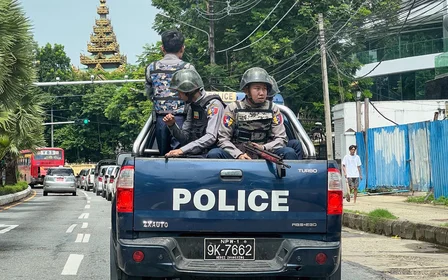

ICJ to deliver judgment on Myanmar's genocide of Rohingya Muslims

Judges at the International Court of Justice (ICJ) in The Hague are scheduled to deliver a judgment on Thursday in a case brought by The Gambia accusing Myanmar of committing genocide against its Muslim Rohingya minority.
If the court rules in Gambia's favour, it will be the first time the United Nations' top court has held a state fully responsible for committing genocide under the 1948 Genocide Convention.
It will be also be the first judgment in a case with large-scale intervention by third states.
On 11 November 2019, the Gambia filed its case at the ICJ with the backing of the Organisation of Islamic Cooperation (OIC).
It was the first time a state not directly affected had brought a genocide case before the court.
New MEE newsletter: Jerusalem Dispatch
Sign up to get the latest insights and analysis on Israel-Palestine, alongside Turkey Unpacked and other MEE newsletters
Eleven states have intervened, filing submissions on how the Genocide Convention should be interpreted, but mainly in support of the Gambia's case rather than as parties. The states, also present at the court on Thursday, are: Belgium, Canada, Democratic Republic of the Congo, Denmark, France, Germany, the Republic of Ireland, the Maldives, the Netherlands, Slovenia and the United Kingdom.
The ruling will be final and binding, with no right of appeal.
Several governments have already described the violence as genocide, including the US and Canada.
Legal experts say they expect the outcome to have consequences for other ICJ cases involving allegations of genocide, most pressingly South Africa's case against Israel over its war against Palestinians in Gaza, where the confirmed death toll has reached almost 75,000 people.

The case, brought by the Gambia in 2019, concerns the Myanmar military's 2017 violence in Rakhine State, which drove more than 700,000 Rohingya into neighbouring Bangladesh and involved widely documented massacres and rapes.
About 1.2 million Rohingya, a predominantly Muslim minority, now live in camps around Cox's Bazar, the world's largest refugee settlement.
Myanmar has denied committing genocide, saying its forces were responding to insurgents from the Arakan Rohingya Salvation Army (Arsa), whose attacks on police posts in August 2017 killed 12 security personnel.
The Gambia has accused Myanmar of breaching the 1948 Genocide Convention during its campaign against the Rohingya from 25 August 2017.
The operations were carried out under Min Aung Hlaing, then the military's commander-in-chief.
Myanmar at the time had a civilian government led by Aung San Suu Kyi, but the military-drafted constitution left the armed forces outside its control.
In February 2021, Min Aung Hlaing overthrew Suu Kyi's government in a coup, and in April this year he stepped down as army chief.
He was later elected president by a parliament dominated by military-backed lawmakers, following elections organised by the junta.
Rohingya fled mass killings, rape and the burning of villages during what the military described as "clearance operations".
The case is a dispute between states, so the court will decide whether Myanmar as a state is responsible, not whether any individual is guilty.
A finding against Myanmar would arguably add to international pressure on Min Aung Hlaing, whose move to the presidency is widely perceived as a bid for international legitimacy.
In 2018, the UN Independent International Fact-Finding Mission on Myanmar concluded that there was sufficient information to infer genocidal intent and recommended that senior military officials be investigated and prosecuted for genocide.
On 11 November 2019, the Gambia filed its case at the ICJ with the backing of the Organisation of Islamic Cooperation (OIC).
It was the first time a state not directly affected had brought a genocide case before the court.
The west African country relied on the principle that every state party to the 1948 Genocide Convention has a common interest in seeing it upheld.
In December 2019, Aung San Suu Kyi, then Myanmar's civilian leader, appeared at the court to deny the allegations.
In January 2020, after finding "a real and imminent risk of irreparable prejudice to the rights" of the Rohingya under the Genocide Convention, the court ordered Myanmar to prevent genocidal acts and preserve evidence.
The court rejected Myanmar's objections to its jurisdiction in July 2022, and heard the merits of the case from 12-29 January 2026, including closed-door testimony from Rohingya witnesses.
This is a developing story.
Middle East Eye delivers independent and unrivalled coverage and analysis of the Middle East, North Africa and beyond. To learn more about republishing this content and the associated fees, please fill out this form. More about MEE can be found here.