
Gaza’s children caught in the grip of a meningitis outbreak

For 10 days, two-month-old Mostafa Hallawin has been bedridden at Al-Rantisi Children’s Hospital in Gaza City.
After suffering a persistent high fever, reaching 39C, and recurring abdominal swelling, the Palestinian infant was diagnosed with meningitis.
“It started with a skin rash and a high fever, with his temperature reaching 39C,” his mother, Amal, told Middle East Eye.
“Every day, doctors perform medical scans and laboratory tests,” she added, saying his condition has shown little improvement, largely because of shortages of essential medicines.
Hallawin is one of the most recent children to develop meningitis amid a spike in cases across the war-torn enclave, where Israel has all but destroyed the healthcare system and continues to ban essential medicines.
New MEE newsletter: Jerusalem Dispatch
Sign up to get the latest insights and analysis on Israel-Palestine, alongside Turkey Unpacked and other MEE newsletters
The UN Office for the Coordination of Humanitarian Affairs (Ocha) reported 413 suspected meningitis cases in Gaza between 27 September and 31 October, including 294 viral and 119 bacterial cases. The report said 68 percent were recorded in Gaza City.
On Tuesday, the Palestinian Health Ministry declared an "epidemic alert" across Gaza, citing a sharp rise in meningitis cases and deaths.
The ministry said 1,790 people had been diagnosed with meningitis since the beginning of the year, with 15 deaths recorded. In October alone, at least 272 infections were confirmed.
The risk of infectious diseases has increased amid overcrowded displacement shelters, unsafe drinking water, damaged sanitation systems and the collapse of essential healthcare services across Gaza.
In September, the World Health Organisation (WHO) said microbiological contamination in tested water samples rose from less than six percent in January to nearly 20 percent in August.


At Al-Rantisi Children's Hospital, which was heavily damaged in Israeli attacks during the war, beds are filled with children suffering from infectious diseases, including meningitis.
The growing number of cases threatens to create conditions in which infections can spread easily between children. Amal believes her child’s condition deteriorated during his hospital stay because of overcrowding and inadequate isolation facilities.
“There is little access to basic hygiene facilities, clean food and safe drinking water,” she said.
“I appeal for medicines and essential medical equipment to be allowed into Gaza for our children.
"We have lost our homes and our lives in this war. We don’t want to lose our babies too.”
Contaminated water
For Reham Wahdan, the health crisis became personal when her nine-month-old son, Mohammed, developed a high fever.
Wahdan and her family have been living alongside other displaced families in a room in the partly destroyed Islamic University building, after their home in Shujaiya, east of Gaza City, was destroyed by an Israeli attack during the war.
She said Mohammed's health began to deteriorate a day after they visited relatives staying in a makeshift tent near their displacement shelter.
'I appeal for medicines and essential medical equipment to be allowed into Gaza for our children'
- Amal Hallawin, Palestinian mother
She believes he got the infection from a child with meningitis whom they'd visited.
“He had suffered from a high fever for nearly a month, despite repeated attempts to give him medication to bring his temperature down,” she said.
Wahdan took Mohammed to several medical tents and treatment points, where he was given medication to reduce his fever. His temperature would fall briefly, only to rise again.
“Doctors at Al-Rantisi Hospital performed a lumbar puncture to collect a cerebrospinal fluid sample, and the test results confirmed that he had meningitis,” she said.
Wahdan also said her family had no access to safe drinking water where they were displaced.
“We drink contaminated water, and we rely entirely on distributed food,” she said.
Deteriorating conditions
Dr Nidal Ghunaim, the deputy director-general of primary health care for public health at the Ministry of Health, said both bacterial and viral meningitis cases had increased significantly compared with previous years.
He attributed much of the rise to enterovirus, which he said was closely linked to deteriorating environmental conditions across the Gaza Strip.
The contamination of drinking water with sewage had further worsened the situation, contributing to the increase in reported infections, he said.
The situation has become even more concerning following recent heavy rainfall in Gaza.
“Many areas were flooded with rainwater, and sewage mixed with drinking water. The destruction of infrastructure has made the situation worse, and we expect that any further wave of flooding could make things much more difficult,” he told MEE.
“There are also significant shortages of laboratory supplies, medical treatments and isolation facilities in hospitals,” Ghunaim added.
He called on the international community to intervene urgently and support a comprehensive, long-term response to Gaza's environmental and water crises.
“The extensive destruction of water infrastructure has severely affected access to safe and clean water. Restoring and rehabilitating the water network must be an essential priority,” he said.
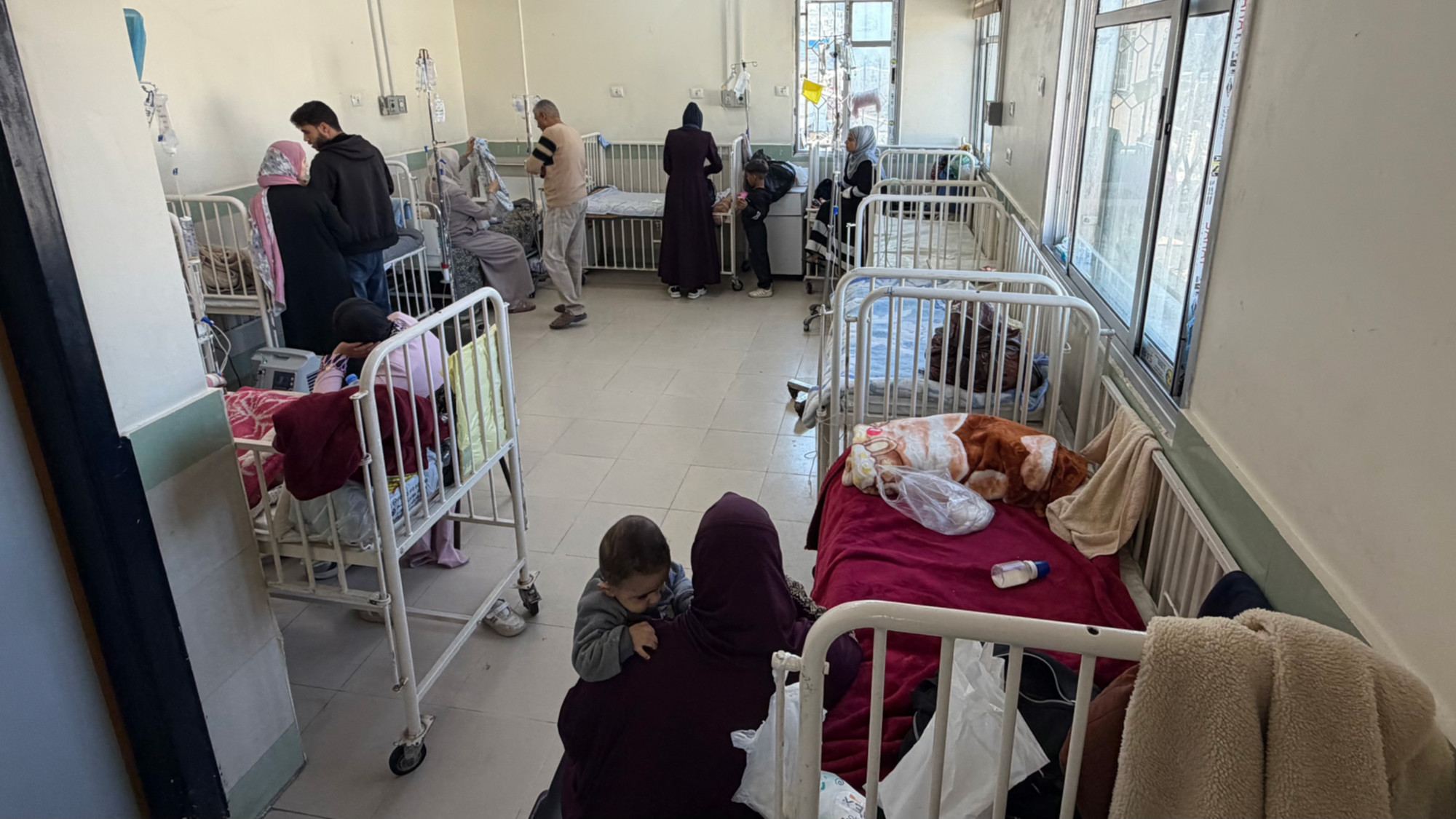
Back at Al-Rantisi Hospital, Reem Hamada has spent the past 10 days at the bedside of her five-year-old grandson, Mohammed, after he developed a high fever.
“One day, he came back from kindergarten with a high fever. We applied cool compresses to his forehead, neck and armpits to try to bring his temperature down, but it did not improve,” she said.
Throughout the interview, Mohammed lay beside her, his eyes closed, a cool compress resting on his forehead as the fever persisted.
“He is my only grandchild. What has he done to deserve this suffering?” she said.
“We are no longer living; we are as good as dead.”
Middle East Eye delivers independent and unrivalled coverage and analysis of the Middle East, North Africa and beyond. To learn more about republishing this content and the associated fees, please fill out this form. More about MEE can be found here.