Kerry warns Assad of 'repercussions' if truce not agreed and respected

US Secretary of State John Kerry warned Syria's Bashar al-Assad of "repercussions" if his government flouts a new truce being negotiated, as talks to halt the violence shifted to Berlin on Wednesday.
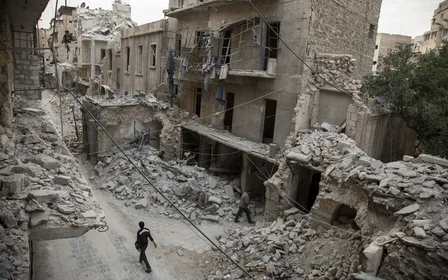
Russia has said a new ceasefire to halt fighting in Aleppo could be imminent, with Syria's divided northern city hit by a wave of violence that has killed more than 270 people since 22 April.
With the UN Security Council to hold urgent talks on the crisis later on Wednesday, diplomatic efforts to stem the violence shifted to Germany where Foreign Minister Frank-Walter Steinmeier was to meet UN Syria envoy Staffan de Mistura, Syria's main opposition leader Riad Hijab and France's top diplomat Jean-Marc Ayrault.
Renewed fighting between government and rebel forces has centred on Aleppo, where heavy clashes left around 30 people dead on Tuesday, with Kerry issuing a stark warning to Assad if his government failed to abide by the new deal.
"If Assad does not adhere to [the new ceasefire], there will clearly be repercussions and one of them may be the total destruction of the ceasefire and they go back to war," Kerry told reporters after returning from an earlier round of talks in Geneva.
New MEE newsletter: Jerusalem Dispatch
Sign up to get the latest insights and analysis on Israel-Palestine, alongside Turkey Unpacked and other MEE newsletters
"I don't think that Russia wants that. I don't think Assad is going to benefit from that," Kerry added.
The Security Council meeting to discuss the bloodshed, which is threatening to derail international peace efforts to end the five-year war in Syria, was called for by France and Britain.
"[Aleppo] is to Syria what Sarajevo was to Bosnia," said France's UN ambassador Francois Delattre.
Russian Foreign Minister Sergei Lavrov said late on Tuesday he hoped to agree on a freeze of fighting in Aleppo "in the near future, maybe even in the next few hours," after meeting de Mistura in Moscow.
A 27 February truce between Assad and rebels raised hopes for efforts to resolve the five-year conflict, but it has come close to collapse due to the recent surge in violence.
UN condemns attacks
After a relative lull on Monday and early on Tuesday, rebels in eastern Aleppo fired at least 65 rockets into government-controlled neighbourhoods, Syrian state news agency SANA said.
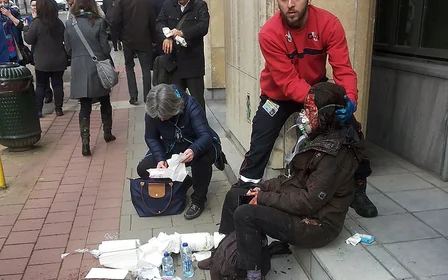
The rockets killed 16 people and wounded 68, including at least three women at al-Dabbeet maternity hospital, it reported.
It was the sixth time a medical facility has been hit in 11 days in Aleppo, the International Committee for the Red Cross said, calling it "unacceptable".
The Syrian Observatory for Human Rights monitor said it counted at least 19 dead and 80 wounded from the attacks on government-held areas, while civil defence workers said air strikes on the rebel-held east killed 11 civilians, including a child.
Fierce fighting also raged on Aleppo's western edges after rebels detonated explosives in a tunnel, an AFP correspondent said, adding the clashes subsided at nightfall.
'Regime of silence'
Washington and Moscow are working together to include Aleppo in a so-called "regime of silence" - a freeze in fighting - aimed at bolstering the broader truce.
The city was initially excluded from a deal announced last week to "freeze" fighting along two major fronts in the northwest and in Eastern Ghouta near Damascus.
The pair have agreed to boost the number of Geneva-based truce monitors to track violations "24 hours a day, seven days a week," Kerry said on Monday.
In a nod to Moscow's demands, Kerry said Washington would press rebels to separate themselves from al-Qaeda affiliate al-Nusra Front in Aleppo.
Russia and Assad have cited the presence of al-Nusra, which was not party to the ceasefire, as justifying their offensive.
The Observatory says more than 270 civilians - including 54 children - have been killed on both sides of divided Aleppo since 22 April.
Meanwhile, the Organisation for the Prohibition of Chemical Weapons said there were "extremely worrying" signs IS may be making its own chemical weapons and may have used them already in Syria and Iraq.
Middle East Eye delivers independent and unrivalled coverage and analysis of the Middle East, North Africa and beyond. To learn more about republishing this content and the associated fees, please fill out this form. More about MEE can be found here.