Nearly 100,000 people flee week of fighting in western Syria

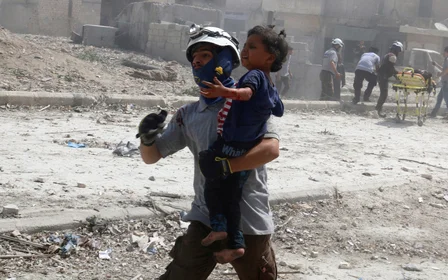
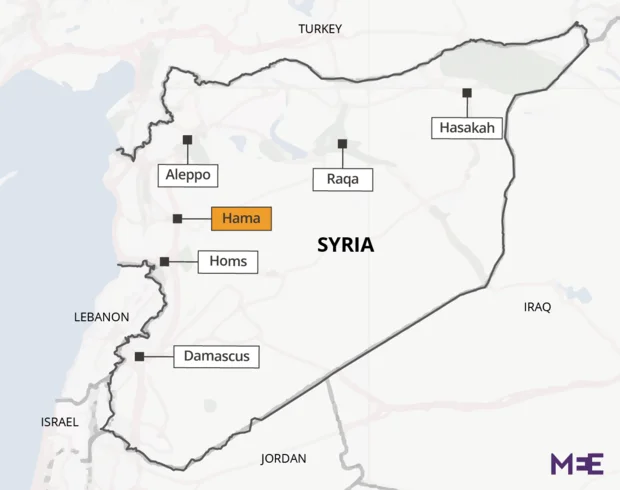
Fighting in Syria's western Hama province has displaced an estimated 100,000 people in just over a week, the UN said on Wednesday.
The exodus began on 28 August, when Syrian rebels launched an offensive against government forces in the north of the province, the UN said, citing the Syrian Arab Red Crescent and the governor of the province.
The offensive is taking place in an area of strategic importance to President Bashar al-Assad, one that is home to loyalist towns populated by minority Christians and Alawites.
Rebels rapidly captured the town of Halfaya, while forces backing Assad forces have hit back with heavy air strikes.
Many people have fled from the fighting towards Hama city and neighbouring villages, as well as north into Idlib province, the UN said.
New MEE newsletter: Jerusalem Dispatch
Sign up to get the latest insights and analysis on Israel-Palestine, alongside Turkey Unpacked and other MEE newsletters
There were originally about 4,500 families in the town of Halfaya, of which 2,800 remain trapped by the fighting. The rest have managed to flee, the UN report said.
Another 4,500 families were displaced from Taybat al Imam, out of 9,500 in that town, and 5,000 families were uprooted from the army stronghold of Soran, about half the population there.
Many of the displaced people are now sleeping outdoors, but four mosques in Hama city and 12 schools in rural areas are temporarily housing people, the UN said.
The Red Crescent had provided aid to roughly 35,000 people in Hama, and the UN on 4 September sent a convoy of 12 trucks to the province, including aid for another 15,000 people.
But another 6,500 families in the area still urgently need food and other aid, the UN warned.
Middle East Eye delivers independent and unrivalled coverage and analysis of the Middle East, North Africa and beyond. To learn more about republishing this content and the associated fees, please fill out this form. More about MEE can be found here.