After Israel's annihilation of Gaza, can I ever return home?


It was a routine online meeting with my academic supervisors during the summer. One of them, who had just returned from visiting her home country, spoke about the joy of being surrounded by family, the comfort of familiar places, and the quiet sense of belonging that comes from returning home.
Then she used a phrase that has stayed with me ever since: “The privilege of home.”
Until that moment, I had never considered home a privilege. I had always thought of it as something ordinary, something everyone simply had.
But since leaving Gaza almost a year ago, those three words have echoed in my mind, forcing me to ask questions I had never needed to confront before: what is home? When does it become part of our identity?
Can it be destroyed not only physically, but psychologically? And what happens when there is nowhere left to return to?
New MEE newsletter: Jerusalem Dispatch
Sign up to get the latest insights and analysis on Israel-Palestine, alongside Turkey Unpacked and other MEE newsletters
Ironically, I do not think I truly understood the meaning of home until I first arrived in the United Kingdom in 2019 to pursue my master’s degree. Like countless international students, I became homesick.
I missed my family, the familiar sounds of Gaza, speaking Arabic without thinking, Friday lunches, and the ordinary routines I had always taken for granted. Yet beneath all that longing was a certainty I barely recognised at the time: Gaza was still there.
My family was still there. My neighbourhood was still there. My home was still there. The distance between us was geographical, not existential.
I knew that when my studies ended, I would return. That certainty quietly shaped everything. It allowed me to embrace a different culture, build friendships, and imagine a future without ever questioning where I belonged.
Only in memories
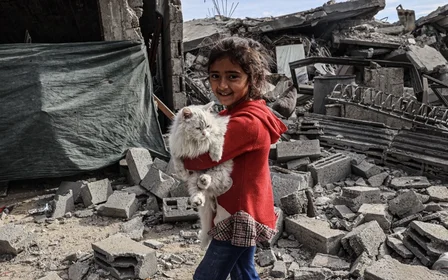
Everything changed in February 2024, when our family home was destroyed. Since that day, I have had no home.
The destruction of our house was not simply the loss of walls or furniture. It was the loss of the place that held together my childhood, my family’s memories, and my own understanding of where life began.
Home stopped being somewhere I could return to. It became somewhere I could only remember.
When I returned to Britain as a PhD student after being evacuated from Gaza during Israel’s genocide, the physical journey looked remarkably similar to the one I had made five years earlier. Psychologically, however, it was an entirely different experience.
We move forward not because we have confidently chosen a new direction, but because there is nowhere left to go back to
This time, I was not temporarily away from home. I had been permanently separated from it. Even if I am able to return to Gaza one day, I often find myself asking a question that never crossed my mind during my first stay in Britain: what exactly would I be returning to?
That question has quietly accompanied me throughout my PhD studies. While many doctoral students look towards graduation with excitement and anticipation, I increasingly fear the end of mine. The closer I come to completing it, the more one question occupies my mind: where will I go?
This is not simply a question about employment or immigration. It is a question about belonging. Life assumes that after years abroad, there remains somewhere that recognises you: a family home, familiar streets, neighbours who know your name, a place where your story naturally continues. That assumption no longer exists for me.
Perhaps this is why my supervisor’s words affected me so deeply. It is summer in Britain, when universities empty as students return to their families, and academics travel home for the holidays. Airports fill with people making journeys so ordinary they scarcely deserve a second thought.
Returning home is treated as one of life’s natural rhythms. For those of us evacuated from Gaza, however, holidays have become a reminder of what we have lost.
Point of origin
While others go back, we remain. We become temporary residents in countries that have offered us safety, while carrying the painful knowledge that the places we call home no longer exist in the way we once knew them.
I now understand what the privilege of home really means. Home is far more than a building: it is the quiet certainty that you are rooted somewhere. It is belonging to people, memories, language, and a landscape that continues to hold you even when you are absent.
It is knowing that if life becomes overwhelming, there is somewhere you can return to; somewhere you can rest, grieve, recover, and begin again.
I often imagine life as an arrow. Home is the point from which the arrow is first released. As life unfolds, the arrow travels through new places, relationships, ambitions and disappointments - but its direction and strength are always shaped by its point of origin. However far it travels, it can always turn back. That possibility of return gives us confidence to keep moving forward.
Psychologists have long argued that human beings need a secure base from which to explore the world. Attachment theory explains that children develop confidence because they know there is someone waiting for them when they return.
I believe that for adults, this secure base extends beyond people to places. Home becomes part of our psychological architecture. It quietly reassures us that whatever happens beyond its walls, we are not alone.
Perhaps that is why most people rarely notice it. The confidence to move abroad, take risks, rebuild after failure, or begin again often rests upon an invisible assumption: if everything falls apart, there is still somewhere to go back to.
Privilege of home
People often tell those of us who have lost our homes to “move forward”. There is kindness in those words, and moving forward is necessary. Yet I have come to realise that many people offer this advice from a position they themselves rarely recognise.
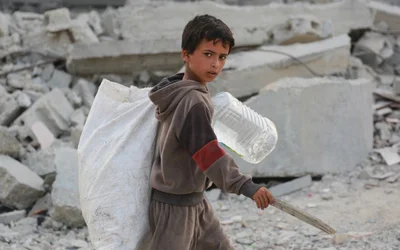
They speak from the privilege of home. Even if they never consciously think about it, they know there remains somewhere behind them. Their journey forward is supported by the quiet certainty that, should life become too difficult, they can return.
For those of us whose homes have been destroyed, moving forward carries a different meaning. We move forward not because we have confidently chosen a new direction, but because there is nowhere left to go back to.
Looking back, I realise that my first experience in Britain taught me something I only understood years later: homesickness is, paradoxically, a privilege. It assumes that home still exists and patiently waits for your return.
Today, I no longer count the days until I can go home. Instead, I find myself counting the years until my PhD ends, with a question I cannot answer: where will home be when that day arrives?
Perhaps that is the deepest wound left by Gaza’s destruction. It is not only that homes were reduced to rubble. It is that an entire generation has lost the certainty that there will always be a place to return to.
Perhaps that, more than anything else, is the privilege of home.
The views expressed in this article belong to the author and do not necessarily reflect the editorial policy of Middle East Eye.
Middle East Eye delivers independent and unrivalled coverage and analysis of the Middle East, North Africa and beyond. To learn more about republishing this content and the associated fees, please fill out this form. More about MEE can be found here.