At the Arab Cup, Palestinian football is uniting what politics has divided


In a time of deep Palestinian anguish, the national football team's successive victories in the Arab Cup, currently taking place in Qatar, have ignited a rare and precious sense of unity.
This joy begins in the rain-soaked tents of displaced families in Gaza, stretches to refugee camps in Lebanon, Jordan and Syria, and ripples across Palestinian communities worldwide.
From Rafah comes Ihab Abu Jazar, the team's coach, whose family home was destroyed and whose mother was moved to a tent in the Mawasi area. He becomes, suddenly, a beacon of hope.
For a fleeting moment, his squad delivers triumph on the green pitch, qualifying for the next round and dedicating the victory first to Gaza and then to Palestinians everywhere.
Behind the Fida'i, the team's nickname meaning fighter, a collective spirit emerges. It transcends sport, reflecting a profound yearning among Palestinians to reclaim an unfragmented identity, free from the suffocating grip of political division and despair.
New MEE newsletter: Jerusalem Dispatch
Sign up to get the latest insights and analysis on Israel-Palestine, alongside Turkey Unpacked and other MEE newsletters
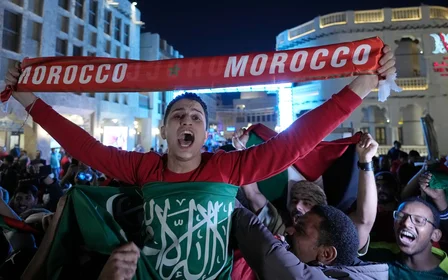
Images captured by cameras and amplified by social media tell the story: fans of all ages, women, homemakers, and elders, cheering with unrestrained passion in stadiums, cafes and living rooms across the globe.
Football may be a global obsession, but for Palestinians today it carries a weight far beyond the ordinary.
This team's victories feel like defiance, a symbolic uprising against the genocidal war on Gaza
This team's victories feel like defiance, a symbolic uprising against the genocidal war on Gaza. Each goal declares: we are still here, like the phoenix rising from ashes, as many Palestinians like to say.
Israel's attempt to erase Palestine from the map meets its answer in the swift feet of these players, a slap in the face to those who claim Palestinians do not exist.
The symbolism runs deep. For once, Palestine appears pure, its name and flag raised without partisan colours or political baggage.
In this brief interlude, Palestinians carve out a timeout from relentless pain, siege and internal strife, a moment to wash away the sins of division.
Arab solidarity
The team embodies unity: from Gaza's resilience to the West Bank, from Palestinians inside the 1948 borders to those scattered across the diaspora, from Egypt to Latin America.

And then comes the Arab embrace. Fans and players across the region rally behind Fida'i, expressing a solidarity long suppressed in political arenas and now unleashed through sport.
It marks a re-emergence of soft Arabism that connects Arabs across political borders, as we saw during the recent World Cup in Qatar.
A Tunisian player, after scoring against Palestine, rushes to hug the Palestinian coach as if apologising. Arab crowds wave Palestinian flags alongside their own.
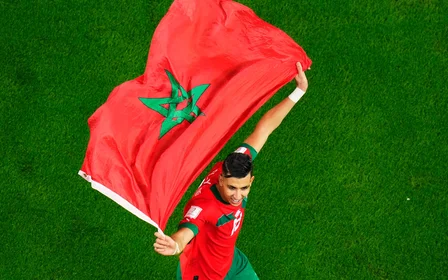
A Palestinian player circles the pitch, the Syrian and Palestinian flags intertwined. The keffiyeh stitches the scene together from start to finish.
For many, stadiums become the only space to express what authorities in some Arab countries have forbidden, with flags and chants of Palestine flowing freely.
Follow Middle East Eye's live coverage of Israel's genocide in Gaza
In this rare space of fresh air, the Palestinian team delivers football of remarkable quality despite the odds stacked against it. Gathering the squad was a challenge; training opportunities were scarce, and resources were almost nonexistent.
The domestic league has been suspended for years, and Israeli bombardments have destroyed stadiums and sports facilities.
These realities make the team's performance even more extraordinary. It feels as though sheer willpower, determination and the spirit of fida' compensate for every technical shortfall.
Collective memory
This surge of pride taps into something deeper, a collective memory shaped by more than a century of struggle against colonialism and occupation, when will and resolve outweigh the imbalance of power.
This vibrant, determined team reminds Palestinians of their essence, forged through decades of resistance.
It evokes the image of "a horse bred for mountain slopes", as described by the renowned poet Mahmoud Darwish, signalling that beyond the rugged path lie the green valleys of home.
How, after two years of a brutal genocidal war waged by global fascist powers complicit in an attempt to annihilate two million Palestinians, does this team regroup and deliver a performance that feels like the result of years of preparation?
That question alone speaks volumes.
Palestinian sociologist Jamil Hilal has long written about the vital role of culture in preserving a unified Palestinian identity, an identity that transcends politics, parties and factions, especially as the political field fractures painfully.
Literature, poetry, art, music, dance, folk songs, cuisine, embroidery, symbols and heritage, traditional and modern, form a foundational layer of collective consciousness.
This cultural bedrock must remain intact, shielded from ideological rifts. Disputes should hover above this layer, never penetrate it, lest it crack. Protecting this cultural sphere is the Palestinian insurance policy for the future.
A new pillar
And because it is so vital, Israel targets it relentlessly, just as it targets Palestinian land through theft and settlement.
We know the attempts to appropriate Palestinian culture, its symbols, its embroidery, even its knafeh and falafel. When a people's cultural core disintegrates, they drift into the winds, their national identity and cohesion at risk.
Palestinians everywhere saw warriors, carriers of history, bearing far more than the desire to win a game
Today, we can add a new dimension to this cultural field: the national sports field as a pillar of collective awareness and identity. It offers a compass pointing to one homeland, where everyone meets, shedding political uniforms.
Some may see this as an exaggeration, but the harsh reality engulfing Palestinian politics demands strengthening these supporting pillars to prevent total collapse or cascading breakdowns.
In the matches played by the Palestinian team, millions of Palestinians everywhere were not just watching players. They were watching fida'iyyin - fighters. They saw warriors, carriers of history, bearing far more than the desire to win a game.
The views expressed in this article belong to the author and do not necessarily reflect the editorial policy of Middle East Eye.
Middle East Eye delivers independent and unrivalled coverage and analysis of the Middle East, North Africa and beyond. To learn more about republishing this content and the associated fees, please fill out this form. More about MEE can be found here.