Badenoch must answer for the Tories' blanket support for Israel

UK Prime Minister Andy Burnham’s change of stance on Israel is popular in Britain, though many consider that it comes much too late and does not go far enough.
It has naturally been condemned by Israel, with Prime Minister Benjamin Netanyahu denouncing the “Islamic Republic of Britain” and Foreign Minister Gideon Saar slapping down his counterpart, Ed Miliband, for his “patronising tone”.
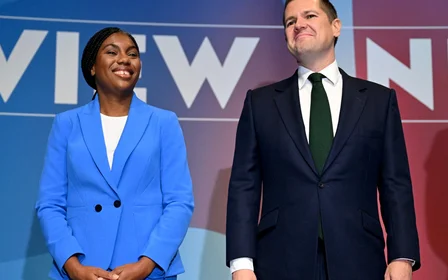
Israel can, however, continue to rely on one significant supporter: Kemi Badenoch’s Conservative Party.
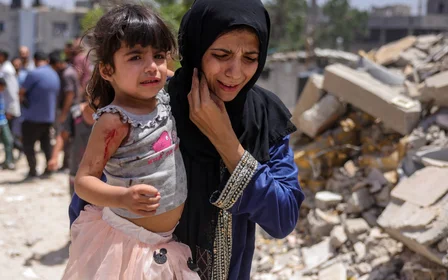
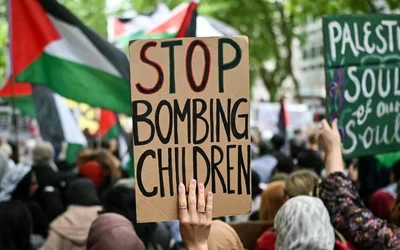
According to the latest polling, 62 percent of British voters oppose Israel’s ongoing military actions in Gaza and the occupied West Bank, with a mere 13 percent in support.
More than half want to end all arms sales to Israel, with only 22 percent in opposition. These figures are not surprising, since half of British voters have come to believe that Israel is committing genocide in Gaza.
New MEE newsletter: Jerusalem Dispatch
Sign up to get the latest insights and analysis on Israel-Palestine, alongside Turkey Unpacked and other MEE newsletters
When voter sentiment is as strong as this, it is most unusual for political parties to ignore it. Yet Badenoch offers near-blind support for Netanyahu.
We can find no example of the Tory leader ever seriously criticising Israel over the annihilation of Gaza, the settler pogroms in the occupied West Bank, or the bloody incursions into Lebanon.
When the United States and Israel launched their catastrophic assault on Iran, Badenoch flung her weight behind the fiasco. Indeed, her admiration for Israel is so strong that she has condemned Reform UK leader Nigel Farage for being insufficiently supportive of Israel.
Sharp departure
Again and again, Badenoch echoes Netanyahu’s central claim that Israel is fighting a battle for western civilisation in Gaza. “Supporting Israel is not just right - it is necessary for our own national security,” the Tory leader wrote in the Sunday Times last year. “Israelis are at the front line in the fight for the West and for our shared values.”
This level of support marks a sharp departure from traditional Tory policy. Badenoch’s predecessor (and personal political heroine) Margaret Thatcher certainly stood up for Israel, but her backing was never unconditional.
For example, Thatcher denounced the 1982 massacres in Lebanon committed by Christian Phalangists, with the Israeli army’s complicity, as “pure barbarism”. It is extremely difficult to imagine Badenoch using this kind of language to condemn contemporary Israeli atrocities.
Badenoch's adamant support for Israel does not just differentiate her from Thatcher and other Tory leaders. It also makes her Conservatives an outlier among European centre-right parties
In 1982, when Israel invaded Lebanon, Thatcher told Ronald Reagan, then the US president, that a “balanced policy” was best, and that “unlimited support for Israel can only lead to growing polarisation and despair in the Arab world”. Such measured statecraft appears beyond the capacity of Badenoch.
Thatcher, moreover, stood up for international law, while Badenoch mocks it. When the incoming Starmer government called time on former prime minister Rishi Sunak’s policy of undermining the International Criminal Court’s attempts to investigate Israeli (and Hamas) war crimes, Badenoch announced that Labour had “cowed to the mob”.
On Israel and Palestine, Badenoch regularly twists the truth and ignores basic facts. She has accused Iran of orchestrating the 7 October 2023 attack, despite the assessment of the US director of national intelligence, published in February 2024, that “Iranian leaders did not orchestrate nor had foreknowledge of the Hamas attack against Israel”.
Last year, she called Israel “a vibrant democracy that protects women and minorities and encourages them to vote, speak and dissent”.
These comments were made years after a consensus emerged among human rights groups - including Human Rights Watch, Amnesty International and Israel’s B’Tselem - that Israel practises apartheid.
An apartheid state cannot be democratic. Badenoch ignored the opinion of international authorities to say that Israel was a democracy, when in fact it rules over millions of Palestinians with no rights.
Vested interest
Badenoch’s position on Israel was arguably constrained by her role as business and trade secretary in Sunak’s government. This meant it fell to her to approve arms sales to Israel, which she continued to do during a period when Israel was accused of genocide.
If the International Court of Justice (ICJ) determines that Israel has indeed committed genocide, the judgment will open Badenoch herself up to charges that she was an accomplice, alongside senior Tory colleagues. She thus cannot accuse Israel of criminality (at least in the period until July 2024) without risking incriminating herself.
In common with all senior Tories from the last government, Badenoch therefore has a vested interest in denying Israeli atrocities.
Badenoch’s adamant support for Israel does not just differentiate her from Thatcher and other Tory leaders. It also makes her Conservatives an outlier among European centre-right parties.
Italian Prime Minister Giorgia Meloni suspended defence cooperation with Israel earlier this year. In Germany, the strongly pro-Israel Merz government in August 2025 announced a halt to exports of arms to Israel that could be used in Gaza.
Although Germany lifted this partial suspension of arms exports after the “ceasefire” was called, it is striking that Badenoch has never supported such a suspension.
In May 2025, France and Canada joined Britain in condemning Israel’s “egregious actions” in Gaza, in response to renewed military operations, obstruction of aid, and threats to permanently displace the Palestinian population.
Shadow foreign secretary Priti Patel attacked this statement by saying that Hamas had supported the French, Canadian and British position.
The Tories’ position seems closest to that of France’s extreme-right National Rally, whose president, Jordan Bardella, said during a recent visit to Israel that its “war in the face of barbarism … is also our fight”.
Questions unanswered
This week, Middle East Eye wrote to the Conservative Party with a series of questions. We asked for evidence that Iran orchestrated the 7 October attacks.
We asked whether Badenoch’s approval of arms sales to Israel during her time as business and trade secretary had compromised her ability to impartially judge whether Israel’s actions are criminal.
We asked whether Badenoch accepted the July 2024 opinion of the ICJ - and human rights organisations including B’Tselem, Human Rights Watch and Amnesty International - that Israel has breached the legal prohibition of apartheid.
We asked whether any member of the leadership of the Conservative Party has criticised the large-scale torture of Palestinian detainees by Israel (our own searches have not revealed any such criticism).
We asked whether Badenoch believes that Israel has committed any war crimes in Gaza since October 2023.
We pointed out that Badenoch’s foreign affairs spokesperson, Patel, resigned from her office as international development secretary after holding unauthorised meetings with Israeli officials in 2017, and we asked: “In view of Patel’s failure to uphold transparency and openness in dealing with foreign officials, why did Kemi Badenoch appoint Priti Patel shadow foreign secretary?”
We sent these questions several times to the Conservative Party, giving ample time to reply, but received no answer.
These questions matter very much. Miliband is expected to soon announce a series of punitive measures against Israel in response to settler violence and settlement expansion - a programme that, in the light of the E1 development, threatens to destroy any possibility of an independent Palestinian state.
So we wrote: “Kemi Badenoch has strongly opposed Labour’s recognition of a Palestinian State. The Conservative Party, however, claims to support a two-state solution. How can the Conservative Party support a two-state solution while granting recognition to Israel, and refusing to recognise Palestine?”
We sent this question more than once to the Conservative Party. We received no answer.
The views expressed in this article belong to the authors and do not necessarily reflect the editorial policy of Middle East Eye.
Middle East Eye delivers independent and unrivalled coverage and analysis of the Middle East, North Africa and beyond. To learn more about republishing this content and the associated fees, please fill out this form. More about MEE can be found here.