British Museum row reveals the limits of decolonisation movements


Many observers are reeling in shock at a report that the British Museum has decided to erase the term "Palestine" from some of its collections, amid pressure from pro-Israel activists.
Others are not remotely surprised at these developments, including myself, for a couple of reasons.
The first is circumstantial. Only a few weeks before publicly complaining to the British Museum, the UK Lawyers for Israel (UKLFI) activist group appealed to my own institution, the Open University, with a similar demand: to erase the term "ancient Palestine" from our teaching materials.
The second reason is that I understand museums to be colonial institutions, and am therefore not surprised to find them on the side of the occupier and not the occupied.
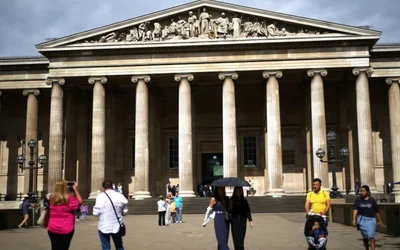
Like most European national museums, the British Museum is a thoroughly colonial institution. It was founded in 1753, and neither its physical presence nor its collections are imaginable without the British Empire.
New MEE newsletter: Jerusalem Dispatch
Sign up to get the latest insights and analysis on Israel-Palestine, alongside Turkey Unpacked and other MEE newsletters
The museum contains objects looted from colonised populations who were dehumanised, and whose histories were stolen and erased. The same British Empire that created the British Museum also created the modern nation-state of Israel - and like the colonisers that created it, Israel is itself a colonial occupier, according to the UN and many other international organisations.
Indeed, the entanglement between colonial museums and settler-colonialism is a tale as old as time.
Colonising mission
European colonialism has always attempted to rewrite history. When the British coloniser Cecil Rhodes wanted to seize Zimbabwe (which he would call Rhodesia), he sent a team of archaeologists to the ancient city of Great Zimbabwe.
Their role in his colonising mission was clear: to come back with the "discovery" that Great Zimbabwe had been built not by ancient Africans, but by Phoenicians, whom British colonisers could easily position as early European colonisers whose occupying presence justified their own.
Rhodes legitimated the British colonisation of Zimbabwe by erasing ancient Africans. So it is not at all surprising that Zionism - itself a project of European colonisation - should attempt the same rewriting of history in Palestine.
The erasure of ancient Palestine takes multiple forms. In Palestine itself, Israel is waging a sustained campaign to destroy and occupy ancient Palestinian sites.
Outside of Palestine, pro-Israel organisations are putting pressure on institutions responsible for the public understanding of history - such as universities and museums - to change their terminology and delete "ancient Palestine" from the record altogether.
This erasure is a key aspect of the genocide of the Palestinian people, which targets both their past and their present. Rewriting history is crucial to Israel's colonial project, just as it was crucial to other European colonial projects - because for Israel to legitimate its occupation, it needs to invent an antiquity for a state that is really not very old at all. The erasure of ancient Palestine is how an entity that is only as old as 1948 presents itself as having always existed.
Early Zionism had a relationship with antiquities collecting, and especially with Egyptology. In 1799, Napoleon Bonaparte invaded Palestine as an extension of his colonial campaigns in Egypt and Syria.
As his army was failing to take control of Akka (Acre), he had an idea that he hoped would win him allies: what if Palestine was turned into a Jewish state? His plan was unsuccessful, but the idea did not die. A century later, in June 1899, the New York Times published a notice from the Conference of Zionists held in Baltimore, which asserted their plan to "colonise Palestine".
Symbolic reckonings
Napoleon's invasions of Palestine, Egypt and Syria would be remembered by scholars of the ancient world for another reason: alongside his soldiers, Napoleon took with him more than 100 academics who would author the books sometimes known as the first works of professional Egyptology (and find - though it was not lost - the Rosetta Stone).
There is nothing particularly new in saying that museums and the disciplines that study history and the ancient world were forged in the ferocious fires of European colonialism.
In the immediate aftermath of the murder of George Floyd, as part of the "decolonise the curriculum" movement, many museums, universities and other institutions wanted to be seen as decolonising. Those institutions that wanted - in word, if not in deed - to engage with this call for decolonisation are being targeted.
It is a project of rewriting ancient history according to the narrative that best suits the coloniser
Attempts to put pressure on these institutions to force them into being complicit in Israel's erasure of Palestinian history shows us the limits of these decolonisation movements. It shows us that while institutions might have made symbolic reckonings with their own histories of empire (and updated their webpages accordingly), they have not equipped themselves to stand with the occupied, rather than the occupier, in the present.
We should also be wary of taking the pronouncements of pro-Israel groups at face value. Some of these groups are prone to exaggerating the capitulation that their intimidation campaigns win from organisations.
The British Museum's recent statement seems to suggest that this is the case, though it does not make the argument for the appropriateness of the term "Palestine", nor do anything to highlight the dangers of this recent resurgence of European colonialism's penchant for rewriting history.
The removal of the term "ancient Palestine" from gallery labels or pedagogic materials has nothing at all to do with historical accuracy. Widely used by ancient historians, this term is simply the most appropriate for this region in antiquity.
Instead, it is a project of rewriting ancient history according to the narrative that best suits the coloniser. Museums and universities urgently need to reject colonial rewritings of history, or they risk being complicit in Israel's genocide of the Palestinian people. Until they equip themselves to do this, Palestine will remain the limit of their claims to decolonisation.
The views expressed in this article belong to the author and do not necessarily reflect the editorial policy of Middle East Eye.
Middle East Eye delivers independent and unrivalled coverage and analysis of the Middle East, North Africa and beyond. To learn more about republishing this content and the associated fees, please fill out this form. More about MEE can be found here.