
'Fight back or die': How Elon Musk is weaponising Britain's working-class grievances


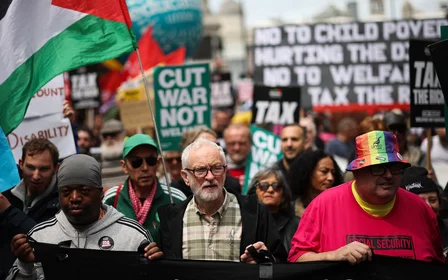
This past weekend, more than 100,000 people gathered in London for the “Unite the Kingdom” rally led by far-right agitator Tommy Robinson.
What began as a populist march quickly turned into a anti-democratic spectacle, with calls to dissolve parliament and to evict “Islam from Europe”. At the centre of it all was a live-streamed message from billionaire Elon Musk, declaring: “You either fight back or you die.”
Let us be clear: this is not an organic, working-class uprising. It is a movement fuelled by the ultra-rich, amplified by digital platforms, and cloaked in the language of white working-class redemption. It is exploitation masquerading as populism, and the stakes have never been higher.
Musk’s presence at the rally was not incidental. It reflects the growing alignment between techno-oligarchs and far-right populists.
When the world’s richest man, owner of X (formerly Twitter), SpaceX and Tesla, beams into a London protest and proclaims that “violence is coming”, it signals not only the legitimisation of extremist rhetoric, but also the power of digital platforms to coordinate and embolden it.
New MEE newsletter: Jerusalem Dispatch
Sign up to get the latest insights and analysis on Israel-Palestine, alongside Turkey Unpacked and other MEE newsletters
Musk’s political trajectory has followed a familiar pattern: from libertarian technocrat, to cultural reactionary, to open amplifier of far-right conspiracism. His calls for the dissolution of parliament and scorn for the “elite” are not policy positions, but ideological signals aimed at destabilising democratic norms in favour of deregulation, authoritarianism and digitally consolidated power.
We are witnessing the construction of digital fiefdoms: ideological ecosystems ruled by billionaire lords, policed by algorithms, and populated by millions of people who feel alienated by the political establishment. In these spaces, anger is harvested, redirected and monetised. Political rage becomes engagement; engagement becomes capital.
Hollowed-out towns
If the rhetoric of the far right remained online only, it might be dismissed as hyperbole. But its consequences are already unfolding in the streets, with most hate crimes in the UK being racially motivated, according to government data.
When political leaders and media personalities repeatedly frame migrants, Muslims and other minorities as “invaders” or “threats to civilisation”, they license violence. The rallying cry of the populist right is that it speaks for the “forgotten man”.
And there is a grim truth at the heart of this claim: many white working-class communities have been neglected - by the market, by neoliberalism, and most damningly, by the contemporary left.
If the left wants to win that war, it must remember its roots - not in Twitter threads or metropolitan think-tanks, but in the lived realities of working-class people of all colours and creeds
In post-industrial Britain, once-proud towns have been hollowed out by decades of austerity, under-investment and wage stagnation. The social infrastructure that held working-class life together - union halls, council housing, reliable public services - has been dismantled. In its place, populist demagogues offer pride, purpose and identity.
But their solution is not redistribution or empowerment. It is scapegoating. It is division. It is false redemption that puts the blame on Muslims, migrants and current democratic structures, while quietly advancing a corporate agenda of deregulation, privatisation and digital monopolies.
The irony is brutal: the white working class, in its search for power and its fight-back against the “elite”, is being led by the hand into the service of power itself.
And where, one might ask, is the Labour Party in all of this? Under Prime Minister Keir Starmer’s cautious centrism, the party has embraced a platform of technocratic stability; what critics now call “reform-lite”. It offers modest adjustments, not moral vision or conviction. It is a politics designed not to inspire hope, but to remain stranded in the grey pond of stagnation and dismay.
In a country where entire regions feel abandoned - economically, culturally and politically - a managerial left cannot compete with an insurgent right promising transformation, however illusionary.
Speaking across divisions
Even those to the left of Labour - the Greens, independents and democratic socialists - have too often failed to address the white working class directly. Many feel that doing so may entail cultural compromise. Others have simply misread the terrain. The result is a vacuum, and nature abhors a vacuum.
The way out is neither to ignore white working-class grievances, nor to pander to extreme far-right sentiment. It is to reconstruct a universal, democratic class politics that speaks across divisions, while confronting hate without compromise.
This will require the left to do things differently, and to shatter the stagnant status quo. Firstly, it must re-engage economically abandoned areas - not just through policy, but with a physical presence, including local campaigns, unions and cooperative initiatives.
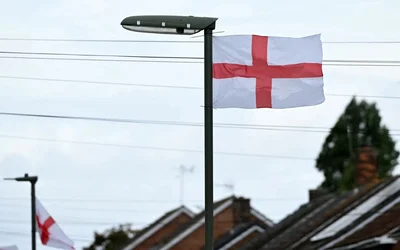
Secondly, the left must acknowledge grievances specific to the white working-class identity, without sanctifying it. Cultural recognition is not racial essentialism; it is the first step towards rebuilding political trust.
Thirdly, the left must build bridges between communities, not walls - a process that should emphasise the shared material interests among working-class people of all backgrounds. It must confront the far right directly, naming their rhetoric for what it is: dangerous, manipulative and deeply anti-working class.
Finally, the left needs to reclaim the language of nation and belonging - not by exclusion, but by rooting it in solidarity, mutual aid and democratic participation.
The left must understand that if it does not offer belonging, meaning and material hope - if it does not listen in order to understand - others will, and on far more dangerous terms.
We are at a critical junction. Far-right movements are growing not in the shadows, but in broad daylight, with corporate endorsement, billionaire amplification and real-world consequences. Musk’s words - “You either fight back or you die” - are more than hyperbole. They are a declaration of ideological war, not just on migrants or Muslims, but on democracy itself.
If the left wants to win that war, it must remember its roots - not in Twitter threads or metropolitan think tanks, but in the lived realities of working-class people of all colours and creeds. Until then, the far right will continue to occupy the ground it has been ceded.
And Britain will continue its drift into something colder, darker and far more dangerous than discontent.
The views expressed in this article belong to the author and do not necessarily reflect the editorial policy of Middle East Eye.
Middle East Eye delivers independent and unrivalled coverage and analysis of the Middle East, North Africa and beyond. To learn more about republishing this content and the associated fees, please fill out this form. More about MEE can be found here.