Gaza is an open graveyard, yet the West still debates whether Israel has gone 'too far'


My niece is barely alive. A week ago, her sister, Juri, was killed in an Israeli air strike.
Juri was just six years old. She was asleep when the missile hit. Her tiny body, wrapped in white cloth, is now one more number in a growing mass grave.
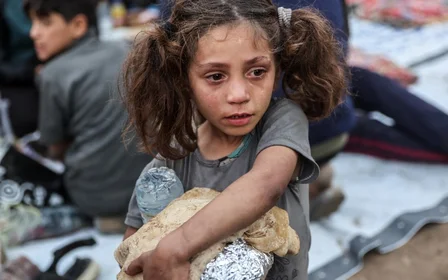
Her sister survived the blast, but barely. Their father and grandfather were also injured in the strike. But now, the little girl is fading. Her haemoglobin level has dropped to seven, and she needs a blood transfusion. She needs proper food and safety - but in Gaza, those things no longer exist.
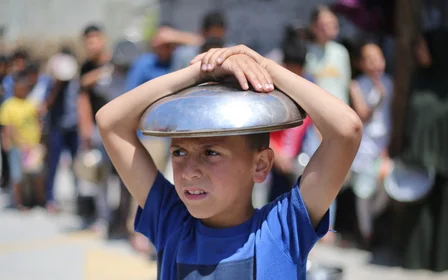
There is no food or clean water. There are no working hospitals or blood banks. There is no safety.
And yet, this week, Israel announced to the world that it had “allowed” humanitarian aid into Gaza - as if this was a gesture of mercy that excused the slaughter.
New MEE newsletter: Jerusalem Dispatch
Sign up to get the latest insights and analysis on Israel-Palestine, alongside Turkey Unpacked and other MEE newsletters
Just five trucks were let through, while the United Nations says at least 500 are needed every day to meet basic humanitarian needs.
Five trucks for two million people. This is not aid; it is humiliation. It is a smokescreen. It is dust in the eyes of the world, to allow Israel to carry on with its killing - uninterrupted, unquestioned and unpunished.
'I wish I had died'
This is not about defending civilians. It is about breaking them.
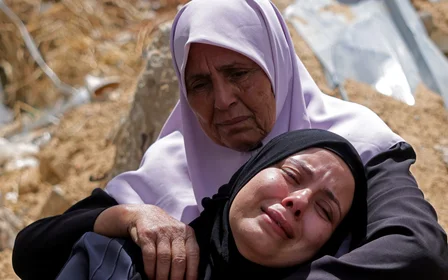
I spoke to my mother recently. She is displaced now, like nearly every Palestinian in Gaza. Her voice was quiet. I asked her how she was holding up, and she said something that has haunted me ever since: “I wish I had died at the beginning - so I didn’t have to see any of this.”
Follow Middle East Eye's live coverage of the Israel-Palestine war
What do you say to your own mother when she says that; when she has lost her home, her grandchildren, her country - and now, perhaps, her will to live?
Now, at last, the governments of the UK, France and Canada have issued a joint statement demanding that Israel change course.
Israel hasn’t paused. It hasn’t listened. It hasn’t cared. It continues to drop bombs and block food. It continues to kill.
British Prime Minister Keir Starmer, French President Emmanuel Macron and Canadian Prime Minister Mark Carney warned: “If Israel does not cease the renewed military offensive and lift its restrictions on humanitarian aid, we will take further concrete actions in response.”
They also called Israel’s actions “wholly disproportionate”.
But I want to say this, clearly and without apology: It’s not just disproportionate. It has been described as genocide. And it’s already too late for tens of thousands of Palestinians.
Israel hasn’t paused. It hasn’t listened. It hasn’t cared. It continues to drop bombs and block food. It continues to kill.
And if the UK is serious, if Starmer’s words are more than diplomatic noise, then it must stop arming Israel. You don’t call violence disproportionate and then sell the perpetrator more weapons. You don’t condemn an atrocity while financing the next one.
War on survival
My niece’s body is weak, and her blood is dangerously thin. Her life now depends on whether the world finds its conscience - and whether it finds it fast enough.
The starvation of Gaza is not an accident. It is not collateral damage. It is policy. Starvation is not separate from the bombs; it is a continuation of the genocide.
This is a war on survival itself. And the most painful part is that it is happening in full view of the world, as western leaders watch, calculate, excuse and delay.
This is not just a failure of diplomacy. It is a failure of humanity.
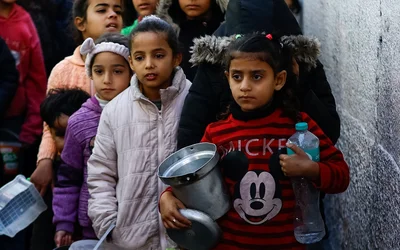
What are we supposed to do with this grief, this rage? I scroll through videos of my hometown reduced to ash. I listen to my brother weep on the phone. I see a photo of my niece, her skin pale, her eyes dim, too weak now to stand. I hear my mother’s voice, wishing she hadn’t lived to witness this.
And I wonder what it means to survive a genocide while the world debates which word to use, which line has been crossed, which moment is “too far”.
My niece is five. As I write this, she is hungry, in pain, and possibly dying.
I want to scream at the world: how is this still happening? How are we still debating whether Gaza’s children deserve food? How are we still pretending this is complicated?
Five trucks. Two million people. Another child - my niece - whose life might end because we’ve accepted this horror as normal.
There is still time, perhaps, to act. But not much. I hope, with every shred of hope I have left, that governments will move quickly - not just to protect my niece, but to save the two million others still trapped in Gaza’s open-air graveyard.
Because if they don’t, then all the statements, condemnations and resolutions will come far too late - to people who will no longer be alive to hear them.
The views expressed in this article belong to the author and do not necessarily reflect the editorial policy of Middle East Eye.
Middle East Eye delivers independent and unrivalled coverage and analysis of the Middle East, North Africa and beyond. To learn more about republishing this content and the associated fees, please fill out this form. More about MEE can be found here.