

Gaza starvation: Why Israel's supporters are misrepresenting Unicef study

Israel has consistently denied that it has used starvation as a weapon of war in Gaza.
These denials date back to Israel’s submission to the International Court of Justice in response to South Africa’s genocide case at the Hague in January 2024. Its lawyers asserted that “Israel has publicly stated repeatedly that there is no limit on the amount of food, water, shelter or medical supplies that can be brought into Gaza”.
From the start, these protestations have been challenged by human rights organisations.
Amnesty International reported that “at no point” between October 2023 and early July 2024 did Israeli authorities allow “adequate aid and other essential life-saving supplies” to be provided.
After Israel imposed a total blockade spanning March to mid-May 2025, the World Health Organization (WHO) said it generated “one of the world’s worst hunger crises”, with 57 children reportedly dying of malnutrition - and noted that “this number is likely an underestimate”.
New MEE newsletter: Jerusalem Dispatch
Sign up to get the latest insights and analysis on Israel-Palestine, alongside Turkey Unpacked and other MEE newsletters
When the International Criminal Court (ICC) issued an arrest warrant against Israeli Prime Minister Benjamin Netanyahu in November 2024, the allegations included “the war crimes of starvation as a method of warfare and of intentionally directing an attack against the civilian population”.
Israel is naturally entitled to challenge these allegations, and its supporters have regularly done so. Last week, they launched a fresh campaign in the wake of the publication of a Unicef survey addressing malnutrition in Gaza, focusing on children under the age of five.
'Both findings stand'
US Ambassador to Israel Mike Huckabee was one of the first to seize on this document, posting on X (formerly Twitter): “This is awkward for Israel haters. When a UN (no friend of Israel) organization … debunks the lie that Israel was ‘starving kids’ it’s worth a read. Israel genocidal? They botched it again!”
Former Israeli government spokesperson Eylon Levy added on X that “the ‘Gaza famine’ was always a hoax”, while UN Watch - which monitors the United Nations from a pro-Israel perspective - posted: “Gaza Famine? Not according to UNICEF. A new survey shows Gaza has one of the lowest acute child malnutrition rates in the world.”
Meanwhile, Andrew Fox, a researcher at the Henry Jackson Society, wrote on X that the notion of a famine in Gaza during Israel’s assault had been “conclusively disproven”.
'Claims that famine never happened in Gaza are incorrect, misleading and dangerous'
- Medical Aid for Palestinians
The first thing to say is that anyone with an ounce of humanity should cheer to the rafters any news that the children of Gaza are better fed.
This Unicef study certainly shows that the ceasefire, which has proved a sham in so many respects, has allowed more food to enter the enclave. If Israeli authorities deserve credit, we should be more than happy to say so.
Yet we could find no evidence in the study to justify the claims from Huckabee and others that famine never took place in Gaza.
We reached out to Unicef to clarify this point, and they responded: “The recent nutrition survey measures conditions in mid-2026, more than nine months after the IPC [Integrated Food Security Phase Classification] confirmed famine in August 2025 and after a ceasefire and substantial scale-up in humanitarian assistance. It cannot tell us what conditions were in August 2025, and it was never designed to.
“Both findings stand: famine was confirmed then, and acute malnutrition among children has fallen since. That improvement is a product of the assistance delivered in between, not evidence that it was unnecessary.”
Horrifying consistency
Medical Aid for Palestinians (Map), a UK-based charity, was also emphatic on this point, telling us: “Claims that famine never happened in Gaza are incorrect, misleading and dangerous.”
The group further noted that a survey of children’s nutritional status today cannot retroactively disprove a finding of famine that was made last year.
“Both findings can stand at the same time: famine was confirmed in Gaza by the IPC in August 2025, and the Unicef-coordinated survey shows that malnutrition among surveyed children has fallen since then,” Map told us. “Reading the second finding as disproving the first is an abuse and misrepresentation of the data and survey findings.”
Indeed, one finding in the latest study - ignored by Huckabee and others - is horrifyingly consistent with starvation claims.
Unicef found that around one in eight children under the age of five suffers from stunted growth, noting: “This points to longer-term nutritional stress and repeated deprivation beyond immediate wasting.”
The WHO defines stunting as “the impaired growth and development that children experience from poor nutrition, repeated infection, and inadequate psychosocial stimulation”.
Stunting is largely irreversible and has serious long-term consequences. It is, in fact, the inevitable result of the malnutrition and starvation recorded by aid organisations after the Israeli military assault on Gaza began.
Protecting Gaza's children
Martin Shaw, an emeritus professor of international relations and politics at the University of Sussex, and an expert on genocide, told us that the effects of previous periods of Israel’s starvation policies between 2023 and 2025 were evident in children’s stunted growth.
“The effects of three years of Israeli military violence - wounding, amputation, untreated illness, bereavement, huge psychological stress, destruction of health services, schooling, etc - are all showing in the condition of the child population,” he said.
Moreover, the study’s conclusion that children under five in the areas outside of Israel’s yellow line have a low rate of acute malnutrition is based on the recorded weight of these children.
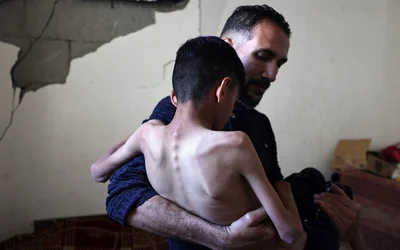
Mike Spagat, an economics professor at Royal Holloway, told us: “Children’s weights can fall dramatically in a few weeks and can be brought back up in a few weeks with the right treatment - especially when it is administered by professionals, as it is here.”
He continued: “A wasting measurement is therefore a snapshot of conditions at a moment in time, and the moment matters. This survey was fielded in June 2026: eight months into the ceasefire, after two full quarters of feeding at scale.”
Spagat thus concludes that the low wasting figure represents “the measured effect of a professional intervention, and Israel’s supporters are citing it as proof the intervention was never needed”.
The new Unicef study does not have any bearing on the allegation, made in the ICC arrest warrant, that Netanyahu used starvation as a weapon of war. Nobody, whether friends or critics of Israel, should weaponise or make political capital out of this report.
Surely we all have a duty to do everything we can to protect the children of Gaza, who have suffered greatly and endured so much horror. They should be allowed to return, as a matter of urgency, to the kind of normal life that everybody has the right to enjoy.
The views expressed in this article belong to the author and do not necessarily reflect the editorial policy of Middle East Eye.
Middle East Eye delivers independent and unrivalled coverage and analysis of the Middle East, North Africa and beyond. To learn more about republishing this content and the associated fees, please fill out this form. More about MEE can be found here.


