Germany's UN defeat is a verdict on its complicity in genocide


On 3 June, for the first time, Germany failed to secure a rotating seat on the UN Security Council, falling 23 votes short. The announcement was made by Annalena Baerbock, Germany's former foreign minister and current president of the UN General Assembly.
The vote was a verdict on Germany's standing in the world, and even Berlin knows why.
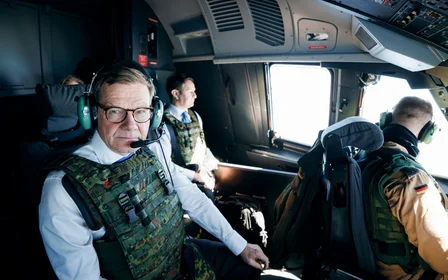
German Foreign Minister Johann Wadephul acknowledged that the country had lost votes over its support for Israel's war on Gaza, or as he put it, "Germany's special responsibility for Israel".
He was quick to add that Germany would continue to fulfil that responsibility, despite the international embarrassment.
At a moment when rogue states such as the United States and Israel are waging wars and pursuing coercive campaigns against countries of their choosing - from Iran and Yemen to Lebanon, Palestine and Venezuela - the rest of the world is looking for international partners who can help weather the storm, not fuel it.
New MEE newsletter: Jerusalem Dispatch
Sign up to get the latest insights and analysis on Israel-Palestine, alongside Turkey Unpacked and other MEE newsletters
Germany has shown that it is willing to undermine international law and bend human rights principles in defence of what many countries increasingly view as indefensible. It has failed to convince the world that it is a beacon of diplomacy. Instead, it has exposed the very historical liabilities it has spent decades trying to overcome.
Backing genocide
Germany is the second-largest supplier of arms to Israel after the US, responsible for roughly 30 percent of Israel's arms imports between 2019 and 2023.
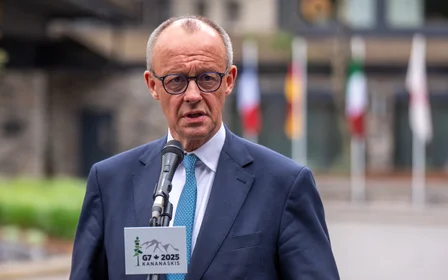
In August, Chancellor Friedrich Merz announced he would limit arms deliveries to Israel. But the suspension applied only to new export licences for weapons that could be used in Gaza - not to previously approved exports, which continued to flow.
The facade collapsed in November shortly after Germany announced it was lifting even that partial restriction and resuming arms exports.
It is not only the weapons sales that have the world questioning Germany's international standing, but also the lengths to which it is willing to go to curtail and undermine international law.
It is not only the weapons sales that have the world questioning Germany's international standing, but also the lengths to which it is willing to go to curtail and undermine international law
On 4 June, European Union foreign ministers were set to vote on sanctions against two extremist Israeli ministers, Itamar Ben Gvir and Bezalel Smotrich. Germany, however, prevented the vote from taking place and continues to block the EU sanctions.
This was not the first time. In April, Germany blocked a vote to suspend the EU-Israel Association Agreement - through which Israel gains preferential access to the European market and EU funding - despite a majority of EU member states being in favour.
Germany described the attempt to hold a vote as "inappropriate" and prevented any EU action.
In December 2023, South Africa brought a case against Israel before the International Court of Justice (ICJ), alleging that Israel is conducting a genocide. Germany not only publicly rejected these allegations almost immediately, but also declared its intention to intervene directly in the ICJ proceedings.
"Particularly in light of its own history, upholding the integrity of the United Nations Genocide Convention is an expression of Germany's special responsibility," the German government said, citing its commitment to protect Israel.
Yet as legal pressure mounted - most notably through Nicaragua's separate case challenging Germany's support for Israel before the ICJ - Berlin ultimately stepped back and did not follow through with its planned intervention.
History as a shield
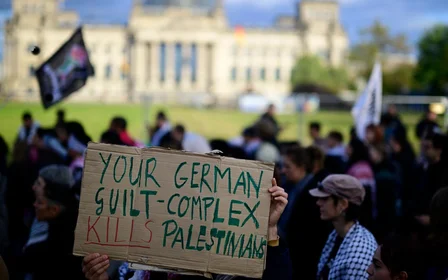
Germany consistently invokes "historical responsibility" as a central justification whenever it faces criticism for its positions on international law and its unwavering political and military support for Israel.
This framing cannot be understood in isolation from the doctrine of Staatsrason, which has effectively elevated support for Israel into a quasi-state principle that often overrides other international legal obligations and human rights considerations.
In March 2008, former Chancellor Angela Merkel told the Israeli Knesset that the security of Israel was part of Germany's Staatsrason: its reason of state.
Follow Middle East Eye's live coverage of Israel's genocide in Gaza
In practice, Staatsrason functions less as a neutral moral reminder of historical responsibility and more as a guiding political logic that narrows the space for critique, even in cases involving serious allegations of violations of international law.
Germany's commitment to "Never Again" increasingly operates as a selective interpretive framework whose goal is to shield itself and complicit state actors from international scrutiny, rather than universally protecting vulnerable people from state-sanctioned violence.
Instead, Germany's moral posturing turns to vengeance. In January 2024, Germany was among the states that suspended funding for Unrwa following unsubstantiated Israeli allegations that the UN agency's staff had supported terrorism - claims that a subsequent independent review found Israel had failed to substantiate with evidence.
And in the immediate aftermath of its embarrassing defeat at the UN, German political commentators called to withdraw financial support for the organisation altogether.
Hesse's Minister for International Affairs, Manfred Pentz, told Bild: "If [Germany] doesn't have the influence there that we are entitled to, the question arises: why should we continue to invest so much money in the UN?"
Let it be noted that while many states - including Austria, which did secure a UN Security Council seat - are also implicated in political, military or diplomatic complicity in the ongoing crimes against the Palestinian people, Germany's support operates on a qualitatively different level.
It is not merely aligned with prevailing western policy, but is structurally and historically overdetermined, expressed through sustained military exports, legal interventions and a doctrinal commitment - Staatsrason - that elevates support for Israel into a core principle of state identity.
Through its violent treatment of protesters, punishment of journalists who critique hegemonic state rhetoric, and the stripping of citizenship from Palestinians, Germany's position does not simply mirror broader international complicity - it intensifies and legitimises it through that very same language of historical responsibility.
It has become, in Germany's telling, historically responsible to support genocide again.
It was fitting that it was Baerbock who announced the disappointment - the same individual who claimed that "civilian areas [such as hospitals] could lose their protected status because they are being abused by terrorists".
As one Austrian diplomat put it: "Vote for us precisely because we're not the Germans."
The views expressed in this article belong to the author and do not necessarily reflect the editorial policy of Middle East Eye.
Middle East Eye delivers independent and unrivalled coverage and analysis of the Middle East, North Africa and beyond. To learn more about republishing this content and the associated fees, please fill out this form. More about MEE can be found here.