Gulf states must act to avoid Israel's war on Iran spiralling into chaos


The bombs may have fallen silent, but Israel's assault on Iran is far from over.
In Tehran, many remain on edge, bracing for a second wave of air strikes, car bombings and acts of sabotage.
This uneasy lull could break at any moment, plunging the region into renewed violence and chaos.
Israel's war on Iran threatens to upend the regional balance of power.
The Gulf states now stand at a critical juncture, with vastly different futures ahead: one of prosperity and regional influence, or one of prolonged instability and economic turmoil.
New MEE newsletter: Jerusalem Dispatch
Sign up to get the latest insights and analysis on Israel-Palestine, alongside Turkey Unpacked and other MEE newsletters
The choices they make today will shape their economic futures and the wider stability of the region.
Unrealistic ambitions
Israeli Prime Minister Benjamin Netanyahu's ambition to overthrow the Islamic Republic and elevate Israel to regional hegemony is likely to remain out of reach.
Internal regime change through revolution is improbable, given the absence of a strong, cohesive opposition.
Meanwhile, Iran's layered security and military apparatus renders a coup equally unlikely.
External regime change would require the deployment of hundreds of thousands of ground troops, at a cost of trillions of dollars and countless lives - a scenario even Israel's most hawkish advocates know is unrealistic.
Netanyahu may prefer a collapsed Iran like Iraq or Syria - or settle for a nuclear-armed, isolated Iran resembling North Korea
Yet Gulf states cannot afford to ignore the dangerous alternative scenarios.
Netanyahu may seek to push Iran into a scenario reminiscent of Iraq after the 1991 Gulf War, or Syria in the 2010s: a failed state, crippled by sanctions, plagued by internal violence and economic collapse. Alternatively, Israel might tolerate a nuclear-armed but impoverished and isolated Iran, akin to North Korea.
Both scenarios would spell economic and security disasters for the Gulf region.
Already, around 80 percent of Iranians suffer from food insecurity, and over 60 percent live in or near poverty. Even before the air strikes, the country faced a nearly 20 percent deficit in electricity, natural gas and fuel supplies.
Those shortages have now deepened following Israeli attacks on natural gas plants, oil depots and refineries.
Facing collapse
Before the war, Iran already required more than $500bn in investment to address critical infrastructure shortfalls, particularly in the energy, transport and industrial sectors - all of which remain strained under longstanding US sanctions.
If Iran fails to reclaim control of its airspace, continued Israeli escalation risks turning it into a militarised, failed state.
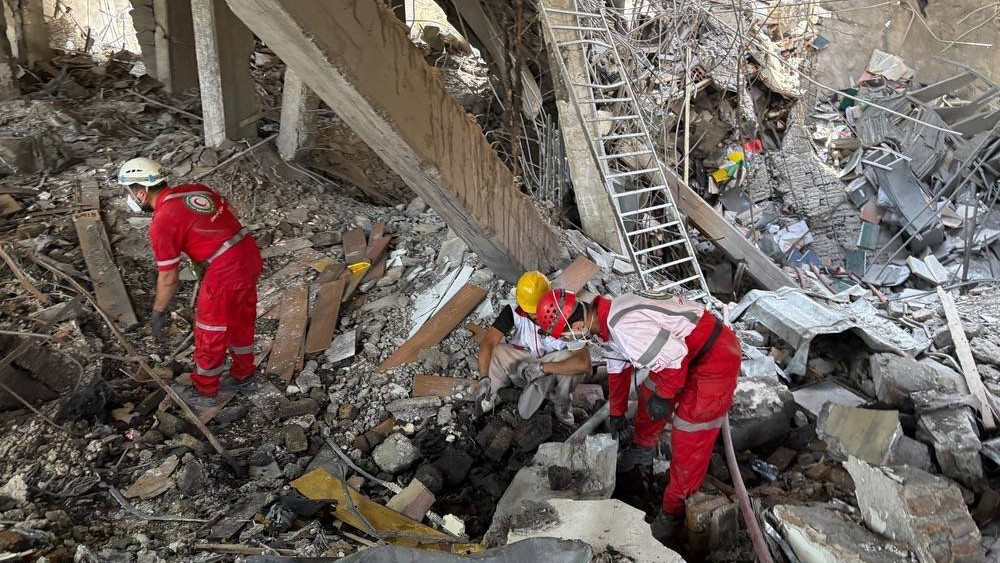
This would spark a humanitarian catastrophe on the Gulf's doorstep and fuel instability across the region. A collapsed Iran would spread chaos, undermining the security and stability essential for the Gulf's most ambitious economic initiatives.
Iran's former president Hassan Rouhani once warned: "If Iran cannot export oil, no oil will be exported from the Persian Gulf."
Recently, a prominent Iranian hardliner said diplomatic formalities must be cast aside when the Gulf states secretly aid Israel through open airspace and shared intelligence, despite their public condemnations.
While Iran may be unable or unwilling to block the Strait of Hormuz or directly attack Gulf infrastructure - as it did during the 2019 Aramco and Fujairah incidents - its capacity for disruption remains significant.
From maritime sabotage to asymmetric warfare and cyber attacks, the risks are considerable.
Looming risks
The 12-day war might have demonstrated the region's economic resilience and ability to weather short-term disruptions. But a two- to three-year conflict could cost Gulf economies between $730bn and $1 trillion.
This would include declining growth, falling foreign direct investment and delays to mega-projects. A prolonged regional conflict would severely shake investor confidence and derail national development strategies, erasing years of economic progress in the Gulf.
If Iran follows a North Korea-like trajectory - a nuclear-armed yet failed, militarised state under heavy sanctions - its economic consequences could be dire.

Beyond the uncertainty and regional arms race this would trigger, the spectre of nuclear proliferation from Ankara to Riyadh could divert vital resources away from economic development.
In a worst-case scenario, Iran might even share nuclear technology with non-state partners, much as it has done with missiles and drones supplied to Yemen's Houthis - further destabilising an already fragile neighbourhood.
Faced with these looming risks, Gulf states must choose between mitigation and avoidance strategies.
A mitigation strategy would involve enormous increases in military spending, especially on air defence systems mirroring Israel's multi-layered model.
Israel's sophisticated, multi-layered air defence system required an estimated $7bn to $8bn in investment. For Gulf Arab states to replicate this model at a significantly larger scale - and at up to 100 times the cost - is simply unfeasible.
Even if they relied exclusively on US defence support, this would likely exceed the recent $189bn deal with Washington. And as the war in Ukraine has shown, even the most advanced defences can be breached by relatively inexpensive weapons, leaving nations vulnerable despite massive spending.
Averting chaos
A more realistic and cost-effective strategy is for Gulf states to adopt an avoidance strategy rather than mitigate the risk. They can leverage their relationship with the US and Iran to foster diplomacy and broker lasting peace, despite Netanyahu's obstruction and sabotage.
Instead of leaning further into security pacts like the Abraham Accords, they should pursue economic and diplomatic initiatives that reduce tensions.
A potential diplomatic framework could involve establishing a regional nuclear consortium - one that recognises Iran's right to peaceful nuclear enrichment, but relocates the enrichment process outside Iranian territory in exchange for lifting US secondary sanctions.
Another approach might centre on a broader regional security pact, linking nuclear negotiations with a non-aggression agreement between Iran and Israel, in return for removing both US primary and secondary sanctions.
Such measures could significantly boost Iran's economy, potentially adding between $600bn and $1 trillion to its GDP by 2040, while helping to stabilise the region both economically and politically.
These steps would also open Iran's largely untapped $4 trillion investment market to Gulf countries and American investors.
Diplomatic action
The Israeli air strike during recent Iran-US negotiations has temporarily inflamed nationalism and public support for nuclear capabilities within Iran, further complicating diplomatic efforts.
However, a well-structured regional initiative, led by the Gulf states and backed by the US, could still capitalise on internal divisions among Iran's ruling elite, creating momentum for compliance, de-escalation and cooperation.
Gulf states now stand at a crossroads: passivity risks instability and stagnation, while diplomacy offers a path to peace and shared prosperity
Gulf states must seize this critical moment. Rather than observing passively or betting on a weakened Iran, active diplomatic engagement offers the best chance to protect their long-term economic and strategic interests.
By proactively pursuing peace and regional stability, they can avoid the costly chaos of prolonged conflict and realise their economic visions.
A weakened and fragmented Iran may seem advantageous in the short term, but history tells a different story. The aftermath of the 2003 US-led invasion of Iraq offers a stark reminder of how quickly failed states can unravel regional stability and burden neighbouring countries.
Gulf states now stand at a crossroads: passivity risks years of instability and economic stagnation, while proactive diplomacy offers the prospect of lasting peace and shared prosperity.
Arab leadership in this crisis is essential - and decisive diplomatic action is needed now more than ever.
The views expressed in this article belong to the author and do not necessarily reflect the editorial policy of Middle East Eye.
Middle East Eye delivers independent and unrivalled coverage and analysis of the Middle East, North Africa and beyond. To learn more about republishing this content and the associated fees, please fill out this form. More about MEE can be found here.