Here's what Burnham must do if he really wants to reset Labour's Palestine policy


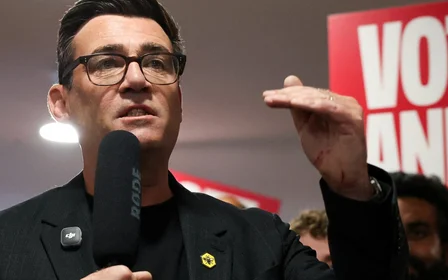
Having maintained a near-total silence on Labour’s policy in relation to Palestine since he began his open campaign for the leadership, Andy Burnham has now broken his omerta with an “apology” for the party’s past failures.
One must presume his advisers made clear that a shift on Palestine was crucial to win back the voters whose desertion was key to precipitating British Prime Minister Keir Starmer’s ignoble removal from office.
If they are earning their salaries, they should have pointed to recent opinion polling, which revealed that Labour is losing more voters to parties of the left than the right. More than half of voters who switched to other leftist or centrist parties said that Labour’s policy on Palestine was a factor.
Among those who are still members of the Labour Party, a poll released in June by Save the Children UK and other groups showed overwhelming support for a ban on trade with illegal Israeli settlements (87 percent) and a suspension of all arms sales to Israel (78 percent).
In addition, 58 percent said policy on Palestine was a crucial factor in their view on who should lead the party. There is thus a clear demand for a fundamental shift - and this is not new.
New MEE newsletter: Jerusalem Dispatch
Sign up to get the latest insights and analysis on Israel-Palestine, alongside Turkey Unpacked and other MEE newsletters
At the Labour conference last September, delegates passed a motion - with overwhelming support from trade unions and constituency parties - accepting the conclusions of a UN report that found Israel is committing a genocide in Gaza, and calling for a full arms embargo.
The problem for those demanding fundamental change, both inside and outside of the party, is that this is not what Burnham is offering - at least not in his initial statement on the matter.
Appalling failure
Even Burnham’s apology for Labour’s past failures was limited to an admission that at the start of Israel’s assault on Gaza, the party’s response was inadequate.
He makes a direct reference to the UK’s slowness in calling for a ceasefire. He is right about that appalling failure, most notoriously in Starmer ordering MPs not to support a ceasefire motion tabled by the Scottish National Party in November 2023, at a time when Israel was destroying Gaza’s infrastructure and killing a Palestinian child every 10 minutes.
It is also a reminder that Burnham, by that point, had already become one of the few prominent Labour politicians to depart from the party’s official policy, coming out in support of a ceasefire by late October 2023.
Will he adopt the policy passed at the Labour conference last year, by accepting the UN finding that Israel is guilty of the crime of genocide?
But the public anger towards Labour is not rooted in the failures back then. It is driven by the party’s continuing failure to hold Israel to account - and further, by its ongoing military, economic and political support for Tel Aviv.
A clear manifestation of this failure is the response to the advisory opinion issued by the International Court of Justice (ICJ) in July 2024 which affirmed the illegality of Israel’s occupation of the Palestinian territories. The ICJ called for the occupation to end and for third-party states, including the UK, not to provide any aid or assistance that enables it to continue.
For two years, the UK has failed to offer a response to this opinion. Pressed on the issue in a committee meeting earlier this month, Foreign Office minister Hamish Falconer was still unable to say when one would be forthcoming.
Demands for more robust action on Israel’s crimes do not suggest that the country should be treated differently from others violating international law, but rather that it must be held to the same standard.
This should begin by accurately naming these violations. Under Starmer, Labour dealt with the question of whether Israel is committing a genocide by hiding behind the line that this was for the courts, not politicians, to determine.
In his statement, Burnham actually retreats further by not even being prepared to state that war crimes are being committed, but merely that “they appear to have been”.
Ramping up pressure
Contrast this with Burnham’s statement as mayor of Manchester in November 2024, that the conflict in Ukraine “has seen the Russian government committing war crimes and human rights abuses”. No court has made a definitive ruling on this. Instead, Burnham’s statement correctly relied on the copious reports from UN bodies and human rights agencies.
And even when the world’s top court weighed in with a clear opinion, as in the aforementioned ICJ ruling of July 2024, it was not sufficient to drive the Labour Party to act.
If Burnham is serious about the need for a change of policy, then here is the test. Will he ensure the government finally responds to the ICJ opinion and implements its recommendations in full? Will he adopt the policy passed at the Labour conference last year, by accepting the UN finding that Israel is guilty of the crime of genocide?
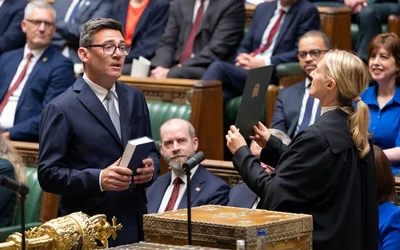
Will he also accept the findings of a further UN commission report issued last month, which documents in forensic detail Israel’s targeting of Palestinian children, and implement its recommendations in full?
Taking these steps would commit the government to a full arms embargo, comprehensive sanctions, and an end to all trade that supports Israel in its ongoing violations of international law and Palestinian rights.
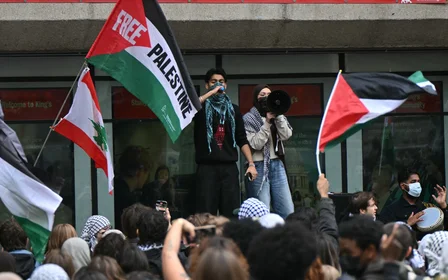
Burnham’s apology and admittance that Labour got things wrong must be accompanied by an admission that those who have been protesting Israel’s actions, and calling on the government for a change in policy, got it right. That would mean ending the repression of protests and the proscription of Palestine Action.
Britons involved in the Palestine solidarity movement will not accept Burnham’s recent statement as sufficient, but they can take heart from the fact that his issuing of it is a clear admission of concern that Labour’s policy is costing the party votes that need to be won back.
This should be interpreted as a signal to ramp up the pressure, beginning with ensuring that the next national march on 18 July, likely just hours before Burnham moves into No 10, is huge in numbers - and clear in its articulation of what is required to meet the test of real change.
The views expressed in this article belong to the author and do not necessarily reflect the editorial policy of Middle East Eye.
Middle East Eye delivers independent and unrivalled coverage and analysis of the Middle East, North Africa and beyond. To learn more about republishing this content and the associated fees, please fill out this form. More about MEE can be found here.