I have boycotted Israeli elections for years, but this time I will vote


In almost every interview I have conducted in recent weeks, and in nearly every conversation with Palestinian citizens of Israel on the streets of our towns, I have heard the same fear.
People are no longer talking primarily about civil rights, equality or better living conditions. They are talking about survival, and about whether they will be able to remain on their land.
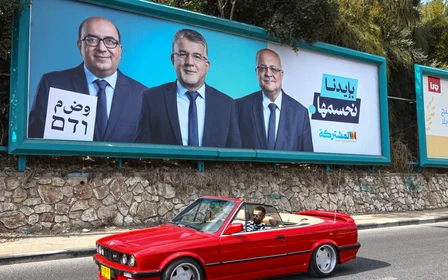
At the entrances to our towns, Israeli election billboards are everywhere. Among them are those of the Religious Zionism party, whose leaders advocate extending the land seizures and settlement building pursued in the occupied West Bank to the Galilee and the Naqab, or Negev.
These messages confront us on the roads we travel, at the entrances to the places we call home.
How are people supposed to carry on calmly amid such threats?
New MEE newsletter: Jerusalem Dispatch
Sign up to get the latest insights and analysis on Israel-Palestine, alongside Turkey Unpacked and other MEE newsletters
For many people I have spoken to, voting is not about faith in parliamentary politics or expecting an Israeli government to deliver justice. It is an attempt to protect themselves, or at least to delay what they fear is coming.
As Palestinian political activity inside Israel has faced severe restrictions since 7 October 2023, voting remains one of the few political acts that does not carry the risks associated with protest.
My father is 70 years old. He has never voted in an election to Israel's parliament, the Knesset. This time, he will.
He is the son of a displaced Palestinian family and spent his childhood under Israeli military rule. Now he fears for our future on this land, for his grandchildren, and for the possibility that his family's history could repeat itself. He does not underestimate the danger. Neither do I.
A painful reckoning
Since 2018, I have held a clear ideological position against participating in Israel's Knesset elections.
I believed, and still believe, that our presence in this framework has harmed our political discourse. Too much of our struggle has been reduced to parliamentary work, while building independent political tools and organising ourselves as a community have been pushed aside.
In fundamental ways, this framework contradicts our vision of liberation and an end to the occupation. That is why I chose to boycott.
But today I find myself questioning that decision. After a painful political and intellectual struggle, I reached a conclusion I never expected. At this stage, we are too weak to boycott.
I turned down invitations to join initiatives encouraging Palestinians to vote. How could I ask others to vote when I was unsure myself? As a journalist, I covered the election campaign without calling on anyone to vote or boycott, and I stepped away from the noise to wrestle with my thoughts. It was exhausting.
At this stage, we are too weak to boycott
I have watched Israeli society's shift further towards the far right since 7 October, alongside the weakness and paralysis of Palestinian politics. Even amid a genocide in Gaza that has killed more than 74,000 Palestinians, the Palestinian political leadership has failed to agree on a decision that could bring us together. Well, except for postponing Palestinian elections.
We are at rock bottom. We cannot even secure the simple right to harvest our olives safely. We lack effective political tools, a unifying national project and a clear way out of this devastation. There is nothing wrong with admitting it.
For me, boycott is not a moral position that can simply hang in the air. It is a political tool. It must have meaning, impact and a place within a larger political project, or at least offer an alternative.
An individual's refusal to participate can express a principle. A collective boycott that can challenge a system requires organisation, shared objectives and a way to turn refusal into political power.
The politics of remaining
I am not questioning the legitimacy of boycott. I am questioning what it can achieve now, when that collective project is missing. If participation cannot liberate us, and boycott offers no practical alternative, what do we do with the few possibilities that remain?
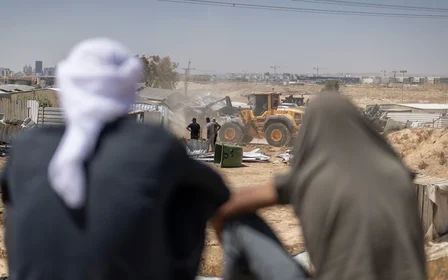
I have listened to people who want to vote even if all they hope for is to delay the demolition of a single home. Yet the fear now reaches beyond demolitions to displacement from the Naqab and the Galilee. "We're next," I hear everywhere.
When people fear losing their homes and land, how can I dismiss their concerns from the comfort of political theory?
We are a frightened community, and I do not think we fully understand the political and moral meaning of simply remaining: holding on to our place, surviving and enduring in the face of war and killing. That, too, is resistance.
How many around us have considered leaving? How many already have? How many of us have quietly wondered whether we can go on living here? The right to remain is no longer something we can take for granted.
We need reasons and resources to remain. I do not believe the Knesset itself can provide them. What matters is whether people coming together around Arab electoral lists might also rebuild collective political action beyond parliament.
Our crisis will not be solved by a few more Knesset seats. We need to rebuild ourselves politically and socially, far beyond any election.
I will vote.
I know that any alternative government would be no dove of peace. Changing governments will not end the occupation, dismantle colonial structures or transform a system built on Jewish supremacy. I have no illusions about that.
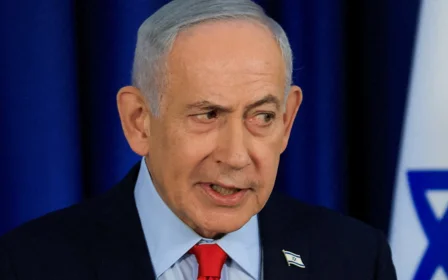
But I cannot bear the thought of Benjamin Netanyahu, Bezalel Smotrich and Itamar Ben Gvir remaining in power for another year. I want to see these blood-soaked men defeated, even if only for a moment. Anger is not a political strategy, but neither can I pretend it plays no part in my decision.
Voting without illusions
I understand the argument that Palestinian participation can help Israel present itself as a democracy while concealing structures of domination and inequality. Yet after all this bloodshed, I struggle to see how my ballot could restore the state's moral legitimacy. Participating does not mean endorsing the system; it means making a choice within the narrow space still available.
Perhaps political change will not prevent catastrophe. Perhaps it will only delay it, giving people a moment to breathe. When possibilities are so scarce, I do not want to let even one slip away.
I will vote for the slightest possibility that conditions might improve for Palestinian prisoners, even though their cause does not receive the place it deserves on Arab parties' electoral platforms.
And I cannot turn away from the pleas of Palestinians on the other side of the wall: "For God's sake, get this government off our backs. We just need to breathe, even if only for a little while."
I am not presenting voting as salvation. My reservations remain. I still believe liberation will not come through the Israeli parliament, but through our ability to build institutions, organise collectively and act as a people. Yet political convictions must remain accountable to the lives of those in whose name we hold them.
I think of my father, who lived seven decades without voting in an Israeli election and now plans to do so because he fears for his grandchildren. I cannot dismiss what that means, or the concerns of the many others who see a ballot as one remaining attempt to protect their place on this land.
I will go to the ballot box carrying all my old doubts with me. And at this rock bottom, I do not want to leave a single stone unturned.
The views expressed in this article belong to the author and do not necessarily reflect the editorial policy of Middle East Eye.
Middle East Eye delivers independent and unrivalled coverage and analysis of the Middle East, North Africa and beyond. To learn more about republishing this content and the associated fees, please fill out this form. More about MEE can be found here.