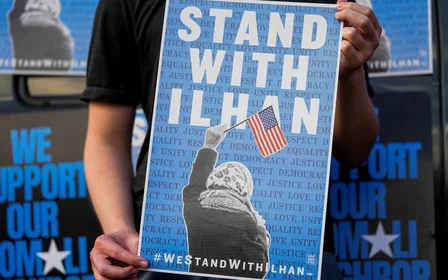
Ilhan Omar was never supposed to be an equal


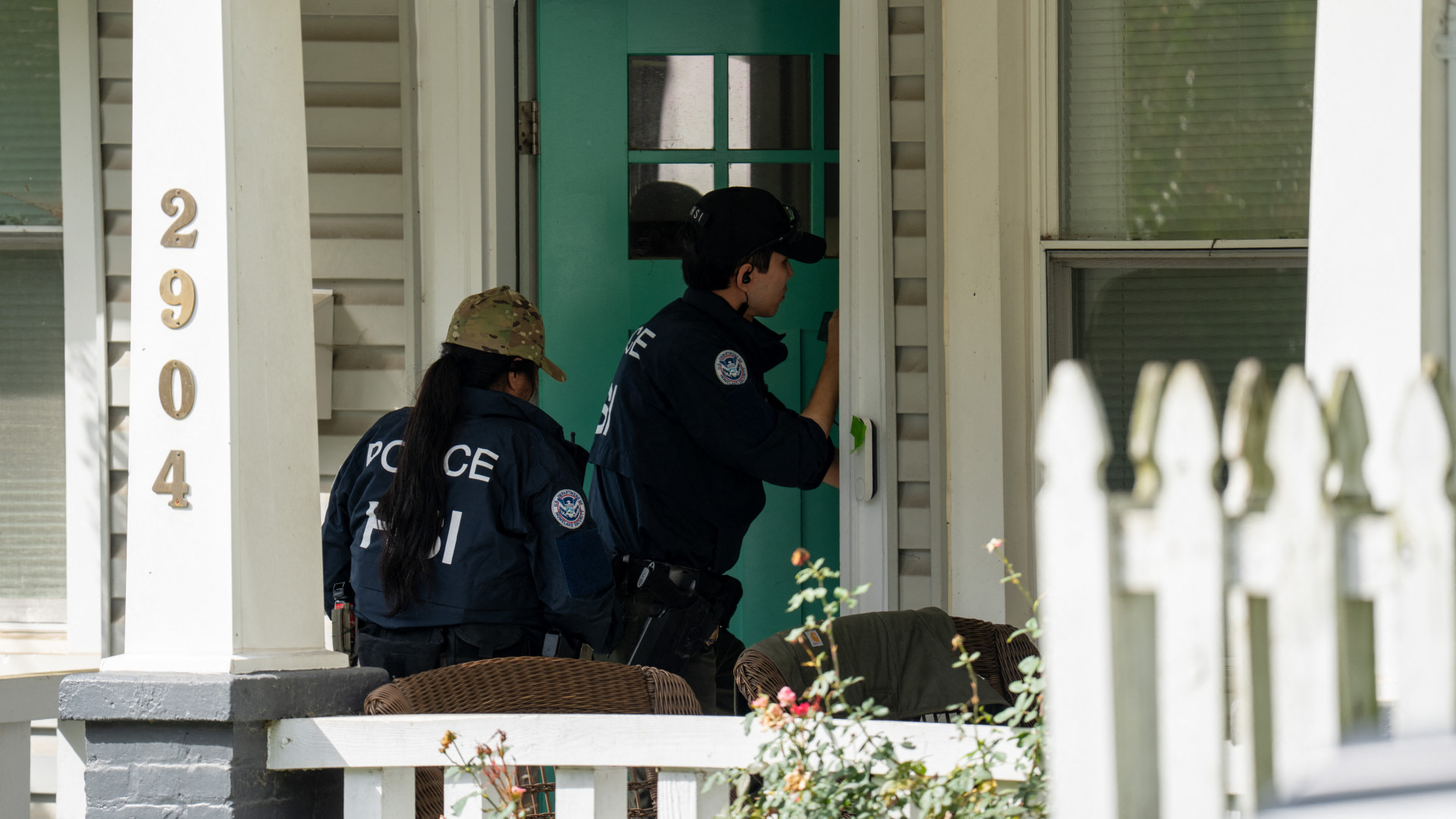
In the early hours of 12 October, US Congresswoman Ilhan Omar's home in Washington, DC, was raided by federal agents.
They spent hours combing through her belongings, Omar said, emerging with 17 items, including phones, notebooks and a Somali-language phrasebook, before leaving her residence.
It soon came out that authorities were investigating whether her family had falsified her immigration paperwork decades earlier, with the aim of stripping her of her citizenship and deporting her.
For years, the Trump administration has accused Omar of immigration fraud. No proof has ever been presented publicly, and the allegations have been characterised by innuendo. Officials who scrutinised her citizenship in 2019 found no grounds to challenge it, The Washington Post reported.
Omar has long been a lightning rod for the American right and especially for Trump, who has found in her - an immigrant Black, hijab-donning Muslim woman and a former refugee from Somalia - someone he could use to both distract from his failures and make an example of before his base.
New MEE newsletter: Jerusalem Dispatch
Sign up to get the latest insights and analysis on Israel-Palestine, alongside Turkey Unpacked and other MEE newsletters
In 2019, Omar became the first African refugee and first Somali American to enter the US House of Representatives.
From the outset, she wasn't afraid to speak her mind. Or fight back.
For those accustomed to hearing American politicians repeating Israeli talking points, her intervention became a rare and uncomfortable challenge in the halls of power
On Palestine, she forced a conversation that Washington was used to suffocating. She questioned American interventionist foreign policy, including military support for Israel.
When Israel barred her and fellow Congresswoman Rashida Tlaib from visiting in August 2019, Omar used the moment to double down on talking about the occupation.
For those accustomed to hearing American politicians repeating Israeli talking points, her intervention became a rare and uncomfortable challenge in the halls of power.
"This is the most formidable foe Israel has faced in US politics - ever. No exaggeration. She doesn't get intimidated by anyone. What a force," wrote Asad Abukhalil, a professor at California State University, in 2019.
Still, the raid on her home and her family marks a significant escalation, with potentially far-reaching consequences beyond Omar herself. For other naturalised citizens, it makes clear that even an elected official is not guaranteed to belong.
Omar the fire starter
Omar's questions about the role of the American Israel Public Affairs Committee (Aipac) in US politics, raised when others felt it too risky to do so, illustrated how quickly the establishment obfuscated when it came to Israel.
The firebrand approach cost her dearly.
She was vilified for refusing to conform to the dominant discourse on foreign policy; her viewpoints were branded "un-American", and she was also labelled antisemitic for criticising Aipac in ways that are now commonplace. More than 100 Democratic candidates in the 2026 midterm cycle have pledged to reject donations from pro-Israel groups and oppose US military aid to Israel.
Her staff recounted to Middle East Eye in 2023, after she was voted off the Foreign Affairs Committee, that while Omar's bills and resolutions struggled to find bipartisan support, there was a time when few in the Democratic Party would back her.
Omar's record also deserves scrutiny beyond right-wing attacks. Those who wanted her, along with the much-vaunted "Squad", to push the Democratic Party to the left have reason to feel aggrieved by the lack of progress.

In July 2021, she voted for a foreign operations spending bill containing $3.3bn in military aid to Israel, drawing criticism from supporters of Palestinian rights.
Despite her earlier defiance, she also became a vocal defender of Joe Biden's re-election bid. In July 2024, as Israel's genocide in Gaza continued with US support, she called him "the best president of my lifetime".
When he withdrew, she endorsed Kamala Harris, expressing hope that a Harris administration would end US support for atrocities in Gaza.
But she continued to focus on improving the lives of her constituents and remained willing to scrutinise US power. In April 2024, she voted against an aid package for Israel, citing the genocide, and she is a co-sponsor of a House resolution recognising the genocide, which has killed more than 74,000 Palestinians.
Consequences of the attack
The latest salvo against Omar is more than just an attack on a US representative and her family.
The suspicion cast on her extends to the community she comes from and is inseparable from the White House's white supremacist leanings and its deeply racist and xenophobic rhetoric, which has culminated in Immigration and Customs Enforcement (ICE) raids on immigrant communities.
Trump has been calling for her deportation since 2019, too.
Chants of "send her back" have rung out at Trump events, reminiscent of KKK rallies.
At a rally in June 2020, he said: "She would like to make the government of our country just like the country from where she came - Somalia. No government, no safety, no police, no nothing, just anarchy."
On the morning of 12 October, following the pre-dawn raid on Omar's home, Katie Miller, the spouse of Stephen Miller, Trump's deputy chief of staff for policy, shared a report of the search with a comment: "Promise made, promise kept." She later deleted the post.
Whatever the outcome of the investigation, its consequences are already tangible. Omar says she must now move out of her home because the publicity surrounding the search has made it unsafe amid death threats.
Omar represents Minnesota's fifth congressional district, a diverse Minneapolis community. The state of Minnesota is home to the largest Somali community in the US and among the largest outside the African continent.
While some arrived as refugees from Somalia in the 1990s, as it was torn apart by civil war, almost 58 percent of the Somalis in Minnesota were born in the US. Of those born outside the US, around 87 percent are naturalised US citizens.
Trump has periodically looked to demonise the community, calling Somali Americans "garbage" and nonchalantly characterising the community as fraudsters and accusing it of having "destroyed" the country.
Somalia featured in Trump's first-term travel ban and remains in his renewed ban, while his administration has also ended Temporary Protected Status for Somalis covered by the programme.
The relentless barrage of negative commentary and derogatory characterisations has left the Somali community on edge.
No equal treatment
To consider the attack as exclusively directed at Somalis would be a mistake. The consequences extend far beyond one community.
Amid widespread economic discontent, an unpopular war with Iran and Trump's low approval ratings, the attack on Omar fits into an old and trusted template: blame the "other".
The timing raises further questions about the investigation's purpose. For a matter raised since 2019, no reason has been offered for the raid just weeks before the midterm elections.
For those who keep on insisting that entering the House or the Senate is how the marginalised find representation and how bigotry is nullified, Omar's experience shows the limits of making it to political office in the US.
She could represent Americans in one of the highest offices in the land, win elections, and yet continue to be treated as an outsider if she looked and dressed differently and brought a perspective that challenged some of the key assumptions of white supremacist America.
Humiliation was the point. It was to remind her that America had granted her a favour. She was supposed to be eternally grateful.
When I reported on her rise in 2019, Habon Abdulle, Omar's mentor and someone who encouraged her to run for office, spoke about the congresswoman's expectation of equal treatment.
"Ultimately, she believes she is equal to everybody. Some people can't and will never accept that."
Seven years later, little seems to have changed.
The views expressed in this article belong to the author and do not necessarily reflect the editorial policy of Middle East Eye.
Middle East Eye delivers independent and unrivalled coverage and analysis of the Middle East, North Africa and beyond. To learn more about republishing this content and the associated fees, please fill out this form. More about MEE can be found here.