Worship in Jerusalem has been overshadowed by oppression and fear

My friend and I were standing near Damascus Gate, observing how empty the Old City of Jerusalem was during the last stretch of Ramadan, when we noticed that we had become surrounded by more than a dozen fully armed Israeli police officers.
In a climate designed to intimidate, my friend proposed that we leave for the sake of our safety. As we walked away, we acknowledged the new status quo enforced by Israel: a general atmosphere of looming fear, more entrenched than ever before.
For the rest of the night, we walked the streets of Jerusalem, discussing how much our city has changed over the past few years. From a city that would normally be filled with worshippers going to pray, it is now heavily militarised.
Our minds wandered back a decade to when Jerusalemites flooded the streets to protest Israel’s installation of security barriers at Al-Aqsa Mosque complex, rejecting any sort of Israeli control over our religious sites. Today, such scenes would be met with brutal military repression and vindictive repercussions.
As we continued to walk, we saw Israeli forces randomly stopping young Palestinian men and subjecting them to degrading physical searches, unwarranted and unjustified - a provocative practice that has now been normalised in Jerusalem.
New MEE newsletter: Jerusalem Dispatch
Sign up to get the latest insights and analysis on Israel-Palestine, alongside Turkey Unpacked and other MEE newsletters
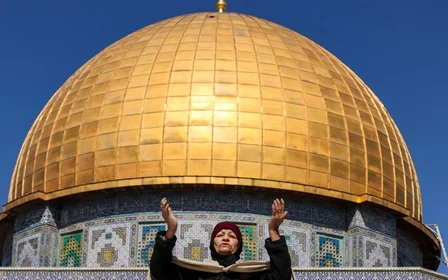
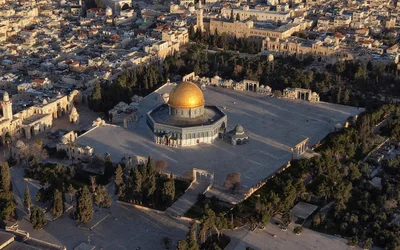
During my visit to the Old City, I was only able to enter Al-Aqsa Mosque once. Even then, most gates were closed by Israeli authorities, with a designated route drawn through metal barriers and an intensified police presence.
Ever since the war on Iran started, Al-Aqsa Mosque complex has been locked down, with Israeli authorities citing concerns for the safety of worshippers. The irony is all too apparent amid more than two years of genocide in Gaza and myriad oppressive policies targeting all Palestinians across the occupied territories, enacted by Israeli authorities and settlers, often in collaboration.
Entrenching control
It seems clear that Israel is using the war on Iran as a thinly veiled excuse to expand its control over religious sites in Jerusalem and the rest of the occupied Palestinian territories.
This is especially apparent given the context of other measures taken against such sites in recent days, including Israel’s decision to revoke the Hebron municipality’s planning and construction authority over the Ibrahimi Mosque, and instead transferring these powers to Israeli entities.
Many of the recent conversations I’ve had with friends and family in Jerusalem have revolved around the lack of any future prospects in Palestine, considering the tightening grip of Israel’s occupation. Wherever you look, the deteriorating reality glares back at you, breaking your soul again and again.
I don't know if there's a level of language mastery that would enable me to truly express what it is like to be Palestinian
My friend, a Said Foundation alumni, noted how out of touch scholarship applications can be, asking Palestinians to describe our five- or seven-year plans. Whether we have a home, or are even still alive, remain our primary day-to-day questions.
I complained to another friend about the long and humiliating queues at checkpoints, after having spent nine hours total on two separate occasions commuting from Jerusalem to Ramallah in one week. As I explained how degrading it felt, she told me: “They want to make us angry; they want us to lose our minds, and because you do not want to give them what they want, you cannot allow it to get to you.”
I rarely speak about my own lived experiences as a Palestinian, despite the fact that I’ve worked on Palestine-related matters for the past 10 years. In a sense, I’ve always considered myself to be a bit more privileged, having lived a less difficult life as a Jerusalemite.
In reality, this feeling has been manufactured by an occupation that has successfully fragmented the lived realities of Palestinians on the basis of their geographical location - a crucial tool of apartheid. This results in a fake sense of privilege for being “less” subjugated.
Decades of impunity
In moments like these, it overwhelms me just how much we’ve normalised less brutal forms of repression under the facade of “privilege”. In a city where you are constantly in direct contact with your occupier, your continued existence becomes your sole means of resistance.
The current situation in the occupied Palestinian territories puts the international community at a critical crossroads. Israel’s utter disregard for international law is a direct result of the continued inaction of the global community.
Decades of impunity granted to the Israeli state can no longer be addressed with empty condemnations.
If the world has any real interest in safeguarding the international rules-based order, then states must undertake much stronger economic and diplomatic sanctions. Otherwise, the repercussions for the entire world will be irreversible.
In his book 1984, George Orwell described his protagonist Winston’s thoughts on a seemingly bleak life, and the feelings of discontent and alienation that arise in a dystopian society.
“He meditated resentfully on the physical texture of life. Had it always been like this? … Always in your stomach and in your skin, there was a sort of protest, a feeling that you had been cheated of something that you had a right to,” Orwell wrote.
“It was true that he had no memories of anything greatly different … Why should one feel it to be intolerable unless one had some kind of ancestral memory that things had once been different?”
I don’t know if there’s a level of language mastery that would enable me to truly express what it is like to be Palestinian. I speak both English and Arabic fluently, and all the words that exist cannot even begin to describe the life we’ve been cheated out of living and knowing. Always, in every fibre of one’s existence, there’s a feeling of protest - always completely justified.
The views expressed in this article belong to the author and do not necessarily reflect the editorial policy of Middle East Eye.
Middle East Eye delivers independent and unrivalled coverage and analysis of the Middle East, North Africa and beyond. To learn more about republishing this content and the associated fees, please fill out this form. More about MEE can be found here.