John Esposito taught the West to see Islam on its own terms


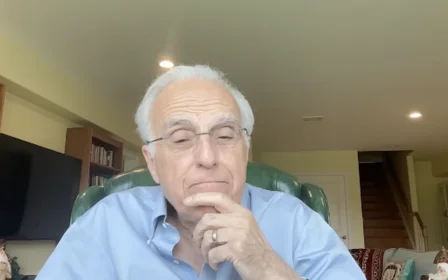
On 15 July, Jean Esposito informed our team at the Prince Alwaleed bin Talal Center for Muslim-Christian Understanding (ACMCU) at Georgetown University that her husband, John, had died.
He was 86, and died in Philadelphia from complications following heart surgery.
Born in Brooklyn in 1940, John Esposito was a scholar of Middle Eastern and religious studies, and distinguished university professor emeritus of religion and international affairs and of Islamic studies at Georgetown's Edmund A. Walsh School of Foreign Service.
He was the founding director of ACMCU and of The Bridge Initiative on Protecting Pluralism and Ending Islamophobia, where I have had the privilege of working at his side since 2017.
Our team at ACMCU and The Bridge Initiative was devastated to hear the news. Most of us had seen him only in May this year, at our annual gathering on the Georgetown campus in Washington.
New MEE newsletter: Jerusalem Dispatch
Sign up to get the latest insights and analysis on Israel-Palestine, alongside Turkey Unpacked and other MEE newsletters
Writing these lines, I ask myself what one should even write about a man so influential that no single page could ever hold the legacy he has left.
He published 55 books, mainly with Oxford University Press, leaving aside the numerous articles, op-eds, testimonies and countless other contributions.
At the time of his death, he was working on his memoir, tracing the moments that left a mark, from academia to international relations.
Mentor to many
I first met him more than 10 years ago, when I took a pile of his books to a lecture he was giving and asked him to sign them. My own mentor in Austria, at the University of Salzburg, had used his taped lectures while teaching in Pennsylvania.
I came to know him properly in 2014, when I invited him to give a keynote at an International Islamophobia Studies Conference.
I have met hundreds of journalists, officials, politicians and academics who had all at one point in their lives learned from him
We stayed in touch after that, and he later recruited me to The Bridge Initiative. He became a mentor and a friend.
Since then, I have met hundreds of journalists, officials, politicians and academics who had all at one point in their lives learned from him.
The International Herald Tribune once rightly called him the "most influential Islamic scholar in the US". The many awards he received throughout his career attest to his standing.
He was the only scholar to have been elected president of both the Middle East Studies Association and the American Academy of Religion.
Beyond his academic contributions, he advised the US State Department and governments across Europe and Asia.
Truth and courage
Apart from his impact on institutions and his own institution-building - shaping not only the study of Islam and politics in the late 1970s, but the emerging field of Islamophobia studies in the early 2000s - John was a man of truth and courage.
His email signature carried a line from Archbishop Desmond Tutu: "It is my conviction that if we are neutral in situations of injustice, we have chosen the side of the oppressor... The world must learn about respect, listening and forgiveness."
A second was from Anais Nin: "Life shrinks or expands in proportion to one's courage." These were not merely words he liked to share. They were principles he embodied, as a man of faith and of courage.
John signed thousands of petitions and statements calling for the release of political dissidents and fellow scholars, from the Arab world to the heart of Europe, and in defence of free speech. He donated to those causes.
He was a committed Catholic who held Islam and its civilisation in great respect, as he did other religions.
John was a decent human being, moved by faith and courage.
And perhaps more important still, going far beyond his contributions to academia and to public life: his love for Jean, his wife and lifelong partner, was admirable. He spoke of her with affection in almost every conversation we shared.
He would take the time to send an email or text of encouragement at the most random of moments - but always at the right moment.
But most importantly, he was the very essence of the intellectual. As Noam Chomsky wrote, "it is the responsibility of intellectuals to speak the truth". And that captures perfectly who John Esposito was.
I, like many others, have been shaped by his work, and would not be where I am had he not paved the way in redefining the study of the Middle East and of Islam and politics. We are indebted to you.
The views expressed in this article belong to the author and do not necessarily reflect the editorial policy of Middle East Eye.
Middle East Eye delivers independent and unrivalled coverage and analysis of the Middle East, North Africa and beyond. To learn more about republishing this content and the associated fees, please fill out this form. More about MEE can be found here.