UK must reject attempts to derail an Israeli settlement trade ban


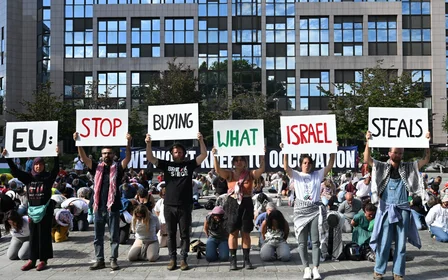
There are mounting rumours that the UK government is planning to introduce a ban on trade with illegal Israeli settlements.
Such a ban has been a core demand of the Palestine solidarity movement for many years, as a key basic step towards ending UK complicity with Israel’s violations of international law.
That it is now close to achievement is a product of two factors. The first is the increasing untenability of the position adopted by successive UK governments, which have treated Israel as a democratic ally to be shielded from accountability, while sustaining rhetorical support for Palestinian self-determination.
The hypocrisy of this position, maintained even as Israel’s military occupation and apartheid descended into full-blown genocide, is collapsing under the weight of the increasingly brazen Netanyahu government, whose “Greater Israel” project aims to cement Jewish supremacy and remove any possibility of a Palestinian state.
As it undertook the genocidal destruction of Gaza, Israel simultaneously accelerated settlement expansion in the occupied West Bank, while retroactively legalising settlement outposts, demolishing more Palestinian homes, and facilitating an epidemic of settler violence.
New MEE newsletter: Jerusalem Dispatch
Sign up to get the latest insights and analysis on Israel-Palestine, alongside Turkey Unpacked and other MEE newsletters
The government’s plan to lift a two-decade freeze on the building of settlements in the E1 zone - which would effectively cut off the West Bank from East Jerusalem - finally triggered UK Foreign Secretary Ed Miliband to announce a series of “comprehensive” measures in response.
The second factor is the recognition by incoming Prime Minister Andy Burnham that the sustained complicity of his predecessor, Keir Starmer, in Israeli violations of Palestinian rights - even amid a genocide - was a key reason for Labour’s declining public support.
It is an acknowledgment that winning back voters requires going beyond Burnham’s weak apology for Starmer’s early endorsement of Israel’s genocidal assault on Gaza and failure to back a ceasefire.
Flawed arguments
The question now is whether Miliband’s statement will ultimately lead to a full ban on all illegal trade with Israeli settlements. This will demand willpower, previously lacking on the part of any UK government, to withstand the pressure coming from the Israeli government and its allies.
Israel has already threatened a punitive response to any trade ban, which could include the expulsion of British diplomats, while the usual cast of pro-Israel groups and individuals in the UK are rolling out familiar arguments in an attempt to prevent any meaningful sanctions. Their core argument rests on the shameful allegation that such a step would constitute a hostile act against British Jews, thus falsely conflating a measure to hold Israel accountable with hatred of the Jewish people.
Other arguments similarly fail to withstand serious scrutiny. One is the suggestion that settler violence, while worthy of condemnation, should be understood as the behaviour of a few fringe extremists.
Half of Britons support banning the trade of goods and services linked to illegal Israeli settlements - a tribute to the strength of the solidarity movement
This ignores both the scale of the current violence - the UN reported in June on a campaign of “systematic abuse” of Palestinians by Israeli settlers - and the fact that attacks are often carried out in the presence of Israeli troops, who fail to intervene.
In one recent shocking case, which captured international attention because it involved a family of Palestinian Americans, Israeli soldiers were filmed praying alongside settlers laying siege to Palestinian homes, where they cut off electricity and water supplies.
In addition, members of Prime Minister Benjamin Netanyahu’s government actively support these actions by settlers. Finance Minister Bezalel Smotrich, who oversees administration of the occupied West Bank, in 2023 notoriously praised a settler pogrom in Huwara, saying the village should be “wiped out”.
What in any other state would be regarded as extremist and racist positions, are endemic across the political mainstream in Israel. This fact undermines a further argument, notably employed by Labour Friends of Israel, that a settlement trade ban could harm moderate candidates in the forthcoming Israeli election.
The reality is that the only opposition leaders with a realistic chance of victory, Gadi Eisenkot or Naftali Bennett, are both on record denying the Palestinian right to self-determination. The issue at stake in the election is not whether Israel’s occupation, annexation and settlement expansion will continue, but to what degree.
Seismic moment
A final argument speaks to the fear that a ban on settlement trade would inevitably morph into a full boycott on all trade with Israel, for two reasons: firstly, the extent to which settlements are heavily intertwined with the broader Israeli economy. Secondly, this argument suggests that removing the taboo on significant material sanctions could fuel further boycotts.
This rests on the fact that the UK government, while actively considering significant action on settlements, remains opposed to a full boycott of Israel - a position motivated by the false narrative that Israel’s oppression of the Palestinian people is only an issue of concern in relation to the territories occupied in 1967.
The reality, however, is that Israel’s military occupation is just one aspect of a wider system of racist domination and apartheid, which extends across all of historic Palestine, including to Palestinian citizens of Israel. This is why the Palestinian civil society movement has long demanded a full programme of boycott, divestment and sanctions, until the apartheid structure is entirely dismantled.
A ban on settlement trade would thus be a seismic moment. It would also reflect the UK’s minimum responsibility in accordance with the International Court of Justice’s advisory opinion of July 2024, which affirmed the illegality of the Israeli occupation and called for an end to all support by third-party states.
Those who attempt to tie British Jews to a position of support for Israel’s violations of international law, while urging the UK to continue its complicity in the dispossession of Palestinians, are not just displaying a lack of morality. They are also clearly out of kilter with public opinion.
Recent opinion polls show half of Britons support banning the trade of goods and services linked to illegal Israeli settlements - a tribute to the strength of the solidarity movement in advancing the demands of the Palestinian people.
If the British government does indeed resist the counter-pressure being mounted by those lobbying for Israel, and the Rubicon is crossed, the task will then be to sustain pressure until the UK ends all of its complicity with Israeli apartheid. This would require a full implementation of boycott, divestment and sanctions.
The views expressed in this article belong to the author and do not necessarily reflect the editorial policy of Middle East Eye.
Middle East Eye delivers independent and unrivalled coverage and analysis of the Middle East, North Africa and beyond. To learn more about republishing this content and the associated fees, please fill out this form. More about MEE can be found here.