Another East Jerusalem neighbourhood is demolished as the world fails to act

Down a track and past a pile of debris, 20 or so well-dressed people are waiting, all diplomats. I am joining them on a trip around al-Bustan, a Palestinian neighbourhood in occupied East Jerusalem that has been scheduled for demolition.
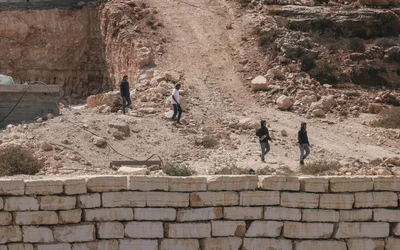
Many homes have been destroyed already. Bustan (“the Orchard”) is to be turned into a car park and recreation ground for settlers - but not for Palestinian residents, who will by then be absent.
We stumble past the ruins of what used to be a house. In the garden is a caravan, where we are met by the owner, Fakhri Abu Diab. His wife Ameena, mother of their five children, stands nearby.
“They arrived at three in the morning, armed soldiers with black masks putting a gun to my head,” Fakhri recalls of a recent visit. “They took me to interrogation.”
On another occasion, they broke Ameena’s glasses. Terrified, she “clenched her jaw so hard that she broke her teeth”.
New MEE newsletter: Jerusalem Dispatch
Sign up to get the latest insights and analysis on Israel-Palestine, alongside Turkey Unpacked and other MEE newsletters
The diplomats shuffle their feet. Fakhri and Ameena, now in their sixties, have lived in Bustan all their lives. Fakhri is chairman of the local residents’ committee, but he won’t be a resident much longer.
Their temporary home is scheduled for demolition within 21 days of 4 October, when a new demolition order was pasted on his gate. They don’t know where to go next.
“Whenever I hear bulldozers or any machinery, my automatic reaction is that they are coming for us,” Fakhri tells Middle East Eye.
Reshaping demography
Suitcases stand packed just outside the door. Fakhri explains that bulldozers sometimes arrive without notice, and often leave no time to gather belongings.
The Jerusalem municipality gives Palestinians the opportunity to “self-demolish”. Fakhri warns that “if you don’t do that, the municipality does it for you and sends you the bill”.
Fakhri says he paid 43,000 shekels ($13,800) when they destroyed his home.
A couple of the diplomats examine their mobile phones.
'We are not allowed to have an identity or a state. We wish for action, not just words'
- Fakhri Abu Diab
Some 1,500 Palestinians lived in Bustan, located at the bottom of a valley half a mile southwest of Al-Aqsa Mosque. It is being destroyed as part of a massive project to reshape the demography of occupied East Jerusalem.
According to a statement from the Israeli human rights group B’Tselem, these demolitions are “a clear manifestation of an Israeli policy aimed at engineering the demographic balance and ‘Judaizing’ the neighborhood by exploiting discriminatory laws”.
The group adds: “These measures are designed to expand Israeli presence and control over one of the most politically and religiously sensitive areas in the region, serving as a crucial component of the broader ethnic cleansing currently unfolding across the West Bank.”
Fakhri, meanwhile, makes a despairing plea to the diplomats: “We ask the world to pressure Israel not to demolish our remaining homes. We have the right to live peacefully and securely in our homes. The international community is allowing Israel to be above international law. Why are you afraid of Israel even when it’s acting against international law?”
He says his house was demolished on Valentine’s Day 2024, one month after Andrew Miller, then the US deputy assistant secretary of state for Israeli-Palestinian affairs, had made an official visit to his home in Bustan.
“Why meet diplomats when our homes get demolished afterwards?” Fakhri asks.
Sleeping in cars
Fakhri says he has also been visited by three delegates from countries that manufacture the bulldozers used to destroy Palestinian houses. “These tools were made to advance civilisation, not to demolish civilisation,” he says.
Not many diplomats are taking notes. Most are from Europe; some appear bored, but a Swiss delegate seems genuinely interested.
“What can you do to help?” pleads Fakhri. “We have lost hope. We would like to see help from the international community. We are not allowed to have an identity or a state. We wish for action, not just words.”
He adds a note of warning: “We do not know how the young men will react.”
There are no British diplomats present, Israel having evicted most of them from the British consulate the previous week in reprisal for Britain decision to sanction West Bank settlements.
This change of policy has come too late to rescue Al-Bustan and does not apply here in any case.
It’s the Jerusalem municipality and Israeli government, not Israeli settler terrorism, which is ethnically cleansing Palestinians from East Jerusalem neighbourhoods.
Palestinians are still totally abandoned even after the euphoria of a British shift in policy
The Israeli non-profit organisation Ir Amim shows in a devastating report published yesterday, "Expulsion: The State Architecture of Dispossession", that virtually all Israeli governmental bodies are involved in forcibly displacing East Jerusalemites.
In other words, Palestinians are still totally abandoned even after the euphoria of a British shift in policy.
Fakhri leads us out and past the wreckage of what used to be his home. On our right is a playground, also marked for destruction. On the left is a football pitch. Ditto.
Everything will be destroyed: property, public amenities, communities, families, lives, hope.
I ask Fakhri where people will go. “We don’t know. Some are now sleeping in cars.”
We climb some steps into the living room of another house. It belongs to Imad Badran, a 56-year-old blind man, who is challenging his demolition order in court.
“I am disabled,” he says. “I live with my wife who is also disabled, and our son whose house has already been demolished. In my situation, as a blind man, how do I look for a home? Even if there was a place to go, how could I afford the 6-7,000 shekels a month?
“There is no need for these demolitions,” he adds. “If they are carried out, I will be left on the street.”
Pleas ignored
Badran says he explained all this to a worker from the Jerusalem municipality, who replied: “That’s not my problem.”
One of the diplomats spoke: “It’s important to hear your voice and your words.”
Our next stop was to visit an elderly lady whose house had been demolished last month - but when we arrived, she wasn’t there. It was explained that she’d been waiting for us outside.
It was the first time she’d been back to her former home, and her son texted Fakhri to say she found it too upsetting, couldn’t bear to speak, and had already left.
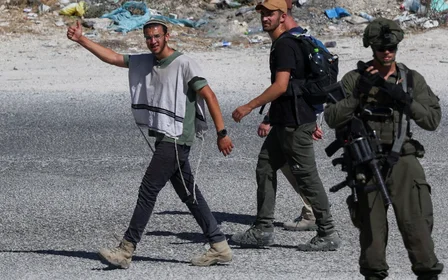
The world’s attention is focused on the wave of settler pogroms across the occupied West Bank. A few days after our visit, a convoy carrying European diplomats was surrounded and pelted with stones by settlers.
These dispossessions are happening all over occupied East Jerusalem, and are part of the same programme of ethnic cleansing.
Fakhri later told MEE that many famous names have come to Bustan to hear his story: former US President Jimmy Carter, former Irish President Mary Robinson, former US special representative for Palestinian affairs Hady Amr, and the UN undersecretary for humanitarian affairs, Tom Fletcher. Navi Pillay, the South African jurist who was recently awarded the Nobel Peace Prize, has also visited.
All listened and witnessed, to no effect. If the Jerusalem municipality has its way, Bustan - until recently a flourishing Palestinian community - will soon become a car park.
The views expressed in this article belong to the author and do not necessarily reflect the editorial policy of Middle East Eye.
Middle East Eye delivers independent and unrivalled coverage and analysis of the Middle East, North Africa and beyond. To learn more about republishing this content and the associated fees, please fill out this form. More about MEE can be found here.