Why Britain must finally compensate the families of Egypt's World War One labourers


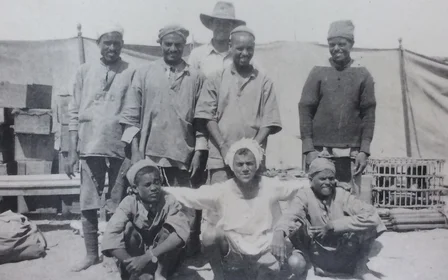
During World War One, the British Empire won campaigns on the backs of Egyptian workers in the Egyptian Labour Corps (ELC).
After British forces entered Jerusalem in December 1917, General Archibald Murray wrote: "The Palestine campaign could not have achieved its glorious consummation without the ELC."
Recruited in the hundreds of thousands from the Nile Valley, often by force, Egyptian workers laid the railways and water pipelines that enabled British troops to move across an inhospitable desert. Yet more than a century later, the families of those labourers have received no meaningful acknowledgment - let alone compensation - for the risks their forebears were compelled to undertake.
When my book The Egyptian Labor Corps was translated into Arabic in 2023, I learned that the grandfather of the translator, Dr Shukry Megahed, was a veteran of this body of labourers. He lived his whole life with a bullet lodged in his shoulder and missing an eye because of the injuries he sustained while working in the First World War. I was proud to contribute to Dr Megahed learning more about his family history.
As Aaron Jakes has shown, British administrators ran the wages of the ELC through a "suspense account" - bureaucratic language for costs that Britain should have paid but instead parked with the Egyptian government and then pressed Cairo to forgive.
New MEE newsletter: Jerusalem Dispatch
Sign up to get the latest insights and analysis on Israel-Palestine, alongside Turkey Unpacked and other MEE newsletters
In effect, Egyptians funded Britain's war effort, rather than the British themselves. "Egyptian taxpayers were lending Britain the costs of their own labour," Jakes writes, capturing the fiscal sleight of hand and the colonial arrogance.
This is not mere scholarly theory. When London dispatched Lord Milner's mission to take the temperature of Egyptian public opinion in 1919, the British government acknowledged that the Egyptian Council of Ministers had "written off the suspense account" under which Egypt "would have been entitled to reclaim advances of three million sterling".
The Milner mission's files preserve this admission in black and white. Egypt - a country declared a British protectorate in 1914 - effectively forgave a £3m wartime claim that belonged squarely on Britain's ledger. Who was protecting whom?
That £3m helped pay for a sophisticated labour network that stretched across rural villages in the Nile Valley to the hills of Palestine and beyond. Between 1917 and 1921, the ELC always maintained more than 100,000 workers on temporary contracts. According to conservative British estimates, Egyptian participation between March 1917 and June 1918 exceeded 325,000 men.
Apology delivered in Cairo, in Arabic
The human cost to Egyptians was unfathomable. Labourers died by the tens of thousands from enemy shelling and disease. They were beaten for resisting conscription and their absence strained households already navigating wartime price shocks. The exact numbers of injuries and deaths among the ELC have never been fully counted, which reflects not their triviality, but the colonial state's priorities.
The financial story told by Jakes is more easily quantifiable. Using a standard UK CPI-based inflation calculator, the cumulative change in prices between 1917 and 2026 is roughly 88.7-fold. On that basis, £3m in 1917 is equivalent to about £270m ($360m) in today's money. This gives us a defensible baseline for a reparations fund - one explicitly tied to the known wartime transfer and its subsequent write-off.
A figure near £270m is, in truth, modest. It reflects only the documented suspense-account forgiveness that Milner's papers record, not the broader universe of uncompensated losses or coerced labour.
It does not include interest on the foregone claim. It does not account for the opportunity costs borne by households and villages emptied of working-age men, nor does it reckon with the ripple effects of injury, disability and premature death. Still, as a starting point pegged to the archival record and to conservative inflation assumptions, it is both supportable and overdue.
What would a just programme look like?
First, the British government should establish an ELC reparations trust capitalised at £270m, indexed to inflation until disbursement. The fund's size represents an amount that even British officials recognised as belonging to Egypt. Anchoring the programme in this acknowledged transfer meets a reasonable evidentiary standard and preempts the cynical objection that "no one can know what is owed".
Second, eligibility must prioritise lineal descendants of ELC workers and of men recruited into associated transport units, like Shokry Megahed. Documentation would draw on surviving Egyptian administrative lists, British military payrolls and local village registers where available, supplemented by sworn affidavits overseen by independent historians and community organisations.
Where names are missing - as is too often the case in colonial records - the programme should allow for credible community attestations. The British state's failure to keep careful tallies cannot become a pretext to exclude those it failed to count.
Third, disbursement should combine individual grants with community investments in the governorates most affected by wartime recruitment (notably in the Delta and middle Egypt). Individual grants would recognise the intergenerational harms borne by families. Community investments - in public health, archival preservation and local development - would acknowledge that extraction was collective and so too should be repair.
Fourth, the UK should accompany payment with an official apology for the coercive recruitment practices used in Egypt and for the fiscal manoeuvres that shifted costs from the imperial centre to the colonial periphery. This apology should be delivered in Cairo, in Arabic, with the names of ELC companies and known casualties read aloud and deposited in both British and Egyptian national archives.
Time to pay what is owed
Britain has precedent for such redress. When Julian Putkowski and Julian Sykes published Shot at Dawn in 1992, they forced a reckoning with one of the darkest legacies of the Great War: the execution of hundreds of British and colonial soldiers for desertion, cowardice and other offences now recognised as the tragic by-products of shell shock and trauma.
The book ignited decades of public campaigning that culminated, in 2006, in the UK parliament's decision to grant posthumous pardons to all soldiers shot by field general court martial. That legislative act - belated as it was - demonstrated that Britain can revisit the injustices of its imperial and military past when confronted with persuasive historical evidence and a moral case, even generations later.
That legislative act - belated as it was - demonstrated that Britain can revisit the injustices of its imperial and military past when confronted with persuasive historical evidence
The same spirit should now extend beyond the Western Front. Some have already been advocating for this for years. Baroness Bennett has been diligently asking questions of the government about commemoration and documentation.
The Commonwealth War Graves Commission, under the leadership of George Hay, has been working to find the names of those previously not commemorated and map burial sites. To date, almost 7,000 names have been recovered thanks to research by pathbreaking historians such as Michele Barrett.
But there is more that needs to be done.
More than 2,200 dead of the Egyptian Labour Corps are buried under Commonwealth headstones, from Port Said to Arras. But perhaps 10,000 more lie in unmarked graves, from Rafah to the villages to which some staggered home.
Their descendants do not ask for mere acknowledgment. It is time to pay what is owed.
The views expressed in this article belong to the author and do not necessarily reflect the editorial policy of Middle East Eye.
Middle East Eye delivers independent and unrivalled coverage and analysis of the Middle East, North Africa and beyond. To learn more about republishing this content and the associated fees, please fill out this form. More about MEE can be found here.