Why is Cair urging US Muslims to seek security from DHS?


Applications for this year's round of security grants from the US Department of Homeland Security (DHS) closed on 24 July - and the Council on American-Islamic Relations (Cair) had been urging mosques, Islamic schools and Muslim nonprofits to apply before the deadline.
Since May's mosque shooting in San Diego, which killed three people, Cair has aggressively pursued renewed Muslim community access to this source of government funding, presenting it as a means of protecting mosques from such violence.
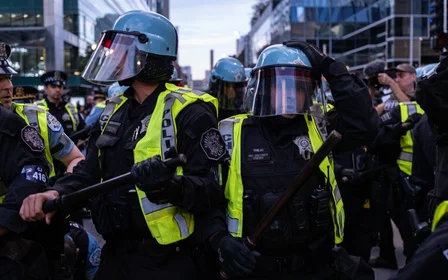
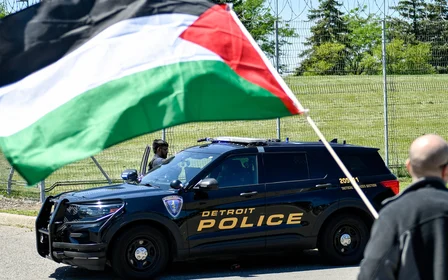
Cair has since also encouraged Muslims to build closer ties with the police - reviving a debate over policing that reflects a growing divide within the community, between those eager to collaborate with "law enforcement" and those who view it as an arm of an unjust social order.
Cair has long walked an ambivalent line on this issue. As a self-described civil rights and advocacy nonprofit with nearly 30 chapters, it positions itself as Muslims' primary defence against "overly-broad" policing.
Yet, at the same time, it has spent decades encouraging Muslims to "build bridges" with the very police agencies whose practices it claims to challenge.
New MEE newsletter: Jerusalem Dispatch
Sign up to get the latest insights and analysis on Israel-Palestine, alongside Turkey Unpacked and other MEE newsletters
Cair's encouragement suggests that Muslims and "law enforcement" are two groups separated by unfamiliarity or misunderstanding. However, the history between them is not one of insufficient contact.
Muslims have come to know local and federal police agencies all too well through a history of hostile encounters: decades of FBI door knocks, entrapment cases, raids of Palestine encampments that local police have turned into prosecutions of Muslim students, harassment outside Zionist land sales and relentless attempts to conscript Muslims into disciplining their own communities.
Though spread unevenly, suspicion towards "law enforcement" has long existed among Muslims in the United States. Such sentiments became more visible in 2020, during the nationwide demonstrations following the police murder of George Floyd. And they have only become more pronounced since Israel's genocidal war in Palestine.
Indeed, when any meaningful resistance to US foreign policy is met with police violence, it becomes difficult to ignore the link between occupation abroad and state repression at home. Despite this growing political consciousness among Muslims, Cair remains committed to strengthening Muslim cooperation with "law enforcement".
'Best practices'
In the aftermath of the shooting at the Islamic Center of San Diego, numerous Cair branches disseminated the national office's "Best Practices for Mosque and Community Safety", a booklet aimed at leaders and everyday congregants. Its recommendations take as given that Muslims embracing "law enforcement" will protect mosques from violence and desecration.
Best practices listed in the document thus include informing local police of mosques' daily schedules, inviting police to mosques for meetings and offering police training in cultural competency.
Recommendations also extend beyond local "law enforcement". The booklet stresses: "Attempt to establish liaison with state and federal agencies in the same manner as you did with the local police. Local police may be able to facilitate this effort."
Cair's best practices appear less concerned with Muslim defence than with having Muslims project respectability
It also reminds congregations unable to afford private inspections of their security protocols that police departments can offer such assessments, as can specialists from DHS.
Most bizarre is the booklet's jumble of non-evidence-based suggestions for deterring anti-Muslim violence. For example, it urges mosques to "acknowledge good work by individual police officers" and other local officials through "complimentary letters, phone calls, tweets, social media postings, annual award events, and the like".
It also recommends that mosque leaders "be personally acquainted and friendly with the officer who is regularly assigned to [the mosque's] area".
Though presented as guidance on "safeguarding" Islamic institutions, Cair's best practices appear less concerned with Muslim defence than with having Muslims project respectability.
"The government exploits the Muslim community's perceived desire to fit in," insisted Terry Albury, an FBI agent-turned-whistleblower. Albury, who served a prison sentence for leaking government documents, underscored that authorities are not kept at bay by Muslims presenting as model citizens.
He emphasised: "[FBI] sources are often willing volunteers who offer their services to the FBI in return for a favour... There are, however, situations in which a member of the community is led to believe they are doing their civic duty. An agent will often carefully cultivate this relationship in such a fashion that the person never views him or herself as a source and is simply being a 'good Muslim'."
Despite "law enforcement" capitalising on some Muslims' need to be viewed favourably, Cair's booklet implies that deference and gratitude towards police can help protect places of worship. Histories of Muslim criminalisation, however, have demonstrated the opposite - that welcoming police to the mosque funnels Muslims into government crosshairs.
Many Muslims who keep their guard up around the FBI still regard the local precinct as something separate and safer. The architecture of US policing, however, does not honour that distinction.
Follow Middle East Eye's live coverage of Israel's genocide in Gaza
Through multi-agency partnerships such as Joint Terrorism Task Forces, created to streamline communication between local and federal agencies, a Pizza with a Cop event at the local mosque can easily become a venue for data collection and community mapping.
For more than a decade after 9/11, the New York Police Department's Demographics Unit did just that, mapping Muslim neighbourhoods and cataloguing mosques, restaurants and student associations in a surveillance programme run with CIA assistance.
"The government uses community outreach and the pretext of liaison for intelligence gathering... I would know because I employed these tactics with the FBI in both the San Francisco Bay Area and Twin Cities of Minnesota for many years," Albury warned.
Cair's "Best Practices" booklet is littered with advice that many civil rights advocates would find alarming. Similarly concerning are Cair's changing recommendations on DHS's Nonprofit Security Grant Program (NSGP), an initiative administered by the Federal Emergency Management Agency (Fema).
A transaction
Muslim access to the NSGP has been a major priority for Cair since the San Diego mosque shooting.
Funds from the NSGP are to enhance the physical security of nonprofits deemed "at risk of terrorist attack". Thus, money obtained through the programme could help a mosque with deteriorating facilities appear more like a military installation or sports stadium, with leaky pipes concealed behind DHS-approved blast-resistant trash cans.
As a DHS programme, the NSGP is not a neutral means of protecting religious minorities, but part of the War on Terror's environment of information-sharing, in which federal agencies, local authorities and, ideally, "community partners" work in tandem. Developing the infrastructure for such interactions has arguably been DHS's key purpose.
Communities are being told that the "threat" in question is the Islamophobic attacker outside the mosque door, but the programme's own paperwork belies that messaging. In it, the mosque is not only the protected party but an object of suspicion.
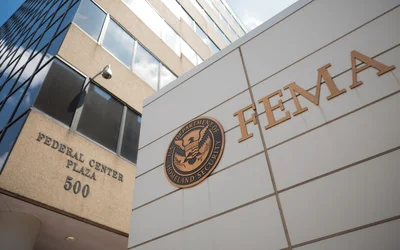
Mosques cannot apply to Fema directly: applications are routed through state homeland security agencies, which score and rank them.
Each applicant must submit a site-specific vulnerability assessment - a documented map of the facility's weaknesses - alongside the names and addresses of its board members, whose resumes are "subject to approval".
The application also requires a mission statement, which the state assesses to validate "the central purpose of the organization". Houses of worship fall under DHS's "ideology-based" category, wherein applicants must flag any "practices that may elevate the organization's risk" and substantiate threats against them "based on their ideology, beliefs, and/or mission".
A mosque seeking cameras must first submit its beliefs for review - and its staff for citizenship checks. This year's funding notice states that grantees "should not include foreign nationals or noncitizens", and that any they employ must be vetted under a policy it calls "staff American, stay in America".
Before any award, DHS checks applicant organisations against "U.S. intelligence community reporting". Integration with these agencies is among the programme's stated objectives, and applications score higher for it.
The notice's own funding priorities include "community engagement efforts to foster trust and encourage threat reporting", coordination with the government's suspicious activity reporting system, and "information-sharing platforms between ICE [US Immigration and Customs Enforcement] and local agencies".
Before releasing a single dollar, Fema asks whether a recipient's "work or mission involves supporting aliens".
Consider, then, a mosque whose Friday sermons defend Palestine or criticise US policy. The application requires it to decide whether that advocacy counts among the "practices that may elevate the organization's risk" - and to substantiate the threats it faces "based on [its] ideology, beliefs, and/or mission". To document why it is threatened, it must first file its politics with the state.
That file is then checked against intelligence community reporting for "derogatory information" - a term the notice never defines - by the same department that arrested Mahmoud Khalil on the theory that his Palestine advocacy harmed US foreign policy. Any award can be terminated whenever Fema decides it "no longer advances the national interest".
A mosque that wants to keep its new cameras has every reason to censor its sermons.
Not a gift
DHS also houses Customs and Border Protection, along with ICE, whose agents have shot and killed immigrants during raids and traffic stops, and whose detention cells last year saw their highest death toll in two decades. Muslim institutions are being pressed into partnership with the agency overseeing it all.
As the NSGP's own 2025 call for applications emphasises, DHS emerged from the consensus that failures in communication helped make the 9/11 attacks possible. A quarter-century later, this origin story continues to shape how DHS views Muslims: as either threats to monitor or sources of intelligence to exploit.
Thus, as attorney and researcher Ahmed Shaikh writes: "The [grant] is not a gift; it is a transaction in which you trade your community's sovereignty for lighting fixtures and a security camera."
Cair actually offers the NSGP an easy path to future community buy-in. It also sanitises the broader counter-terrorism apparatus of which the programme is a part
In this light, recent complaints about Muslims' unequal access to the grant (some citing structural Islamophobia) suggest either a naive assumption that the NSGP is an impartial tool or a cynical attempt by politicians and "community leaders" to appear as defenders of Muslim interests.
Cair itself expressed hesitation about the grant programme in 2020, warning that it could "enlist civil society organisations in activity that should remain in the purview of law enforcement". However, the same Cair statement concludes: "new DHS provisions [emphasis added] produce a de facto quid pro quo that pits the security of vulnerable communities against cooperation with law enforcement".
While the statement correctly recognises DHS's attempt to fuse Muslim institutions with policing agencies, it reduces the problem to specific caveats within the NSGP rather than the post-9/11 reasoning underpinning the programme itself.
Cair's position has thus frequently oscillated, at times reacting to DHS's shifting grant language, at other times to the party in power, and ultimately, to the functional exclusion of Muslims from the grant in 2025.
It is not surprising, then, to see public statements by Cair criticising the terms of the NSGP - namely, its prohibition on grantees boycotting Israel and its mandating of cooperation with ICE.
But this performance of critique is precisely what makes reformist politics like Cair's so insidious. By confining its objections to particular provisions, Cair actually offers the NSGP an easy path to future community buy-in. It also sanitises the broader counter-terrorism apparatus of which the programme is a part.
As recently as 2024, Cair disseminated sample NSGP applications for mosques to emulate. In the model application, the fictional "Unity Mosque" emphasises its dedication to "maintaining a strong relationship with state and local homeland security partners". It seems Cair knows what kinds of proposals DHS actually funds.
This focus on becoming the state's partner follows in the footsteps of Zionist organisations that have long been the primary beneficiaries of the NSGP. In fact, it is not only Cair but also Jewish Federations of North America that have been leveraging recent deaths in San Diego for access to greater NSGP funding.
Perhaps the endpoint of Cair's trajectory is to resemble a group like the notoriously Zionist Anti-Defamation League (ADL). Decades of close coordination between the ADL and FBI gradually eroded the line between the two groups.
In this sense, the issue with the NSGP - as far as the Muslim community goes - is not a particular provision nor the administration in power but its fundamental purpose: dissolving the boundary between Muslim communities and the police.
But Cair has yet to reject the NSGP as such - hence its recent call for Muslim institutions to submit applications for the programme's 2026 funding cycle.
Police work
Cair's contradictions stem from its double role: it presents itself both as lawyer (defender of Muslims) and politician ("good" Muslim). The first role demands an adversarial posture towards state power and its categories of criminality, such as extremism and terrorism.
This, however, conflicts with the aims of Cair-the-politician, whose appeals to local, state and federal officials revolve around portraying Muslims as law-abiding Americans.
It can be difficult to discern where Cair ends and the police begin
This muddiness in mission has enabled many puzzling occurrences over the years: a retired police officer as a Cair banquet keynote speaker, a deputy sheriff moonlighting as a Cair director for nearly a decade, the same officer reappearing as a "mosque security expert" following the San Diego mosque shooting, and even the occasional Know-Your-Rights training presented with "law enforcement".
Akin to a cat instructing mice how to avoid capture, a civil rights workshop involving police is fraught from the outset.
Whether through joint programming or recommendations that mosques honour police officers, Cair uses its trusted position as a community advocate to launder the image of predatory institutions. Because such efforts typically fall within the purview of police departments themselves (Community Relations Units), Cair's activity exceeds simple "bridge-building". It is police work.
There is no shortage of "bridges" joining Cair and law enforcement - so many, in fact, that it can be difficult to discern where Cair ends and the police begin. It is therefore misleading to imagine Cair as standing on one shore and the police on another, constructing a "bridge" in between.
A more accurate picture would place both on the same side of a river, extending a single bridge towards everyday Muslims. Will we step across, or choose a different path?
Cair did not respond to this author's request for comment.
The views expressed in this article belong to the author and do not necessarily reflect the editorial policy of Middle East Eye.
Middle East Eye delivers independent and unrivalled coverage and analysis of the Middle East, North Africa and beyond. To learn more about republishing this content and the associated fees, please fill out this form. More about MEE can be found here.