
Why Canada stands with Ukraine but not Gaza

Ottawa speaks about international law and human rights only when it suits western geopolitical interests. The contrast between Canada’s response to Israel over the Gaza war, and Russia over the Ukraine conflict, highlights the government’s dangerous double standards, which come at the expense of the legitimacy of global norms.
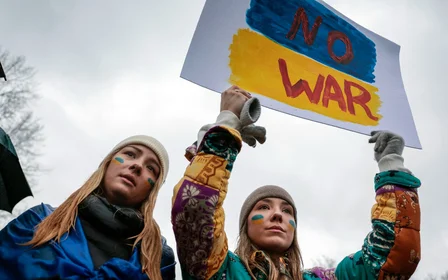
Our analysis of Canadian government statements on both conflicts shows a clear contrast. After Russia invaded Ukraine in February 2022, Canada responded with moral certainty.
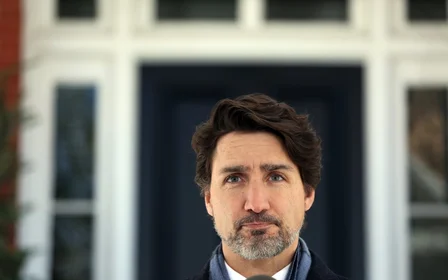
Justin Trudeau, then the prime minister, denounced it as illegal and unjustifiable. Ottawa rapidly imposed sanctions, and within two months of the war breaking out, the House of Commons unanimously declared that Russia was committing genocide.
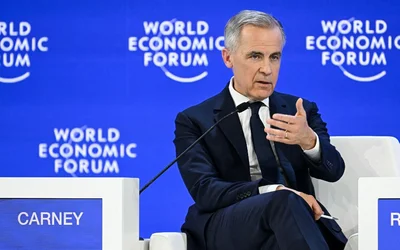
By 2025, Canada had given Ukraine $22bn in aid, including $6.5bn in military assistance, while training upwards of 47,000 Ukrainian military and security personnel. This past May, Prime Minister Mark Carney declared that Ukraine’s fight is “our fight”.
Compare this to Canada’s response to Israel’s war on Gaza, which began after the 7 October 2023 Hamas attack. Ottawa has long emphasised Israel’s right to self-defence, even as leading human rights organisations and UN experts have raised alarms about potential war crimes and genocide.
New MEE newsletter: Jerusalem Dispatch
Sign up to get the latest insights and analysis on Israel-Palestine, alongside Turkey Unpacked and other MEE newsletters
When asked in September 2024 whether Canada would condemn Israel or impose an arms embargo after much of Gaza had been destroyed, and at least 40,000 Palestinians killed, Trudeau asserted: “Israel has a right to defend itself.”
Canada’s tone shifted only after immense public pressure, with Carney recognising a Palestinian state on 21 September 2025. But even as Foreign Minister Anita Anand acknowledged last August that “humanitarian suffering in Gaza has reached unimaginable levels”, with famine declared across the territory, Canada refused to take concrete action against Israel.
Competing frameworks
Canada conveniently oscillates between two competing frameworks. Against rivals like Russia, it invokes the language of the liberal international order, a global system espousing universal human rights, international law, and principles like the Responsibility to Protect (R2P).
Canada helped create the R2P framework, which holds that countries must protect their populations from genocide and war crimes; otherwise, the international community has a duty to intervene.
For friends like Israel, Canada defaults to the rules-based order - a flexible framework that pays lip service to global norms, but ensures they never actually constrain western allies, while applying them disproportionately against geopolitical adversaries and weaker non-western regimes.
Any moral policy Canada pursues is out of convenience or coincidence. Until Canada confronts reality, its moral claims will remain hollow and its international influence weak
The rules-based order is an adaptation that reinforces western hegemony while preserving the appearance of universality.
This structural double standard exposes an uncomfortable truth that few western elites want to acknowledge: their support for Israel, a state built on mass forced dispossession, reveals that only some lives are considered grievable, and only the geopolitically convenient ones are worth fighting for.
After analysing more than 250 official Canadian statements on the Ukraine and Gaza wars using 10 binary codes, we saw a systemic pattern emerge.
On Ukraine, Canada demanded an immediate ceasefire, condemned Russian attacks on hospitals and schools, affirmed Ukraine’s sovereignty, explicitly named Russia as the aggressor, and invoked R2P.
On 28 February 2022, Melanie Joly, then Canada’s foreign minister, told the UN Human Rights Council: “Human rights are universal and can’t be manipulated to justify war and crime.”
Evincing Canadian middle-power activism, she added: “The Russian regime is challenging the international system of peace and law and the very charter that we have been building since the end of the Second World War. Russia has tried to make a mockery of our international system, to force a reversion to a ‘might-makes-right’ world. We will not allow this to happen.”
Damaged moral standing
On Gaza, however, Canada initially resisted making calls for a ceasefire, avoided condemning Israeli strikes as indiscriminate or disproportionate, affirmed Israel’s “right to exist” while shunning equivalent language for Palestine, and failed to summon the R2P that it championed for Ukraine.
In a March 2024 meeting with her Israeli counterpart, Israel Katz, Joly reiterated Canada’s condemnation of the 7 October 2023 Hamas attack. She offered solidarity and an unwavering commitment to Israel’s security, and reaffirmed Israel’s right to defend itself. Unlike its position towards Russia, Canada did not hold Israel to consequential account while stating that it must respect international law.
Canada frames Ukraine’s history as one of Russian imperialism, invoking the Holodomor famine, Soviet Russification, and the 2014 annexation of Crimea to contextualise Russia’s 2022 invasion as a continuation of aggression against Ukrainian sovereignty.
Yet Palestine’s history of Israeli settler-colonialism is even clearer, from the Nakba in 1948, to aggressive territorial expansion in 1967, to decades of siege on Gaza and ongoing ethnic cleansing across the occupied territories.
Amnesty International and the Israeli rights group B’Tselem have concluded that Israel’s system amounts to apartheid. Mass atrocities such as torture, rape, starvation, and the summary execution of civilians are well documented. Canada refuses to acknowledge these realities.
In October 2025, Senator Yuen Pau Woo asked: “Why is there a double standard in the way we have responded to the situation in Gaza compared to, say, Ukraine?” He warned that Canada’s failure to act damages its moral standing.
Canada’s response to Ukraine shows what foreign policy looks like when an aggressor state is a strategic rival that it aims to diminish. Canada’s response to Gaza embodies a parallel western interest in dominating the Middle East.
Any moral policy Canada pursues is out of convenience or coincidence. Until Canada confronts reality, its moral claims will remain hollow and its international influence weak.
The views expressed in this article belong to the author and do not necessarily reflect the editorial policy of Middle East Eye.
Middle East Eye delivers independent and unrivalled coverage and analysis of the Middle East, North Africa and beyond. To learn more about republishing this content and the associated fees, please fill out this form. More about MEE can be found here.