Why Israel's claims cannot be accepted at face value


Every journalism student learns the same lesson: if your mother says she loves you, check it out. A claim is not a fact until it has been tested, and the more power and self-interest behind it, the more rigorously it should be tested.
A BBC Verify investigation has put that principle to a stark test. It identified 254 incidents in which the Israeli military said it was investigating allegations that its forces had killed or injured people in Gaza, Lebanon, the occupied West Bank and Israel, but for which no public outcome could be found.
Of the 300 cases examined, only 28 had outcomes published on the Israeli army's website. The BBC says it repeatedly approached the military about the cases but received information on only two, both still under review.
The findings do not establish that every allegation is true or that every investigation should lead to prosecution. They raise a basic question: what value does "Israel says" have if the public is never told the eventual outcome?
Yet in Britain, applying that rule to Israel risks arousing the ire of those whose entire purpose is predicated on promoting or defending the Zionist state narrative.
New MEE newsletter: Jerusalem Dispatch
Sign up to get the latest insights and analysis on Israel-Palestine, alongside Turkey Unpacked and other MEE newsletters
MP Ayoub Khan, who has been derided as a “Gaza independent” by the British media for his advocacy against Israel’s genocide in Gaza, was recently denounced by a slew of media and politicians for questioning the speed of Israel’s inquiry into the Flydubai incident that resulted in an emergency landing late last month.
Yet Khan’s refusal to simply accept Israeli Prime Minister Benjamin Netanyahu’s word deserves to be taken seriously, mainly because the ire was not reserved for him alone.
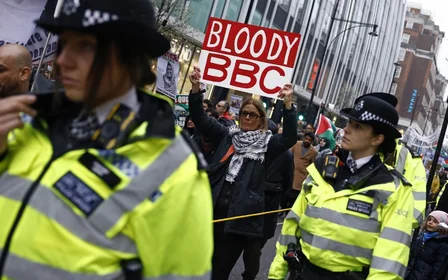
The BBC was attacked for adhering to proper editorial standards by putting the word “hero”, used by Netanyahu, in quotation marks in its coverage of the Indian pilot who was stabbed on the Israel-bound flight.
Sam Kiley, an experienced foreign editor for The Independent newspaper, was condemned for asking who stood to gain from the incident, daring to suggest that it served Netanyahu as he seeks re-election.
Netanyahu had warned of potential attacks ahead of the 27 October vote. After the Flydubai incident, both he and Defence Minister Israel Katz said it proved them right.
Asking who benefits from an event, and from how it is framed, is one of the oldest questions in political analysis. The charge against these critics is that doubt itself reveals prejudice. In reality, it is the other way around: credulity is the failure.
Pushing a narrative
This is not paranoia. It is the historical record.
In 1954, Israeli military intelligence recruited Egyptian Jews to bomb British- and American-owned sites in Egypt, intending to blame the attacks on the Muslim Brotherhood and communists. Israel long denied involvement and only honoured the surviving agents in 2005.
After the October 2023 Hamas attack, a spokesperson for Netanyahu said babies had been found decapitated. The claim reached British front pages, and former US President Joe Biden said he saw photos of the beheadings. The White House later had to walk back his claim, which has since been debunked.
The pattern is always the same: a confident assertion that rapidly spreads, becoming part of the folklore that seeks to paint Israel as a perpetual victim, before later being shown to be false.
“Netanyahu says” is a record of what a politician wants the public to believe. “An Israeli official told us” is the same claim with all accountability stripped out. Neither proves anything. That something was said can be reported, but whether it is true must be shown. Relaying it without that additional work is transcription, not journalism.
Remarkably, British news outlets have repeatedly given Israel’s prime minister a megaphone to deride Britain, however absurd his claims. After the UK recognised the state of Palestine, Netanyahu moved to rile an already Islamophobic nation with a jibe about the “Islamic Republic of Britain” - a premise that collapses on the facts: Britain is a constitutional monarchy in which Muslims make up around 6 percent of the population.
After Britain imposed a settlement trade ban, Netanyahu told the Daily Mail that it had become a “rogue state” under Prime Minister Andy Burnham and accused the Labour government of “appeasing an Islamist-leftist alliance”. He has also reiterated the assertion that Israel helped Britain to thwart an Iranian-backed attack on RAF Fairford, another incident with serious question marks attached.
Where the reporting starts
All of this raises another question: why does an individual facing an International Criminal Court arrest warrant for alleged war crimes and crimes against humanity command so much space in British media? Why is the quote the headline and the evidence an afterthought?
Perhaps Israel’s targeting of major British journalists - including Piers Morgan, Mehdi Hasan and Owen Jones, alongside American commentator Hasan Piker - offers one explanation. All have been, in various ways, critics of Israel’s killing of Palestinian civilians and journalists. Given its well-documented killings of journalists, Israel does not appear to tolerate dissent.
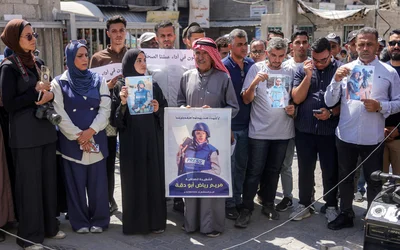
According to the Committee to Protect Journalists, Israel has killed more than 200 journalists and media workers since October 2023. The committee notes that Israel has repeatedly accused journalists of militant involvement “without producing credible evidence”.
It is reasonable for anyone to ask whether Israel is the ally its supporters describe. Journalists cannot help the public to answer that question if they simply relay its statements verbatim
The cost of deference is self-censorship, and the evidence of it is stark. The Centre for Media Monitoring found the BBC gave a rationale for Israeli military actions in 75 percent of articles on attacks or suffering in Gaza, compared with 17 percent for Russian actions in Ukraine. It challenged Israel’s justifications in 41 percent of cases, compared with 55 percent for Russia.
The centre also found that the BBC reported the deaths of just 6 percent of 176 Palestinian journalists killed by the Israeli army, compared with 62 percent of journalists in Ukraine.
With independent journalists barred from Gaza, the world relies on Palestinian reporters and statements from Israeli officials to understand what is happening. If qualifying an Israeli claim brings complaints and political attacks, the response is often silence.
It is reasonable for anyone to ask whether Israel is the ally its supporters describe. Journalists cannot help the public answer that question if they simply relay its statements verbatim. Their job is to scrutinise and challenge. “Israel says” is where the reporting starts, not where it ends.
While brave voices in the trade continue to speak out after three years of genocide in Gaza, “Israel says” remains the routinely used phrase. This is exactly when questions should sharpen.
When trusted media outlets decline to ask the obvious questions, rumours fill the gap. Every question a mainstream newsroom fails to investigate is a question handed to someone who will answer it badly.
The views expressed in this article belong to the author and do not necessarily reflect the editorial policy of Middle East Eye.
Middle East Eye delivers independent and unrivalled coverage and analysis of the Middle East, North Africa and beyond. To learn more about republishing this content and the associated fees, please fill out this form. More about MEE can be found here.