Why Lebanon's army cannot defend the nation after a year of 'ceasefire'


Just hours after Lebanon and Israel sat across from each other in Naqoura last week, holding their first direct talks since 1983, Israeli jets returned to the skies and struck towns across southern Lebanon.
In Mahrouna, Jbaa, al-Majadel and Baraachit, residential buildings were flattened into ash. Families fled with seconds to spare. Fires devoured homes that had stood for generations.
There were no secondary explosions, no weapons depots, no fighters - only civilians once again bombed under the same tired pretext of “Hezbollah infrastructure”.
It was a reminder, if anyone still needed one, that Israel’s definition of ceasefire is unilateral: it fires when it wishes, violates when it pleases, and suffers no consequences.
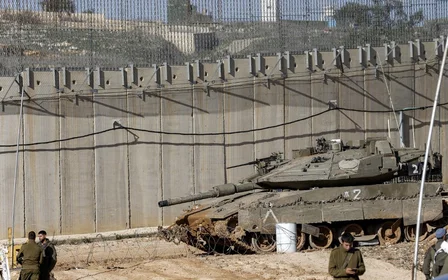
And the Lebanese army, whose checkpoint sat minutes away, could do nothing. This is not because its soldiers lack courage; they have patrolled the south under constant, lethal threat for a year. They have evacuated families while drones circled overhead. They have buried comrades killed in uniform. They were close enough to Mahrouna and Jbaa to hear the jets and feel the shockwaves.
New MEE newsletter: Jerusalem Dispatch
Sign up to get the latest insights and analysis on Israel-Palestine, alongside Turkey Unpacked and other MEE newsletters
But they had nothing to answer with: no air-defence systems, no interceptor missiles, no radars capable of tracking an F-35.
The army is structurally incapable of protecting the civilians it is sworn to defend because for decades, powerful states have ensured it remains incapable.
Repeated violations
A year ago, I wrote a detailed analysis explaining why the Lebanese Armed Forces could not defend the country - not for a lack of bravery or unity, but because they were systematically denied the tools of national defence.
Today, every point has been proven true, brutally and repeatedly.
Since the “ceasefire” began on 27 November 2024, Israel has carried out more than 10,000 violations of Lebanese sovereignty, including more than 7,500 air violations and 2,500 ground violations, alongside repeated naval breaches, assassinations and systematic destruction.
At least 41 Lebanese soldiers were killed in uniform during the period from October 2023 to November 2024. Seven Lebanese border points remain occupied. In Yaroun alone, more than 4,000 square metres of land has been walled off in recent months.
Everyone demands that the army protect the country, but no army can do so when its radars cannot see the aircraft violating its skies
Unifil, which has monitored the ceasefire line for decades, confirms that Israel’s actions violate Resolution 1701, the primary legal framework for maintaining a 2006 ceasefire between Israel and Lebanon. Israel simply ignores it.
And the Lebanese army cannot stop any of this - not because it refuses to, but because Lebanon is not allowed to possess the means.
The Lebanese army is not weak. It has been deliberately weakened. Everyone demands that the army protect the country, but no army can do so when its radars cannot see the aircraft violating its skies; its helicopters are outdated and grounded for lack of parts; it has no air-defence systems; and its soldiers patrol under hostile drones 24/7, with no ability to bring them down.
Since 2006, the US has provided more than $3bn to the Lebanese army, but only for light weapons, Humvees, rifles, night-vision gear and aircraft maintenance. It’s been enough to prevent collapse; never enough to defend Lebanon.
Lebanon’s defence budget up to 2024 came in at $768m, most of it comprising salaries crushed by economic collapse. Israel’s defence budget was $36.9bn. The Lebanese army ranks 115th globally in military power; Israel ranks 15th.
A country with no effective air force and no air-defence systems cannot defend its skies.
This is not misfortune. It is policy.
Foreign-engineered weakness
The Taif Agreement of 1989, heavily shaped by US influence, placed ceilings on Lebanese military capabilities to preserve Israel’s “qualitative military edge”.
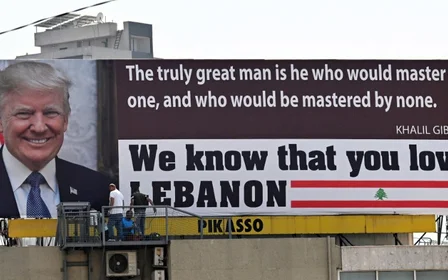
When Russia offered free MiG-29 warplanes in 2008, the US blocked the deal. When Iran offered air-defence systems in 2010 and 2019, Lebanon declined under US threat.
The Lebanese Air Force flies six A-29 Super Tucanos - useful for surveillance, useless against an F-35.
Lebanon does not inherently lack a national army; it is denied one. Israeli officials say this openly, with Education Minister Yoav Kisch declaring in a televised interview: “There is no difference between Hezbollah and Lebanon. Lebanon will be annihilated. It will cease to exist.”
If this is the threat, then denying Lebanon the means to defend itself is not passive; it is part of the strategy.
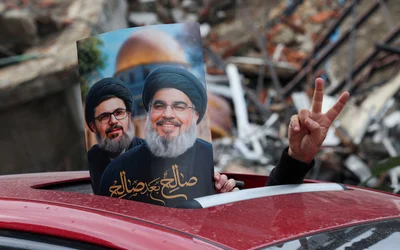
In this vacuum, Hezbollah emerged. Created in response to Israel’s 1982 invasion, Hezbollah evolved into a non-state military force larger than many national armies. It is polarising, politically heavy, and embedded in Lebanon’s complex sectarian system.
But no serious analyst can claim that the Lebanese state would still hold territory south of the Litani River without Hezbollah. This is the uncomfortable truth that every western envoy avoids.
Washington continues to demand that the Lebanese army disarm Hezbollah. Yet US envoy Tom Barrack has admitted openly that “Israel cannot achieve its goals by crushing Hezbollah militarily" adding that "it is doubtful the Lebanese army will disarm Hezbollah".
In other words: Washington knows the demand is impossible, but continues to push it.
Even a fully equipped army cannot be ordered by a foreign state to wage war on its own people. And Washington offers Lebanon zero guarantees. If Hezbollah disarmed tomorrow, would Israel stop violating Lebanese airspace, occupying Lebanese land, bombing Lebanese towns, and assassinating Lebanese civilians and soldiers?
There are no guarantees - not one.
Hezbollah’s position, whether one agrees or disagrees, is logically consistent: when Israel withdraws, violations stop, and the army is capable of defending Lebanon, it is ready for a national dialogue about its weapons.
Washington demands the opposite: disarm first, suffer later. That is not sovereignty. It is collapse.
Removing the mask
Last week, Israel’s Channel 14 reported that US envoy Morgan Ortagus, who co-chaired the Naqoura meeting, urged Israel in February to bomb Hezbollah leader Hassan Nasrallah’s funeral at Beirut’s Sports City Stadium. Hundreds of thousands of civilians were present.
Israel considered the strike. Jets were already in the sky. The only reason it didn’t happen was Israel’s own calculation, not US restraint.
A US envoy reportedly advocated a mass-casualty attack in Lebanon’s capital, then sat at the negotiating table as a “neutral mediator”. This is the environment in which the Lebanese army is expected to “restore sovereignty”.
Last summer, Unifil stated clearly: "The LAF are attempting to fulfil their obligations under the Ceasefire Understandings."
In August, the UN announced that Unifil’s mandate would end in 2026. Israel celebrated. With Unifil gone, fewer witnesses would remain.
Meanwhile, Israeli intelligence tells the US that Hezbollah is too strong; that the Lebanese army cannot confront it, and that “we are heading toward escalation and will decide when”.
The next war is already scripted - and still the Lebanese army stands its ground, with 200 posts south of the Litani, 29 fixed checkpoints, and round-the-clock patrols. It has seized 566 rocket launchers, neutralised 177 tunnels, and closed 11 crossings.
It has done everything asked of it. What it cannot do is what it was never allowed to do: defend Lebanon against Israel.
It has done everything asked of it. What it cannot do is what it was never allowed to do: defend Lebanon against Israel
Lebanon is trapped between a set of impossible demands: disarm its only deterrent, but expect protection; rely on the army, but deny it weapons; trust diplomacy, but accept bombs the next morning; believe in mediation, while mediators propose mass-casualty strikes.
So let this be said plainly: do not blame the Lebanese soldier who has no missiles for the skies he cannot defend. Blame the governments, both foreign and domestic, that ensured the army would never have them.
Until the Lebanese army is allowed to defend Lebanon, for many Lebanese people, Hezbollah will remain the last line of defence - not because Lebanon chose this structure, but because it was engineered into it.
And until the world stops treating Lebanese lives as disposable pieces on a geopolitical chessboard, Lebanon will continue to bury its dead under skies it cannot control.
Author’s note: This piece is a continuation of an analysis I published one year ago, written at a time when many still believed the Lebanese army simply needed “political will” to defend the country. The past 12 months have shown, painfully and unmistakably, that the truth is far more structural and far more engineered.
This was not easy to write. I wrote much of it while watching the south burn again, as soldiers were buried with honours they deserved despite tools they were never given, and as civilians paid the price for decisions made far beyond Lebanon’s borders. My aim is not to defend any faction, but to document a reality that Lebanese people are forced to live every day under skies they cannot control.
The views expressed in this article belong to the author and do not necessarily reflect the editorial policy of Middle East Eye.
Middle East Eye delivers independent and unrivalled coverage and analysis of the Middle East, North Africa and beyond. To learn more about republishing this content and the associated fees, please fill out this form. More about MEE can be found here.