Why the Mecca Agreement has given the UAE-Israel alliance the jitters


Intelligence services don’t like surprises, especially those who pride themselves on being able to listen in on any conversation anywhere in the world.
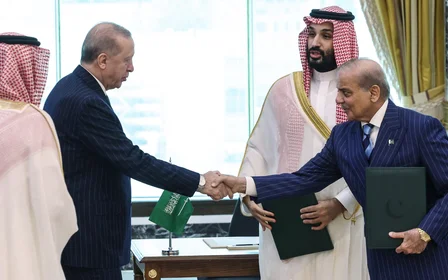
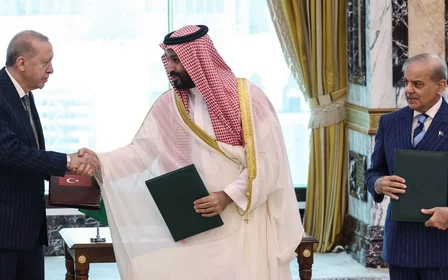
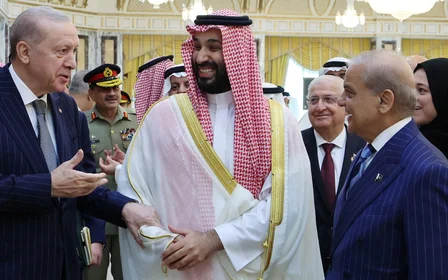
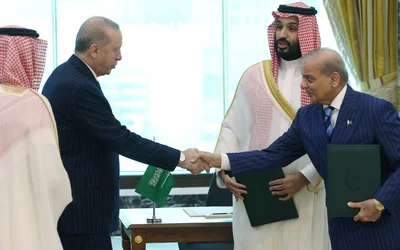
The Mecca Joint Defence Agreement, signed on 7 August, came as a surprise to the Emirati and Israeli intelligence services. The Emiratis only found out about it two weeks before it was declared and by then it was too late.
Turkey’s Foreign Minister Hakan Fidan had made little secret of his wish to create a Muslim alliance in reaction to Israel’s genocide in Gaza. He had his setbacks, but never lost hope in the project.
But Crown Prince Mohammed bin Salman (MBS), Saudi Arabia’s de facto ruler, played his cards closer to his chest, making moves that each side in the Iran war could interpret as collegiate.
After Saudi Energy Minister Prince Abdulaziz bin Salman signed a peaceful nuclear cooperation agreement in Washington last month, the US President Donald Trump appeared to scupper it by demanding retrospectively that Saudi normalise with Israel.
New MEE newsletter: Jerusalem Dispatch
Sign up to get the latest insights and analysis on Israel-Palestine, alongside Turkey Unpacked and other MEE newsletters
Saudi and US air strikes targeted those Popular Mobilisation Force militias who were commanded by "advisers” from Iran’s Islamic Revolutionary Guard Corps (IRGC) in southern Iraq.
Saudi intelligence, according to Saudi and other sources in the region, had got word that they were about to mount cross border raids into Kuwait.
Saudi jets had also attacked Sanaa in Yemen, as the ceasefire with Ansar Allah, also known as the Houthis, unravelled as rockets and drones fell on Saudi oil installations.
Fundamental changes
To the coalition of states who had joined in the US and Israeli attack on Iran, it looked as if an initially sceptical MBS was - at last- coming on their side.
Like all Gulf leaders, MBS may have had conflicting advice. But joining the US military campaign on Iran was very far from his thinking.
For the simple truth is that while the two core military campaigns against Iran and Gaza have become frozen conflicts, and are set to stay that way for some time to come, fundamental changes are taking place in the region around them.
Launching three wars against Iran, Gaza and Lebanon, and failing to win any of them, but being equally unwilling to retreat, has its consequences on the allies which host US bases.
Particularly on the Saudi mindset.
For that group of Saudi foreign policy analysts, who were educated in the West, to witness two US presidents arming Israel’s genocide, was a rite of passage. They could no longer count themselves in the western camp.
And to then see how the US was unable to defend its own airbases in the region, let alone their host country’s strategic assets, was to heap disdain on contempt.
Dr Ahmed Altuwaijri, a former member of the Saudi Shura Council, is at pains to say he does not speak for the Saudi foreign ministry. However, he is a good example of the Saudi intelligentsia to which I am referring.
"The Mecca Defence Agreement is coming into life at a crucial time. Everyone has lost faith in Trump. This agreement serves the interests of the whole region, not just those three countries.
"It is reshaping the region and will continue to do so, with more countries joining in the future from the Arab world and Islamic world, joining such agreements," he told me.
For his former regional allies, Trump has been exposed in this conflict by his inability to turn his war aims into reality.
Not winning, or being locked into a stalemate, rather than the stupidity of launching a war of regime change, turns out to be Trump’s original sin.
Iran's negotiators have understood this and want to prolong the current impasse over the Strait of Hormuz until Trump’s midterm elections, after which they calculate there is a good chance he could lose control of Congress and return to the negotiating table in a weaker position.
All three founding members of the agreement have something to gain.
Dr Altuwaijri said: "It serves Pakistan in its feud against India. It serves Turkey, who has found its membership of Nato insufficient deterrence against Israel’s overt threats against it. They openly said that after Iran had been dealt with, Turkey was next.
"And it serves Saudi Arabia, which will benefit not just from the military power of Turkey and Pakistan, but their intelligence and planning."
Out of the shadows
Israeli diplomatic and military strategists have been saying for some time that they want to build an alliance against a "Sunni" Muslim pact, and their military cooperation with the United Arab Emirates was the core of this.
The joint US-Israeli attack on Iran brought that alliance out of the shadows.
Many view Saudi Arabia as the beating heart of the Muslim world. Israel and its followers are, in comparison, recent and wholly western arrivals on the security scene of the region
It moved from being covert - with visits by Prime Minister Benjamin Netanyahu and accompanying military delegation to Abu Dhabi being denied by the hosts - to overt.
For them, the Abraham Accords, to which Mohammed bin Zayed (MBZ), UAE president, was an enthusiastic signatory, had been tested by fire.
Israel deployed its most sensitive and high-tech kit to Abu Dhabi, which at the time was taking a big hit from Iranian missiles and drones.
Israel also deployed an Iron Dome battery and troops as well as Iron Beam, a battlefield laser, and Spectro, an electro optical system to detect drones.
The deployment of Israel's most advanced defence systems under direct Israeli command to an Arab country was seen at the time as groundbreaking.
But it was only just the start of a much bigger regional ambition.
Once Israel’s foes had all been crushed, an alliance, extending from India to the Eastern Mediterranean, would place Israel at the crossroads of a highway of oil, gas, finance and high-tech trade.
America and the West could retreat at last, leaving the military keys to the region in Tel Aviv’s hands.
The traditional Arab centres of power like Egypt and Syria were destined under this plan to wane, either hopelessly bankrupt or split into confessional and ethnic cantons of power, which is what Israel still plans for Ahmed Sharaa’s Syria.
Both the UAE and Israel had similar interests in stoking civil wars in Yemen, Sudan, Libya, and using breakaway states like Somaliland to set up a spider’s web of forward operating military bases to police their new seaborne empire.
The Mecca Defence Agreement is a counterweight to this project, if not its nemesis.
Competing alliances
Its first effect will be to deepen and accelerate the strategic rivalry between Riyadh and Abu Dhabi, its small but highly active neighbour.
This can be measured by monitoring the social media posts of influencers each country deploys.
As social media is strictly controlled in each Gulf state and influencers can only post under licence, their posts are an accurate reflection of current official thinking.
After the Emiratis were expelled from Yemen in December, Dr Abdulkhaleq Abdullah, associate professor in the department of political science at United Arab Emirates University posted: "We do have differences over Yemen 100%, and the difference has gone to a higher level with current escalation. Allies clash… But they mend their differences and build on what they have in common."
But by January, his mood had darkened. "The rift between Saudi Arabia and the UAE is deeper than what is at play in Yemen."
The Saudi Foreign Minister Faisal bin Farhan Al Saud said at the time that the future of relations between the two depended on "mutual respect for sovereignty and national security".
This period ended with the UAE banning Al Arabiya X accounts and leaving Opec.
Last month, there was a brief rapprochement. Turki Al Sheikh, Saudi royal court adviser, posted a photo of Saudi Defence Minister Khalid bin Salman Al Saud and the UAE Vice President Sheikh Mansour bin Zayed Al Nahyan in each other’s arms.
"Saudi Arabia and the UAE: a story of brotherly relations and a deeply rooted partnership."
Anwar Gargash, former UAE foreign minister, heartedly agreed: "The biggest story in the Gulf is captured in a single photograph."
Abdulla bin Mohammed bin Butti Al Hamed, chairman of the UAE National Media Authority, concluded: "Emirati-Saudi relations are an extension of a shared history and deep-rooted fraternal ties between two brotherly peoples, united by a single destiny."
But this destiny was not to stay shared for long.
Abdulkhaleq Abdullah was incandescent at the Mecca Agreement: "If this agreement is not an alliance, then what is the name that befits it? Was it done with the knowledge of the GCC states? Does it strengthen the Gulf Joint Defence Agreement of 2000 which collapsed because of Iranian aggression?"
Then he posted in Trump-like capitals: "Gulf cooperation is NOT in its best state - it suffers from neglect by its major states who search for security OUTSIDE the Gulf house. The rush to establish regional political axes and military alliances comes at the expense of Gulf cooperation and weakens it."
The kingdom has many allies in the Emirates who are keeping their head down and staying silent, but who are just as critical of the path MBZ is taking them all on, not least his alliance with Netanyahu
To which Prince Abdulrahman bin Musaed replied: “What’s the problem, Doctor? Isn’t it the right of any state to make agreements with any country as it sees fit? Isn’t this a sovereign matter for every state? Or does this principle not seem logical to you when it concerns Saudi Arabia?!”
Dr Ahmed Al-Sanie, also from Saudi Arabia, posted: "Five years ago, the idea that an Emirati account would attack 'Saudi strategic depth' was like science fiction. The Mecca agreement exposed the bitter truth: we disagreed because Riyadh decided to be the ‘beating heart’ of Gulf decision-making, not merely the 'funding heart' for others’ ambitions."
The Saudis now fully expect MBZ to make life as difficult as possible for them in Yemen and Sudan.
One analyst, speaking on condition of anonymity, said: "The situation will get worse between Saudi and UAE, the UAE will purposefully complicate and sabotage things in Yemen and Sudan, and they will push Egypt to take more serious and public stances against the Saudis."
If it reached this level, I am told, the kingdom might be tempted to look at regime change in Abu Dhabi, as this would be the easiest way to stop the local feud.
The kingdom has many allies in the Emirates who are keeping their head down and staying silent, but who are just as critical of the path MBZ is taking them all on, not least his alliance with Netanyahu.
The Saudis are serious about reclaiming power over their own strategic decisions, which is one reason why they opposed the inclusion of Egypt in the Mecca Agreement.
Firstly, both Saudi Arabia and Pakistan had doubts about the security of their military alliance. They thought Egypt would leak information to the Israelis or the Americans. Secondly, they doubted what practical military benefits the Egyptian army would bring to their alliance.
Last week, Turkey's Hakan Fidan stated during a brief visit to Egypt that he hoped Cairo will join Saudi Arabia and Pakistan in the Mecca Agreement. Fidan assured that he hopes "Egypt will be an official partner and that the quartet will continue its work".
Protection and answers
The two competing military alliances are being framed in Washington as an alliance of strategic depth, versus an alliance which is nimble and transactional.
"At first glance, the UAE-Israel bloc delivers more tangible gains for both parties, but the Mecca pact may ultimately resonate more broadly and less transactionally," Theodore Singer, a former US intelligence officer, told Middle East Eye.
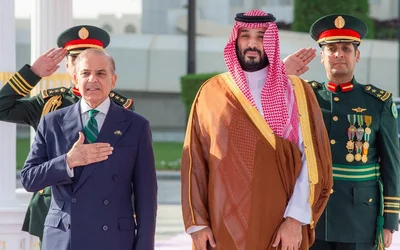
But the Mecca Agreement wins hands down when you look at it through the lens of legitimacy, a concept which admittedly is not often summoned in a landscape of absolute rulers and dictators.
Many view Saudi Arabia as the beating heart of the Muslim world. Israel and its followers are, in comparison, recent and wholly western arrivals on the security scene of the region.
Thanks to America, Israel may have the cutting military edge but it lacks the regional legitimacy to wield it. Furthermore, these wars are not achieving their military aims.
Netanyahu and Trump have brought the Gulf to the brink of destruction, and the war has brought traffic through the Strait of Hormuz to a stop.
"Trump is trapped. If he does a deal with Iran, it will be on Iran’s terms. If he fights on, the domestic opposition before an election will spiral," Dr Altuwaijri said.
In both Gaza and southern Lebanon Israel is building major infrastructure works to cement their presence.
Withdrawal is not on the cards on either front. Frustrated in its military aims to dismantle Hamas and Hezbollah, but told by Trump to stop, Israel’s response is to dig in.
In these circumstances, the Arab world will increasingly look to the Mecca Alliance for protection and for answers.
Whether or not they find them, it is the only mechanism powerful enough to create the very thing that has been absent from three years of war - a region that pushes back and which extracts a cost for this sort of wild, madcap adventurism.
The views expressed in this article belong to the author and do not necessarily reflect the editorial policy of Middle East Eye.
Middle East Eye delivers independent and unrivalled coverage and analysis of the Middle East, North Africa and beyond. To learn more about republishing this content and the associated fees, please fill out this form. More about MEE can be found here.