
Why solidarity with Gaza failed to stop the genocide


On 12 November, Israel attacked Nasser Hospital in Khan Younis, killing six Palestinians and injuring dozens more.
Among those killed were Saif Abu Hatab, who was awaiting surgery, and Dr Rizq Abu Shaeira, a surgeon working at the hospital. Other surgeons, patients and their companions were among the injured.
Beyond the reporting and familiar condemnations from human rights organisations and UN agencies, the attack appeared to provoke little reaction, let alone meaningful political consequences for Israel.
But is this really surprising?
After Israel systematically attacked and dismantled Gaza's healthcare system from 2023 through 2025, why would another attack on another hospital warrant a different response?
New MEE newsletter: Jerusalem Dispatch
Sign up to get the latest insights and analysis on Israel-Palestine, alongside Turkey Unpacked and other MEE newsletters
Still, this is precisely the moment to ask some serious questions about the international political order and its response to Israel's genocide in Gaza.
How have we reached a point where an attack on a hospital, killing patients and the doctors treating them, can pass almost unnoticed?
Growing indifference
Three years into the genocide, the growing numbness and indifference towards Gaza are increasingly difficult to ignore. Since the ceasefire came into effect in October 2025, more than 1,600 Palestinians have reportedly been killed and 5,833 injured, while the humanitarian situation remains catastrophic.

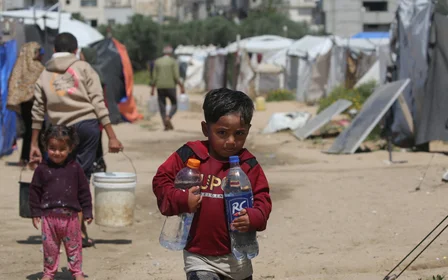
Much of Gaza lies in ruins, its healthcare system devastated, and hundreds of thousands of Palestinians remain displaced. With winter arriving, heavy rains have flooded displacement camps, leaving families who have already lost their homes struggling to find somewhere dry and safe to sleep.
None of this was unexpected, yet Israel's continuous restrictions on essential supplies and the destruction of infrastructure have left people exposed to conditions that could have been prevented.
What is particularly disturbing is that Palestinians are now enduring these conditions with even less international attention than before.
The ceasefire has helped create the impression that the worst is over, allowing governments and political leaders to speak of rehabilitation and peace despite the continued destruction of Palestinian life.
Against the backdrop of the Israeli elections, political attention has increasingly shifted towards Israel's domestic politics, electoral alliances and the possibility of replacing Israeli Prime Minister Benjamin Netanyahu.
For many, the prospect of removing the government responsible for so much destruction offers a sense of hope and political urgency. And while a change of government could bring some relief, there is a danger in treating it as a turning point for Palestinians.
The siege of Gaza did not begin with Netanyahu, Ben Gvir or Smotrich, nor did the occupation and dispossession of Palestinians.
These policies have been pursued and maintained by successive Israeli governments, including those presented as more moderate. Yet, as the debate increasingly centres on who will govern Israel next, the question of what will change for the Palestinians, and particularly for those in Gaza, risks being pushed aside.
The growing indifference towards Gaza cannot be understood simply as a consequence of declining media attention or public exhaustion.
During the first year of the genocide, millions of people took to the streets, students established encampments, workers organised, and campaigns demanding an end to military and institutional ties with Israel gained momentum.
Gaza was at the centre of global attention, and the evidence of Israel's atrocities was impossible to ignore. Yet, none of this brought the genocide to an end.
No concrete change
This is a reality we need to confront. The problem cannot simply be that people are no longer paying attention.
For a considerable period, they were paying attention, protesting and demanding action. And still, Israel continued its attacks and destruction, with the political and military support of some of the world's most powerful governments.
Gaza was at the centre of global attention, and the evidence of Israel's atrocities was impossible to ignore. Yet, none of this brought the genocide to an end
This is not to dismiss the significance of these mobilisations. Steps have indeed been taken within universities, trade unions and other institutions to challenge their complicity and cut ties with Israel.
Some campaigns have secured concrete changes, while others continue to organise towards goals that may take years to achieve.
Political struggles do not produce all their outcomes overnight, nor should their significance be measured solely by immediate results.
But acknowledging these achievements should not prevent us from recognising the enormous gap between the scale of global mobilisation and the reality facing Palestinians in Gaza.
Three years into the genocide, despite extensive documentation of atrocities, mass public opposition to the genocide and international legal proceedings, Israel has not faced consequences sufficient to stop the violence, and meanwhile, trucks carrying tents, blankets, mattresses and other essential supplies remain stranded outside Gaza, as Israeli restrictions continue to obstruct their entry.
This should trouble us profoundly, not because the mobilisations have been meaningless, but because of what their inability to stop the genocide reveals about the broader political and economic order that has enabled it to continue.
The problem is not that the world has failed to understand what is happening in Gaza. It is that this knowledge has not translated into the political will to stop it.
What is particularly alarming is how quickly Gaza fades from public attention when Palestinians are no longer being killed in large numbers, even as the conditions that have made such violence possible remain unchanged.
Mass killing cannot be the only catalyst for outrage and mobilisation, nor can our attention to Gaza depend on the scale of Palestinian suffering at any given moment.
Ongoing political commitment
This brings us to another difficult question: what does solidarity with Gaza look like after three years of genocide, political exhaustion and mobilisation that, despite its scale, has failed to bring an end to the violence?
And how can it be sustained when Palestinians are no longer being killed in the hundreds in a single day, but continue to die from frequent Israeli air strikes, the collapse of healthcare and the destruction of the basic conditions necessary for life?
Palestinians should not have to experience another massacre to bring people back into the streets. Nor should solidarity depend on a constant supply of images and testimonies of death and destruction.
While some of us have the privilege of turning away, Palestinians in Gaza must continue living through what the rest of the world can choose to stop watching
The past three years have demonstrated the limitations of a politics that relies on shock and bursts of outrage to sustain itself.
This is not an argument against demonstrations, but an invitation to think more seriously about how solidarity can become an ongoing political commitment rather than a reaction to particular moments of violence.
How do we organise for changes that may take years, while refusing to accept that Palestinians should have to wait years for their lives to be protected? How do we sustain political pressure while confronting the limitations of the strategies pursued so far?
These questions have no easy answers. But they are precisely the questions we need to confront, rather than waiting for another massacre to return Gaza to the centre of public attention. Solidarity cannot be reduced to witnessing Palestinian suffering.
It must also engage with Palestinian political demands and challenge the conditions that have made this destruction possible.
The attack on Nasser Hospital should have been intolerable. So should the continued killing of Palestinians after the ceasefire and the flooding of displacement camps.
Exhaustion is understandable, particularly after three years of witnessing such immense suffering. But exhaustion is not experienced equally.
While some of us have the privilege of turning away, Palestinians in Gaza must continue living through what the rest of the world can choose to stop watching.
Perhaps solidarity also means recognising this unequal burden, and asking how those of us with greater safety and freedom can take on more of the responsibility for sustaining political attention and action, even when the urgency of the moment has faded.
Three years into the genocide, perhaps the question is no longer simply how to bring Gaza back to the world's attention, but how to sustain a politics of solidarity that does not depend on that attention in the first place.
The views expressed in this article belong to the author and do not necessarily reflect the editorial policy of Middle East Eye.
Middle East Eye delivers independent and unrivalled coverage and analysis of the Middle East, North Africa and beyond. To learn more about republishing this content and the associated fees, please fill out this form. More about MEE can be found here.