
Is Yemen's endless war serving a US-Israeli agenda?


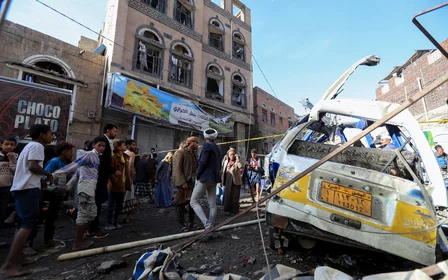
For years, the war in Yemen has not been a conflict in search of a victor. It has become a struggle in which every side seeks to degrade their opponents, without achieving a victory the wider region cannot absorb.
This makes Yemen an ideal test of an idea advanced by US strategist Edward Luttwak in his 1999 essay “Give War a Chance”, later applied to Syria in 2013: not every cessation of war constitutes peace, and not every victory produces a desirable outcome.
Sometimes the strategic interest lies in ensuring no side prevails, preserving a balance that prevents any party from defeating the others. In Syria, Luttwak argued that a government victory would strengthen Iran, while its collapse would open the way for "uncontrollable jihadists", as perceived by Israel and the US, making an “indefinite draw” the optimal US outcome.
More than a decade later, Yemen appears to test this logic without ever formally adopting it. The war has theoretically ended as a conventional confrontation, yet it remains unresolved on the ground.
In March 2015, a Saudi-led coalition intervened after the Houthis seized Sanaa, aiming to restore the internationally recognised government. Yet the war neither returned Yemen to its starting point nor reached a conclusive end.
New MEE newsletter: Jerusalem Dispatch
Sign up to get the latest insights and analysis on Israel-Palestine, alongside Turkey Unpacked and other MEE newsletters
The Houthis never took the whole country; the coalition never removed them from Sanaa. Competing forces in the south further complicated what might otherwise have been a binary conflict.
By 2022, front lines had stabilised, and a truce began, with the Houthis still controlling most of northwestern Yemen. Yet this is not peace; it is a freezing of the conflict, and the key to understanding Yemen through Luttwak’s framework.
Filling the vacuum
A complete Houthi victory would put an Iran-aligned armed power along more than 1,000km of Saudi Arabia’s border, with missiles and drones able to threaten Saudi energy facilities and infrastructure.
For the US and Israel, it would endanger Bab al-Mandeb, one of the world’s most vital maritime passages - a vulnerability the Houthis already demonstrated during the war following 7 October 2023. A Houthi-controlled Yemen could also become a forward base for Iran.
Destroying the Houthis entirely would be no less complicated. They are not simply an Iranian proxy removable by cutting supply lines; they are rooted in Yemen’s political, tribal and social fabric, with real security and administrative institutions. Framing them merely as an Iranian proxy obscures their domestic base.
They haven't won Yemen, but they can impose costs on global trade; the government hasn't been defeated, but it can't govern the country
The harder question is who fills the vacuum if they fall. Yemen has never been one political bloc; it holds the internationally recognised government, tribal and armed factions, and a southern separatist project backed by the UAE.
These contradictions surfaced in late 2025 and early 2026, when Saudi Arabia moved against Southern Transitional Council forces expanding into Aden and eastern governorates, accusing the UAE of backing them. Abu Dhabi, meanwhile, has long worked to contain the Islah party, tied ideologically to the Muslim Brotherhood, a threat Riyadh and Abu Dhabi assess differently.
Every actor - the Houthis and Iran; the Yemeni government, Saudi Arabia and rival Yemeni forces; the UAE; the US and Israel; and even a resurgent al-Qaeda based in Somalia, and its group inside Yemen, has a different vision of Yemen and a different definition of friend and enemy. That divergence makes any settlement exceedingly difficult.
This explains the apparent inconsistency in US policy since 2015. Washington has alternated between arming Saudi Arabia (including Patriot missile contracts) and withdrawing support, at times pursuing accommodation with Iran, as under the 2015 nuclear deal. This left Riyadh unable to fully trust Washington’s commitments; it even borrowed Patriot batteries from Greece. The pattern suggests the US has sought to manage the balance, not to secure a Saudi victory.
Between March and May 2025, the US intensified strikes on the Houthis over shipping attacks, then stopped after an Omani-mediated deal in which the Houthis ceased targeting US vessels. The goal wasn’t to end Houthi rule or the war; only to regulate specific behaviour within it.
Engineered fragmentation
After October 2023, the Houthis’ intervention in the Gaza war, which included strikes on shipping from Bab al-Mandeb to Eilat, turned them from a local actor into a regional player, redefining the stalemate. They haven’t won Yemen, but they can impose costs on global trade; the government hasn’t been defeated, but it can’t govern the country.
This contradiction makes “victory” nearly impossible to define, and gives Washington reason to block any outcome that would make the Houthis dominant, while also restraining their opponents from all-out war - keeping intervention cheap for outside powers, even as Yemeni sovereignty becomes largely nominal.
No one need have consciously applied Luttwak’s theory in Washington for the framework to be useful; it also helps explain patterns in Sudan, Libya, Iraq and Lebanon, where US and Israeli policies have arguably fragmented and exhausted societies, rather than resolved conflicts.

A total Houthi victory would upend the balance along Saudi Arabia’s border; a total defeat of the Houthis would require a costly war, and raise unanswered questions about who rules next. Partition could resolve one conflict while seeding another. Restoring a centralised prewar state looks like a prospect increasingly disconnected from reality.
The stalemate lets everyone keep something: the Houthis hold Sanaa, their opponents hold territory and legitimacy, Saudi Arabia blocks a full Houthi state, and Iran keeps a pressure card without occupying Yemen. But such balances hold only while every side believes disrupting them costs more than it gains - a fragility shown this past July, when the Houthis struck Saudi oil facilities and blockaded its ports, prompting a Saudi-backed military response.
This logic extends to regional alignments. The emerging Turkey-Saudi-Pakistan alignment isn’t yet a genuine defensive alliance; it’s unclear whether Ankara or Islamabad would actually fight for Riyadh.
Turkey and Pakistan appear to be capitalising on Gulf doubts about US reliability (amid Iran’s leverage over the Strait of Hormuz) to sell cheaper, less-restricted weapons and help Saudi Arabia balance Israel militarily, while also countering Iran’s reach.
Does this signal Gulf states losing faith in the US security umbrella? Largely, yes - but the US still has the upper hand among Gulf states, controlling and guiding relations through its influence. Does it conflict with US interests? Probably not; Washington and Israel likely prefer letting other powers absorb the risks and costs of regional conflict.
There’s no clear evidence that the alignment is aimed at Israel. If anything, it mirrors the logic of Yemen's suspended war: the US and Israel remain most comfortable in the back seat, shaping the conflict’s boundaries while others bear its costs.
The views expressed in this article belong to the author and do not necessarily reflect the editorial policy of Middle East Eye.
Middle East Eye delivers independent and unrivalled coverage and analysis of the Middle East, North Africa and beyond. To learn more about republishing this content and the associated fees, please fill out this form. More about MEE can be found here.