
Who is Phoebe Okowa? The newly elected ICJ judge and her opinions on Israel-Palestine

In a vote held on 12 November 2025, Phoebe Nyawade Okowa, a prominent Kenyan international-law scholar, was elected a judge of the International Court of Justice (ICJ).
She becomes the first Kenyan, the eighth woman, and one of only a handful of Africans to sit as a judge on the UN’s principal judicial organ.
Okowa most recently represented Namibia as counsel in the ICJ advisory-opinion proceedings on the obligations of Israel in relation to the presence and activities of the UN’s agency for Palestinian refugees, Unrwa.
In her presentation before the ICJ in May, Okowa argued that Israel’s legal ban on Unrwa violated its international obligations under the UN Charter.
“The conduct entails a blatant refusal to co-operate with the UN, to facilitate Unrwa’s work, and to respect its lawfully established mandate,” she said.
New MEE newsletter: Jerusalem Dispatch
Sign up to get the latest insights and analysis on Israel-Palestine, alongside Turkey Unpacked and other MEE newsletters
“A State’s subjective assessment of its national security, considerations of military expediency or alleged wrongdoing by Unrwa cannot justify the infringement of United Nations' privileges and immunities,” she said.
Okowa's arguments were later endorsed by the court in its advisory opinion issued five months later.
Okowa has also previously backed a scholarly letter denouncing Israel's planned annexation of large swathes of the occupied West Bank.
Cases on genocide and occupation
Okowa's election followed separate ballots in both the UN General Assembly and Security Council, where she secured the necessary majority.
She will fill the vacancy left by the resignation of Judge Abdulqawi Ahmed Yusuf (effective 30 September 2025) and will serve until February 2027, the remainder of Yusuf’s term.
Okowa was co-nominated by Kenya, Colombia, Namibia, the Netherlands, Romania, South Africa, Sweden and Vanuatu.
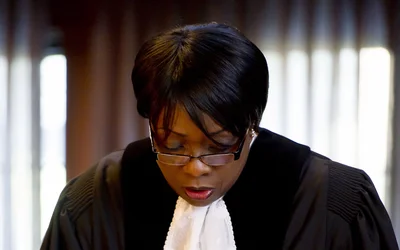
Okowa will be eligible to run for a full nine-year term in the next regular ICJ elections.
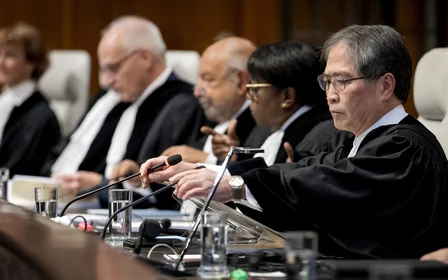
The 15-member bench of the ICJ adjudicates in disputes between states and issues advisory opinions on international law.
The court is currently hearing two cases related to Israel and Palestine: South Africa's case accusing Israel of genocide in Gaza, and Nicaragua's case accusing Germany of complicity in the genocide of the Palestinians.
Her election will help restore credibility to the court's panel of judges at a time of intense scrutiny, following controversy over Ugandan judge Julia Sebutinde’s public remarks in August 2025.
Sebutinde's comment that "the Lord is counting on me to stand on the side of Israel" prompted criticism from legal experts and calls for her disqualification over alleged bias.
Okowa is Professor of Public International Law and Director of Graduate Studies at Queen Mary University of London.
She also holds a bachelor of laws (LLB) with first-class honours from the University of Nairobi and postgraduate degrees (BCL, DPhil) from Wadham College, Oxford.
In 2021 she was elected to the International Law Commission (ILC), becoming the first African woman to serve on that body. The ILC is the UN’s leading panel of international-law experts, tasked with developing and clarifying the rules of international law.
ICJ ELECTIONS:
— Amb. Ekitela Lokaale (@eelokaale) November 12, 2025
Kenya has never had a Judge at the International Court of Justice @ICJ_org. The election of Prof. @PhoebeOkowa by the UN General Assembly and the UN Security Council in New York earlier today marks a historic moment not only for Kenya, but for the Court as Prof.… pic.twitter.com/0An8fM48vH
The jurist is also a member of the Institut de Droit International, an independent association of the world’s leading international-law scholars known for shaping key debates and contributing to the development of international legal norms since its founding in 1873.
Okowa’s scholarship focuses on state responsibility (notably for trans-boundary environmental harm), the law of armed conflict, and the accountability of states and international organisations in contentious settings.
Her book State Responsibility for Transboundary Air Pollution in International Law remains widely cited in the field.
In addition to her academic work, Okowa has acted as counsel or consultant for governments and non-governmental organisations in proceedings before international and domestic courts, including the ICJ and the International Tribunal for the Law of the Sea.
Her combination of academic scholarship and practical litigation experience will be of relevance to the court’s remit in fields such as state responsibility and environmental law.
Middle East Eye delivers independent and unrivalled coverage and analysis of the Middle East, North Africa and beyond. To learn more about republishing this content and the associated fees, please fill out this form. More about MEE can be found here.