Hillary Clinton says TikTok to blame for young Americans' pro-Palestine views. They disagree

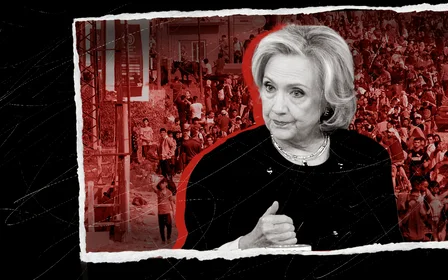
Hillary Clinton is facing a deluge of criticism after stating that young Americans' growing support for Palestinians is influenced by "totally made-up" videos on TikTok and suggesting that American youth - including young Jews - "don't know history and don't understand" Israel's war on Gaza.
Speaking on Tuesday at a summit hosted by the right-wing Israeli paper Israel Hayom in New York City, the former Democratic presidential candidate expressed her concerns that “smart, well-educated young people” in America and around the world are getting a lot of their information, including about Israel and Palestine, from social media platforms like TikTok.
The former US secretary of state described it as "serious problem for democracy", remarking that when she attempted to have "reasonable discussions" with young people, it was challenging because “they did not know history, they had very little context, and what they were being told on social media was not just one-sided, it was pure propaganda".
Social media influenced “not just the usual suspects, but also young Jewish Americans who don’t know the history and don’t understand,” she added.
Many users took to social media platforms to condemn Clinton's remarks as condescending and disengenuous.
New MEE newsletter: Jerusalem Dispatch
Sign up to get the latest insights and analysis on Israel-Palestine, alongside Turkey Unpacked and other MEE newsletters
“Erm, no lady,” one Reddit user wrote. “We saw through social media the horrors and war crimes filmed by IDF (Israeli) soldiers themselves every day that the mainstream media would never show. We also saw videos filmed by Palestinians themselves showing unarmed women with children being gunned down in the street, residential areas, and hospitals being bombed, etc, etc. These weren't misleading TikTok videos; we were watching the atrocities as they unfolded.”
One user on X, formerly known as Twitter, put it more simply: “Social media didn’t drop the bombs on Gaza. Israel did & the U.S. supplied them."
"What 'context' can possibly justify the mass slaughter of tens of thousands of civilians, 20,000 kids," asked journalist Laila al-Arian.
Another user argued that "biased" coverage in mainstream media was driving news consumers to social media platforms: "I have a lot of respect for journalism as a profession. I'm not a huge fan of the TikTok news model. However, when live on-the-ground videos prove that the media is far from unbiased and is, in fact, actively programming people with lies, you don't blame the ones exposing that truth.”
'Jews know our own history'
Several social media users objected to Clinton's assertion that young Jewish Americans "don’t know the history and don’t understand" the war.
"I find it offensive that a non Jew asserting that young Jews like me don't know the history of our people," said one user.
Other users agreed: "What a patronizing thing to say to many young Jewish Americans who refuse to accept a reality where our tax dollars are funding well-documented genocide and apartheid in the name of Jewish safety and survival."
In the past two years, TikTok has come under attack by US and Israeli politicians who allege that the platform spreads pro-Palestinian content.
Former Obama White House speechwriter Sarah Hurwitz recently claimed that the platform is "smashing our young people’s brains all day long with video of carnage in Gaza".
In September, Israeli Prime Minister Benjamin Netanyhu referred to social media as the "most important... weapon" to boost Israel's image in the United States and called the deal that would see pro-Israeli billionaires take over TikTok's operations in the US "the most important purchase".
Middle East Eye delivers independent and unrivalled coverage and analysis of the Middle East, North Africa and beyond. To learn more about republishing this content and the associated fees, please fill out this form. More about MEE can be found here.