Greece's alliance with Israel is becoming a domestic liability
Israel issued a rare warning to its citizens in Greece last Sunday ahead of nationwide pro-Palestine protests: avoid advertising your nationality in public.
The warning was striking in a country that Israelis have long regarded as a close ally, tourist and investment destination, and even a potential relocation haven.
But Israel's relationship with Greece is becoming increasingly complicated.
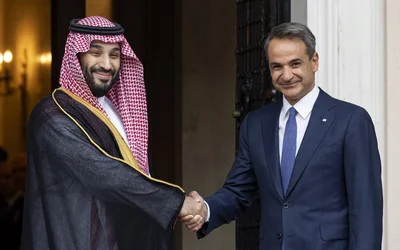
Rising rents, which many Greeks blame on Israeli property purchases, anger over Israelis jeering at pro-Palestinian demonstrations and Prime Minister Kyriakos Mitsotakis' close friendship with Israeli Prime Minister Benjamin Netanyahu are all fuelling anger.
"It's an asymmetrical relationship, where one side is powerful and the other powerless," Konstantinos Isychos, a former deputy defence minister who is opposed to the alliance, told Middle East Eye.
New MEE newsletter: Jerusalem Dispatch
Sign up to get the latest insights and analysis on Israel-Palestine, alongside Turkey Unpacked and other MEE newsletters
"Developing relations with Israel is a double suicide because, were the genocide to pass unnoticed and unpunished, it sets a criminal precedent and could be repeated again."
The hostility is reflected in public opinion.
A 2026 Pew Research poll found that 65 percent of Greeks opposed the partnership, although many view it as a necessary evil because of what they perceive as an expansionist Turkey.
On the streets, meanwhile, pro-Palestinian protests are vastly larger than the smattering of pro-Israeli ones.
For some Greeks, opposition to the relationship is increasingly inseparable from the money Athens is spending on Israeli weapons and surveillance technology during Israel's genocidal war on Gaza.
"There's never money available for better hospitals, firefighting aeroplanes, trains or pensions," Iason Apostolopoulos, a pro-Palestine activist and rescuer of migrants in the Central Mediterranean for Italian association Mediterranea Saving Humans, told MEE.
"But there's always funds for purchasing Predator [a surveillance programme] and arms packages from Israel that feed a military machine that daily produces occupation, death and apartheid."
That growing backlash is now being felt by Israelis who once saw Greece as an attractive escape from a country they regard as increasingly expensive, violent and dysfunctional.
Nearly 100,000 Israelis left their country for more than three months in 2025, marking a third record year.
Emigrants, who tend to be critical of Netanyahu’s policies, cite the constant threat of missile barrages and high cost of living as primary reasons for leaving.
"Buying property in Greece and Cyprus became the secular response to the settler project," Ehud Eiran, an associate professor of political science at the University of Haifa, told MEE.
"Whereas the project of the Orthodox was to go to the mountains and be religious, the project of the secular is to go West and buy property there."
Building up a partnership
According to Eiran, early Zionists originally sought to be accepted within the region in the hope that Israel could be negotiated out of the Ottoman empire.
David Ben Gurion studied in Istanbul, while early diplomat Abba Eban studied Arabic at Cambridge.
"Jewish pirates would join Muslims in attacking Christian galleys," Eiran noted, "and the few Jews involved in the naval battle of Lepanto, where the Ottomans clashed with Christendom, fought under the Ottoman flag."

But the early idea that Israel as a state could find a place within the region was severely undermined by the events surrounding Israel’s creation and the conflicts that followed.
Although current Israeli allies like Greece and India joined Muslim-majority countries like Egypt, Saudi Arabia, Iran and Turkey to vote against the UN Partition Plan for Palestine in 1947, it passed.
Fighting immediately broke out between Palestine's Jewish and Arab communities, prompting the British mandate authorities to withdraw instead of seeking to implement it.
Israel won four wars in a row in 1948, 1956, 1967 and 1973, prompting neighbours like Egypt and Jordan to begin concluding peace with it. These deals lacked popularity but offered strategic depth. The Abraham Accords initiated a fresh series of agreements in 2020, the most enthusiastic of which have been with Morocco and the UAE.
The subsequent rejection of Israel by much of the region eventually pushed the country towards alternative forms of regional integration, including a partnership with Greece.
The relationship has since developed from discreet military cooperation into one of Israel's most important strategic partnerships in the Mediterranean.
Greece and Cyprus offer Israel diplomatic and industrial access into the European Union, while permitting Israeli forces to simulate bombing or fighting in terrain similar to its regional antagonists.
Cyprus offers Israel access to a Lebanon-facing naval base, while the half of the island under Turkish military occupation is of interest since it brings Ankara into closer missile range.
The three countries are connecting their electricity grids, developing submarine natural gas reserves and discussing joint patrols in the Eastern Mediterranean.
A turning point came in 2010, when former Greek Prime Minister Yorgos Papandreou bumped into Netanyahu in a Moscow restaurant and invited him for dinner. The meeting helped pave the way for a closer relationship between the two countries.
Yet cooperation had existed long before then. Although Greece was among the last western countries to recognise Israel, in 1990, the Greek military junta secretly purchased weapons from Israel in the 1960s and discussed establishing joint arms factories.
That relationship was interrupted by the restoration of democracy in 1975, but ties resumed in the 1990s through intelligence and military cooperation. They became public in 2002 and expanded as relations between Israel and Turkey deteriorated.
Israeli fighter jets began using Greek airspace for training, giving Israel an important opportunity to prepare for long-range operations.
'The relationship with Israel puts Greece in a position to regulate situations in the Mediterranean and the Middle East'
- Alexandros Itimoudis, geopolitical analyst
"The average Israeli doesn't know that the ease with which their airforce flew to Tehran, including midair refuellings, was due to the training they had the opportunity to do over Greece," Angelos Raphael, a translator and tour guide living in Israel, told MEE.
In 2015, Greece became only the second country after the US to sign a military cooperation agreement with Israel, allowing the two countries to host each other's troops and materiel.
"A lot more must have been agreed on than was announced," said Isychos, whose tenure as deputy defence minister coincided with the signing but who was at daggers drawn with his minister.
The discovery of gas in the Eastern Mediterranean provided another incentive for closer cooperation.
"When we discovered gas fields in around 2010, we suddenly went from being an energy-poor country to an energy exporter," said Eiran.
"We settled maritime borders with Cyprus, planned to lay pipes and an electric connector from here to Greece... it was easier for us to talk publicly about energy and infrastructure rather than about Turkey as a common foe."
What began as an energy and security partnership has since developed into a much broader strategic relationship, centred on military cooperation, intelligence and the positioning of Israel and its allies around the Mediterranean.
Consequences of the Mecca Pact
That role has become even more important as Israel faces a changing regional security environment.
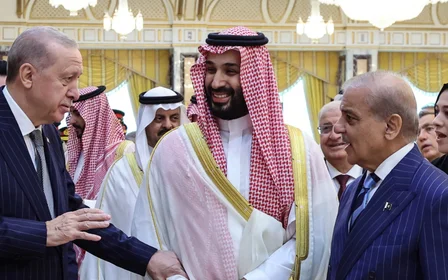
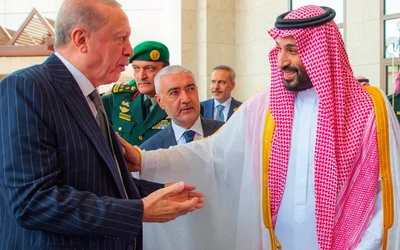
When Turkey signed a mutual defence pact on 7 August with economic heavyweight Saudi Arabia and nuclear-armed Pakistan, officials were careful to say the new alliance was not directed against any particular country, especially Iran.
But the absence of Egypt and the strategic weight of the three countries led to growing speculation in Israel that it was, in practice, directed at Israel.
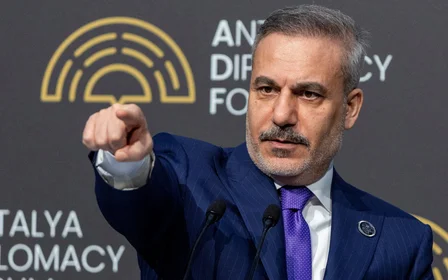
"It could have extremely serious consequences both in the Mediterranean and on the Syrian front," Israeli Diaspora Affairs Minister Amichai Chikli warned, "and it requires us to deepen our alliances with Greece, Cyprus, the UAE, Somaliland and India."
For years, Israel has been assembling what Netanyahu described as a "hexagon of alliances".
The partnerships are heavily maritime-focused, extending from the Indian Ocean through India, across the Persian Gulf via the UAE, into the Red Sea through Somaliland, and across the Mediterranean through Greece, Cyprus and Morocco.
Remarkably, Israel's choices of allies are all situated in or near strategic maritime chokepoints: Morocco is on one side of Gibraltar, controlling access to the Mediterranean; Greece controls the approach to the Turkish Straits; Somaliland sits opposite the Bab el-Mandeb bottleneck accessing the Red Sea; and the UAE bestrides both sides of Hormuz.
Greece and Cyprus, meanwhile, give Israel strategic depth in the Eastern Mediterranean.
"The relationship with Israel puts Greece in a position to regulate situations in the Mediterranean and the Middle East," Alexandros Itimoudis, a geopolitical analyst, told MEE.
"We give Israel strategic depth, knowing that they have a supportive Greece and Cyprus in the sea behind them."
With the Strait of Hormuz and Bab el-Mandeb currently out of bounds to Israel because of military action by Iran and Yemen's Houthis, the Mediterranean has assumed greater importance.
Israel has deepened intelligence and defence cooperation with Morocco, alongside diplomatic support for Rabat’s claim over the Spanish semi-enclave of Ceuta.
In the Eastern Mediterranean, meanwhile, it has strengthened ties with Greece and Cyprus, while supplying weapons that form part of a broader security network facing their common Turkish adversary.
But Israeli analysts are careful not to overstate the relationship.
"It's a strong partnership but I wouldn't call it an alliance," said Gallia Lindenstrauss, a specialist on the Eastern Mediterranean at Israel’s Institute for National Security Studies.
"There's a building up of independent capabilities but without expectations that the sides will come to each other as help in dealing with the adversary in times of conflict."
Arms sales and positioning
The strategic relationship is perhaps most visible in the rapid expansion of Israeli arms sales to Greece.
Israel completed a hat-trick of major Mediterranean air-defence sales in July when Greece agreed to a €3bn deal involving many of the same systems sold to Morocco and Cyprus in 2022.
The agreement will give Greece a unified national air-defence system while potentially linking Israeli-dominated air-awareness networks at opposite ends of the Mediterranean - possibly through hidden protocols sharing telemetry and offering a backdoor switch into the equipment's source code.
There have also been questions over whether the anti-missile shield Greece provided to Saudi Arabia could contain a Trojan Horse element benefiting Tel Aviv.
In April, Greece agreed to spend €650m on 36 rocket artillery launchers, precision-guided missiles with ranges of up to 300km, loitering munitions and a 10-year support package from Israel’s largest arms manufacturer, Elbit Systems.
In August, Athens bought €1.5m worth of armoured vehicles from Israeli manufacturer Shladot, building on an earlier deal with the Greek police to acquire the rugged vehicles frequently seen in media coverage of the occupied West Bank.
Greece also plans to co-produce a hard-to-detect submarine spy drone, the Blue Whale, with Israel Aerospace Industries. The vessel can remain submerged for up to a month.
For critics of the partnership, the appeal of Israeli military technology is inseparable from its use in Israel’s genocidal war on Gaza and decades of occupation.
"Israel's arms industry owes its success to its ability to test its weapons on Palestinians, proving through these endless human labs how useful they are," Yaar Dagan, a lecturer in international law at Middlesex University and author of the forthcoming title Drones, Settler Colonialism, and the Law: How Israel Became a Drone Superpower, told MEE.
"What other country can prove that they've tested their weapons on thousands of people in thousands of locales?"
The €3bn air-defence system will also be interoperable with Nato's Link 16 cryptographic communications system, further integrating Greece into a wider military architecture.
AI development
The relationship is moving beyond conventional arms sales into artificial intelligence and military data systems.
Greece is developing an artificial intelligence-powered Command and Control (C2) network designed to combine data from existing Greek sensors and radars with Nato-standard information from Greek F-16s and F-35s and feed it into the Achilles Shield system.
A custom-built Israeli C4I control centre will combine inputs from Israeli-purchased ELM-2084 radars and Greek fighter jets, allowing the system to track enemy drones in real time and minimise data-transfer delays.
"No system offers 100 percent protection and we still don’t know how it will react in real-world conditions," retired Lieutenant-General Konstantinos Loukopoulos told MEE.
'Greece has great brains but because it's largely corrupt, it fails to maximise them'
- Benny Nathan, professor at Technion
"After all, look how many times the Iron Dome or even the Patriot, which is a standalone system, have been penetrated by Iranian missiles."
The Achilles Shield forms part of the biggest defence overhaul in modern Greek history.
Defence spending has risen from $5.5bn in 2019 to more than $8bn a year.
Under its 2030 project, Greece plans to spend nearly €28bn on military modernisation by 2036, taking defence spending to 3.5 percent of GDP. Its purchases include three C-390 Millennium transport and refuelling aircraft, Hellfire missiles for Apache helicopters and sonar systems for frigates.
"Greece is not preparing only for a traditional conflict involving aircraft, ships and armoured units," Aleksander Olech wrote in Defence 24. "It is preparing for a high-intensity battlefield in which drones, missiles, electronic warfare and the speed of data processing will determine the effectiveness of the armed forces."
But Athens is seeking more than access to Israeli weapons. It wants to develop and manufacture military technology jointly, using cooperation with Israel to gain expertise and technology while making greater use of its own pool of engineers and scientists.
Israel, however, sees an opportunity of its own.
"Greece has great brains but because it's largely corrupt, it fails to maximise them," said Benny Nathan, a Greek-Israeli professor at the Faculty of Aerospace Engineering at Technion, Israel's primary technological university.
"It wants to exploit them so they can function more like Israel's talents function, meaning that Israel wins the brains and Greece gets the know-how."
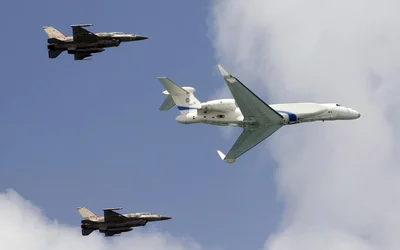
Israeli companies have also expanded their footprint in Greece’s defence sector, acquiring companies that can apply for European Union defence-sector funding.
Turkey has pursued a similar strategy by acquiring defence companies in Italy.
The partnership has extended into surveillance technology, too. Israel has authorised the sale of sophisticated spyware such as Predator and Pegasus to Greece and Morocco, respectively, and possibly to Cyprus.
The software is believed to contain a technological backdoor, potentially allowing Israel to benefit diplomatically from access to intercepted communications.
For Greece, however, the growing strategic value of the partnership comes with a political cost.
The closer the two countries become militarily, the harder it is for Athens to separate its relationship with Israel from the public anger generated by Israel’s genocidal war on Gaza.
Ordinary Greeks and Cypriots increasingly criticise their country’s partnership with Israel, fearing a form of soft colonisation, and point to proposals to purchase Greek islands or examples where Israeli investors blocked off access to the coast or to entire villages following their purchases.
And as Israel seeks to build a network of Mediterranean alliances to compensate for a rapidly changing regional environment, Greece is finding itself at the centre of a relationship that many of its citizens increasingly question.
Middle East Eye delivers independent and unrivalled coverage and analysis of the Middle East, North Africa and beyond. To learn more about republishing this content and the associated fees, please fill out this form. More about MEE can be found here.