‘Hereness’: What the forgotten history of Jewish anti-Zionism can teach us today

British Prime Minister Andy Burnham ruled out a coalition with the Green Party last week after its members passed a motion declaring that “Zionism is racism”, on the grounds that the party is antisemitic.
The motion argues that Zionism, the ideology behind Israel’s creation, is rooted in colonisation and Jewish ethnic supremacy over Palestinians, positioning the party in opposition to it.
Green Party leader Zack Polanski did not vote on the motion due to certain amendments that failed to pass but describes himself as an anti-Zionist Jew.
He hit back in a post on X, calling Burnham “a Prime Minister who arms a genocide and locks pensioners up for opposing it” and accusing him of “the dangerous & irresponsible blurring of challenging Israel & Antisemitism”.
Zionism was a fringe ideology for much of Judaism's modern history, only becoming mainstream in Jewish communities and institutions within the past 75 years.
New MEE newsletter: Jerusalem Dispatch
Sign up to get the latest insights and analysis on Israel-Palestine, alongside Turkey Unpacked and other MEE newsletters
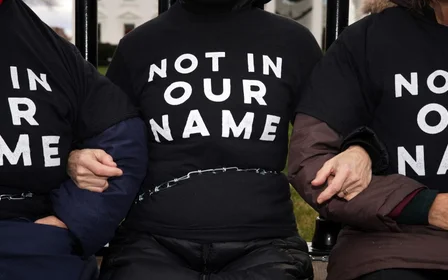
Nevertheless, defenders of Israel routinely conflate Judaism and Zionism to tar critics of Israel as antisemites, erasing the Jewish identity of anti-Zionists such as Polanski and perpetuating the antisemitic notion that Jewish people are monolithic and singularly invested in the Israeli state.
While most British Jews still identify as Zionists, younger generations are increasingly distancing themselves from the label.
The trend is more pronounced among American Jews - only a third of whom identify as Zionists.
Those aged 18-34 are the most likely to describe themselves as anti-Zionist or non-Zionist.
Many of these Jews are uncovering a forgotten history of Jewish anti-Zionism and encountering Jewish identities that could once again become a dominant force within the community.
The Bund movement
When Zionism emerged in the 1880s and 90s, it faced opposition from wide sections of Jewish society, particularly among the Bundists.
Founded in Eastern Europe in the late 19th century, the Jewish Labour Bund was a socialist workers’ movement committed to preserving Jewish cultural identity, or Diaspora Nationalism, alongside a broader internationalist class struggle to emancipate workers from capitalism.
By the beginning of the 20th century, it was the largest and best-organised Jewish party in Eastern Europe, claiming 34,000 members across 274 branches.
Molly Crabapple’s recent book, Here Where We Live Is Our Country, traces her family’s Bundist history, and has received widespread acclaim from Jews and non-Jews interested in this past.

“As American Jews turn away from Zionism, they are seeking these … liberatory, solidaristic and universalist histories which are so present in our story,” Crabapple told Middle East Eye.
A central tenet of Bundism, particularly after the Holocaust, was the concept of “hereness” - or “doikayt” in Yiddish - opposing the Zionist notion that Jewish safety depended on an ethnostate halfway across the world.
“Zionism has always been a movement that gave into antisemitic European logic,” Crabapple continued, submitting to the “European ethnonationalist idea that Jews are foreigners who belong elsewhere”.
Her book documents how Zionists collaborated with Poland’s antisemitic government in the late 1930s, which armed, trained and funded Zionist militias in Palestine and armed youth militias in Poland that murdered Jews.
Arthur Balfour, namesake of the 1917 Balfour Declaration establishing Israel as a “Jewish national home”, described Zionism as a “serious effort to mitigate the age-old miseries created for western civilisation by the presence in its midst of a body [Jewish people] which is too long regarded as alien and even hostile, but which it was equally unable to expel or absorb”.
Edwin Montagu, the only Jewish member of the British Cabinet in 1917, was also the sole member opposing the declaration, predicting that it would “prove a rallying ground for antisemites in every country in the world”.
For non-Zionist Eastern European Jews facing antisemitism in the 20th century, doikayt articulated “a commitment to worldmaking in the places where Jews lived, called home, [and] belonged for centuries”, explained Miriam Chorley-Schulz, a Holocaust scholar at University of Oregon.
“Against Zionism’s settler-colonial solution to the ‘Jewish Question’, this commitment opposed Jewish ‘normalisation’ within racial capitalist structures through ethnostate-building in Palestine, insisting on fighting the material and ideological conditions of oppression here and now instead,” she told MEE.
‘Bundist counterculture’
“Opposition to Zionism was as obvious to the Bund as opposing fascism and any other nationalist violence: Jewish nationalism was just as ugly, just as contemptuous as any other,” Eyshe Beirich, who translated an upcoming collection of Yiddish Bundist writings, We, Traitors, told MEE.
As socialists, Bundists organised Jewish trade unions and mass demonstrations with tens of thousands of Jewish workers and students.
In Russia, they played a significant role in the revolutions and organised Jewish self-defence during the 1903-1906 pogroms.
Bernard Goldstein, the head of the Bund militia in Poland, advocated for armed resistance to Nazi persecution and helped to smuggle weapons ahead of the 1943 Warsaw Ghetto uprising.
Bundists helped establish the first secular Yiddish school system and institutions giving “education, mutual aid, and organisational support to Jewish workers all over Poland”, Beirich said, building what Jack Jacobs called a “Bundist counterculture”.
Yiddish, a European Jewish vernacular spoken by most Jews at the time, was celebrated by the Bund as a secular Jewish language preserving shared culture.
For Bundists, Beirich explained, “Yiddish carried the idioms and revolutionary spirit … of the Jewish working class, and it was incumbent on the Bund to support its development.”
Although some Zionists supported Yiddish education in Poland, most mainstream Zionist parties opposed the school system, and even collaborated with the Polish government to shut them down, Beirich told MEE.
“The Zionist movement eventually opted for an aggressive Hebrew revivalism - a nationalist monolingual project that deliberately suppressed languages spoken by diasporic Jews … as both a tool of negating the diaspora and nation-building in the settler colony,” Chorley-Schulz added.
Yiddish, like the Bund itself, was largely destroyed through the Holocaust or assimilation, only surviving in Orthodox or ultra-Orthodox Jewish communities. However, some are now looking to resuscitate both the movement and its language.
The conscious pariah
Many Jews fleeing Eastern Europe settled in America, bringing “Bundish” ideas which helped build Jewish American socialism during the height of labour organising in the 1880s, joining other immigrants to found mutual aid organisations and celebrate their culture.
Benjamin Balthauser’s book, Citizens of the Whole World, revisits the history of the American Jewish left.
Among American Jews, there remains a “long memory of a Jewish fight against fascism, nationalism, racism”, Balthauser explained.
“That was a Bundist idea: that we are proud of our Jewish heritage, of our Jewish identity, but also want to be in solidarity with the working class, with anti-colonial struggles around the world” - including in Palestine.
"There is no need for any one of us to serve in the IDF. The IDF should not exist. The state of Israel should not exist." Former Israeli soldier, Meital Yaniv, talks about her experience in the IDF and how it turned her into a peace activist and an anti-Zionist organiser. https://t.co/Zm3jRPzjZe
— Middle East Eye (@MiddleEastEye) January 8, 2024
“This memory is coming back … a memory that is buried, but it's a very shallow grave,” Balthauser said, as more American Jews are “remembering this older language, and also realising that this language is not that old”.
In his new book, Anti-Zionism: A Jewish History, Benjamin Moser explores past and present Jewish anti-Zionists largely overlooked in an effort to elide Judaism with Zionism.
He argued that Jews have traditionally occupied the role Hannah Arendt called the “conscious pariah”, which was part of why they were so often targeted by European elites during times of crisis.
Moser told MEE that what tied together these Jewish anti-Zionists across different places and times was that “they are all pariahs, all resistors” who “don’t want to go along with the rationale of power and violence”.
Arendt, one of the figures he examines, wrote about Zionism as a means of “getting Jews to disengage from their own societies”, rather than see themselves as interconnected with other oppressed people and the wider working class.
Reflecting on Theodor Herzl’s The Jewish State, Arendt wrote in 1946: “Only when we come to see ourselves as part and parcel of a world in which we, like everybody else, are engaged in a struggle against great and sometimes overwhelming odds, and yet with a chance of victory, however small, and with allies, however few… only then will we be able to rid the world of its nightmarish quality.”
For anti-Zionist Jews like Moser, the role for these conscious pariahs is now more important than ever.
Middle East Eye delivers independent and unrivalled coverage and analysis of the Middle East, North Africa and beyond. To learn more about republishing this content and the associated fees, please fill out this form. More about MEE can be found here.