NAZA: It’s not just about Israel and Gaza. It’s about the evil lurking in us all


I have just seen NAZA, a documentary in which 24 Israeli intelligence officers and soldiers are filmed explaining how, over the past three years, they went about systematically wiping Gaza off the map.
They did so while nearly every western capital either chose to keep silent or actively assisted in the slaughter.
The filmed interviews take place at night, on the roof of a building in central Tel Aviv. The participants’ faces are masked by darkness, while, in the background, unidentifiable human figures can be seen going about their business in lighted apartments and offices: watching television, hanging the washing, seated at a desk.
Unlike the Venice Film Festival, where the film received a record 25-minute standing ovation, the sold-out screening I attended greeted NAZA with stunned silence.
The credits rolled. The lights went up. We traipsed to the exit. No one said a word.
New MEE newsletter: Jerusalem Dispatch
Sign up to get the latest insights and analysis on Israel-Palestine, alongside Turkey Unpacked and other MEE newsletters
That seemed a much more fitting response than the one in Venice. Ever since, I have been pondering what exactly our stunned silence meant.
Was it shock at the horrors inflicted on Gaza?
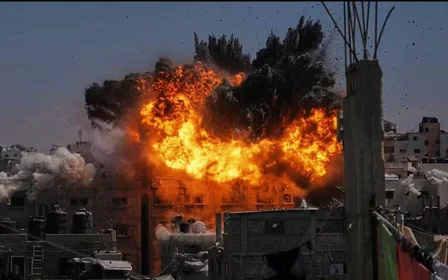
Not really. Barely any of the destruction and mass-killing was shown. We have seen far, far more of the genocide live-streamed on our phones.
Was it the fact that none of the interviewees appeared to regard the official figure of nearly 75,000 dead in Gaza and 175,000 maimed a Hamas-inspired fiction, as the Israeli government continues to claim, with the western media following suit?
In fact, the strong impression conveyed by these military insiders is that the true death toll is likely to be far higher.
Killing by algorithm
Was it the astonishing lack of self-awareness and reflection among most of the interviewees, who spoke drily - mostly indifferently - about the technical aspects of Israel’s innovative AI systems, which drove target selection to destroy homes and kill Palestinians on an unprecedented, industrial scale?
Selected from more than 100 Israeli military personnel who spoke to the film-makers off camera, the chosen 24 included some who had helped engineer what they called a "factory" for murdering Palestinians.
Others operated this production line, killing by algorithm, as though, in their words, they were playing a "video game".
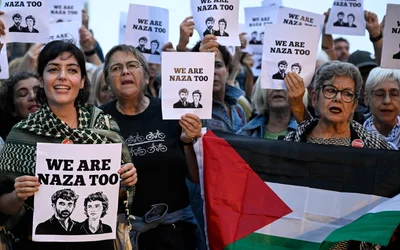
According to the interviewed soldiers, for every person suspected of being in Hamas, however junior their status, Israel authorised the killing of between 20 and more than 100 NAZA - the Hebrew acronym for Palestinian bystanders, including women and children.
When Hamas carried out its one-day attack on Israel in October 2023, the Israeli military claimed the group had around 30,000 fighters.
In addition, Israel - and its AI machinery - connected a far larger portion of the population to Hamas, if only because individuals worked for the Gaza government’s political, bureaucratic and administrative arms, from school teachers to doctors and nurses.
The film’s interviewer, Yuval Abraham, put to one interviewee a simple observation about the maths.
According to the logic of Israel’s NAZA doctrine - permitting potentially dozens of civilian deaths for every Hamas-linked target - almost the entire 2 million inhabitants of Gaza were viewed as acceptable "collateral damage".
The intelligence official mulled this point over for some time, as though it had never occurred to him, before agreeing.
Israel's human shields
Was the stunned silence our distaste at Israel’s decision to launch strikes on Hamas suspects at the very moment when the largest possible number of civilians would be killed alongside them?
The film was about the horror lurking within each of us. What the German-Jewish philosopher Hannah Arendt called 'the banality of evil'
Israel called one of its main AI programmes "Where’s daddy?" because, by tracking the location of phones and listening into calls, the system was able to flag when suspects were most likely to be at home, spending the night away from the fighting, with their families.
One interviewee provided an example of a 12-year-old girl who phoned to tell her mother that daddy was home and asked when she would return to the house. The words "daddy" and "return" were enough to trigger an alert by the AI system, setting up a military strike.
Such attacks, the officer confessed, are designed to kill children and neighbours within the blast range.
Several interviewees carrying out surveillance noted hearing children in the home of a suspect shortly before they authorised an attack. Others heard the screams of children immediately after the explosion, mutilated by the blast or in shock from the mangled bodies around them, or both.
At one point in the film, the camera breaks off from the interviews to circle in on the Israeli military’s headquarters, the Kirya, amid the glinting skyscrapers of central Tel Aviv.
According to the laws of war, the Kirya could be a legitimate military target. Its location intentionally risks turning the residents of Israel’s largest city into human shields.
By contrast, Palestinian militants sleeping at home with their families are not a legitimate military target. Yet the "Where's daddy?" programme required Israel to make human shields of Palestinian children on an industrial scale, in the grossest of violations of international law.
'Just following orders'
Was the stunned silence our discomfort at the soldier who readily confessed that Israel had committed a "genocide" in Gaza - and that from the outset his goal, and that of everyone he worked with, was to kill as many Palestinians as they could get away with.
In his words, he personally used Israel’s military AI systems to oversee the killing of "thousands" of Palestinians. He called this period of his military career "insanely fun".
Another interviewee who was responsible for the mass murder of Palestinians observed that, not only was he serving in Israel’s most prestigious intelligence unit, 8200, but that he had secured one of the unit’s most prized jobs. He noted how envious other officers were of his position in the automated killing machine.
Was the stunned silence our revulsion at the fact that interviewee after interviewee rationalised their participation in the slaughter and maiming of many tens of thousands Gaza’s children with variations of the excuse that they were "just following orders"? One called himself a "small cog" in the machinery of murder.
Was the stunned silence our unease at the participant who noted that he had been raised to hate Germans because of the Holocaust, but then admitted that he was now struggling to see the difference between what the Nazis did and what he had done in Gaza?
Was the stunned silence borne of audience recognition that AI’s frictionless, impersonal acts of surveillance, target selection and execution in Gaza are already being rolled out much closer to home?
That clever, career-minded, obedient young people, just like the ones who engineered Israel’s AI system of absolute control, of inescapable surveillance, of unfeeling murder are designing the same automated system of judge, jury and executioner for us?
What we see on the screen is the prototype for a new kind of AI-enhanced security state, one that will serve as a Pitiless Panopticon in which we are all prisoners. One where even the democratic pretence of rulers being accountable to the ruled collapses.
The horror within
The audience’s shock, I suspect, was at all these things. But there was an even deeper reason why NAZA left us speechless.
This film isn't about the tangible, visible horror of Gaza - a horror we have seen so much of over the past three years on our screens.
Today’s western privileges were built on a long history of naked, racist colonialism - of greed, of pillage, of slavery, of genocide. Israel continues that tradition for us
It was about something more hidden, something far closer to home. This was about the horror lurking within each of us. What the German-Jewish philosopher Hannah Arendt called "the banality of evil".
We were stunned, I think, by the realisation that the 24 Israelis up on the screen - each of whom admitted, often dispassionately, sometimes a little proudly, carrying out the most monstrous of crimes - could have been our son or daughter, our brother or sister.
The only reason to applaud, it seemed to me, was to drown out the still, small voice of one’s conscience asking, "Might I have done as they did? Might my children?"
NAZA is a gut punch not because it tells us anything we did not already know or suspect about Israel and Gaza.
The enclave’s Palestinian journalists showed us daily the evidence of the genocide, before each was picked off by Israel’s AI machinery - in the largest slaughter of media personnel ever recorded.
No, the film tells us something far more shaming. It tells us who we are. It tells us exactly what the pillars of our western "civilisation" stand on.
Today’s western privileges were built on a long history of naked, racist colonialism - of greed, of pillage, of slavery, of genocide - that we have never truly renounced or forsaken.
Israel continues that tradition for us, both in sharpening colonialism’s technical efficiency with endless, murderous experimentation on a captive Palestinian population, and in obscuring our own complicity in this barbarity.
That is the reason why it was so effortless for our leaders to collude in Israel’s genocide: to supply the bombs, to pass on the intelligence, to provide the diplomatic cover, to excuse the "excesses", to crush the protests.
NAZA silences us not because of the monstrosity of what Israel did but because it serves as irrefutable proof of our own monstrosity. Our societies watched it all and did nothing. We are all guilty.
The views expressed in this article belong to the author and do not necessarily reflect the editorial policy of Middle East Eye.
Middle East Eye delivers independent and unrivalled coverage and analysis of the Middle East, North Africa and beyond. To learn more about republishing this content and the associated fees, please fill out this form. More about MEE can be found here.