

More than 70 killed in fighting between Pakistan's military and Baloch separatists

At least 73 people were killed in clashes between Pakistan's military and Baloch separatists after the fighters launched a series of attacks across the province of Balochistan in the deadliest day in Pakistan in recent years.
Nearly two dozen Pakistanis travelling to Balochistan from the Punjab province were shot dead in one of the attacks, a sign of simmering tension between Baloch separatist groups and outsiders to the region.
The attacks were launched on Sunday night, with several targeted sites including police and security stations, according to Pakistani officials.
The Baloch Liberation Army claimed responsibility for the attacks, saying that it targeted military personnel in civilian attire. The BLA said the attacks were part of an operation called Haruf (dark windy storm).
The BLA also mentioned several other attacks to journalists that have yet to be confirmed by authorities.
The chief minister of Balochistan said that 38 civilians were killed in the attacks, while 14 Pakistani soldiers and a total of 21 Baloch fighters were also killed.
The BLA says that 130 "enemy personnel" were killed in their operation, according to an official statement posted on X.
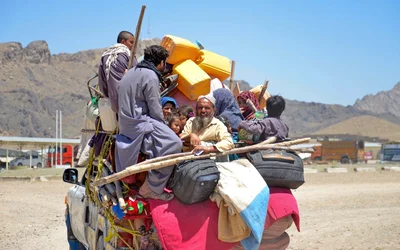
In one attack in the Musakhail district, the Pakistani government said that 23 people were killed after armed men forced people off buses and trucks and shot them after verifying their identities as migrant Punjabi workers.
"People were taken off buses and killed in front of their families," Chief Minister Sarfraz Bugti said in a televised press conference.
The BLA has been battling the Pakistani government for greater regional autonomy for over two decades, saying Islamabad has been exploiting the province's natural resources including gas and precious metals in the province.
The group seeks a sovereign state and has also demanded greater economic investment from the federal government.
Baloch fighters have previously attacked Pakistani citizens from the eastern province of Punjab who represent the country's largest, and most politically powerful ethnic group.
The BLA has called for the independence of the province and also for the expulsion of China, which it sees as playing a role in the region's exploitation, with Beijing running the deepwater port at Gwadar as well as gold and copper mines.
On Monday Pakistan's army chief Asim Munir met with the commander of China's military, Li Qiaoming, but a readout of the meeting made no mention of the attacks.
Thousands of Baloch disappeared or killed
Monday was also the anniversary of the death of Baloch leader Nawab Akbar Bugti, who was killed in 2006 by Pakistan's military, a killing that put Pakistan's former President Pervez Musharraf on trial but from which he was acquitted in 2016.
Bugti was a former chief minister of Balochistan and had served multiple roles in the federal government but was involved in greater separatist activity only a year earlier in 2005, after disagreements with the state.
Balochistan is Pakistan’s largest province by area, however, it is home to only 15 million of the country's more than 240 million-strong population.
The region is home to vast natural resources, including reserves of oil, coal and precious metals. But despite the province's riches, the local population is the country's most impoverished and the region is highly underdeveloped.
Many Balochs in the province, including those in armed groups, accuse the central government of exploitation and say their population's needs are not being met.
Armed groups have meanwhile been battling a two-decades-long insurgency against the military, which in response has cracked down on the region.
As a result, thousands of Balochs in the province have died or disappeared, and a growing movement in recent years has laid the blame for these disappearances on the Pakistani government.
Mahjong Baloch, an activist and leader of the Baloch Yakjehti Committee, held a sit-in in Islamabad in January as well as another similar protest in Gwadar city in Balochistan.
Pakistan's central government accuses the BYC of being a proxy for separatist groups.
Middle East Eye propose une couverture et une analyse indépendantes et incomparables du Moyen-Orient, de l’Afrique du Nord et d’autres régions du monde. Pour en savoir plus sur la reprise de ce contenu et les frais qui s’appliquent, veuillez remplir ce formulaire [en anglais]. Pour en savoir plus sur MEE, cliquez ici [en anglais].