Live: Israel dropped 153 tonnes of bombs on Gaza on Sunday

Live Updates
Forty-five activists detained by Israeli forces from aboard Gaza-bound Freedom Flotilla vessels arrived in Jordan on Sunday, Jordan's foreign ministry has reported in a statement on X.
The group, which includes nationals from Tunisia, Spain, Belgium, France, Germany, Italy, Ireland, Finland, the US and Canada, arrived in Jordan via the King Hussein (Allenby) Bridge crossing between the occupied West Bank and Jordan.
Israeli naval forces illegally intercepted the nine-boat convoy which was bound for Gaza with the intention of breaking Israel's illegal siege on the territory. They detained the 150 activists on board.
A Hamas source close to the group's negotiating committee has told AFP that the group will not take part in Gaza's post-war governance.
"For Hamas, the governance of the Gaza Strip is a closed issue. Hamas will not participate at all in the transitional phase, which means it has relinquished control of the Strip, but it remains a fundamental part of the Palestinian fabric," the source said.
On the question of disarmament, a Hamas official told AFP on Saturday that the weapons handover outlined in the second phase of Trump's plan is "out of the question and non-negotiable".
Under Trump's original plan, the next stage of the deal would involve the dismantling of Hamas's military infrastructure and the demilitarisation of Gaza, calling for the enclave to become a "deradicalised terror-free zone that does not pose a threat to its neighbours".
However a leaked copy of the agreement does not stipulate a weapons handover, nor whom should govern the Strip.
But experts quoted by Al Jazeera have reported that the group have privately communicated to interlocutors that it is open to "a decommissioning process of Hamas's offensive weapons".
An armed group has the right to bear arms and resist an occupying power in line with international law.
Israeli Prime Minister Benjamin Netanyahu has pledged that "Gaza will be demilitarised".
"If this is achieved the easy way, then that will be good, and if not, then it will be achieved the hard way."
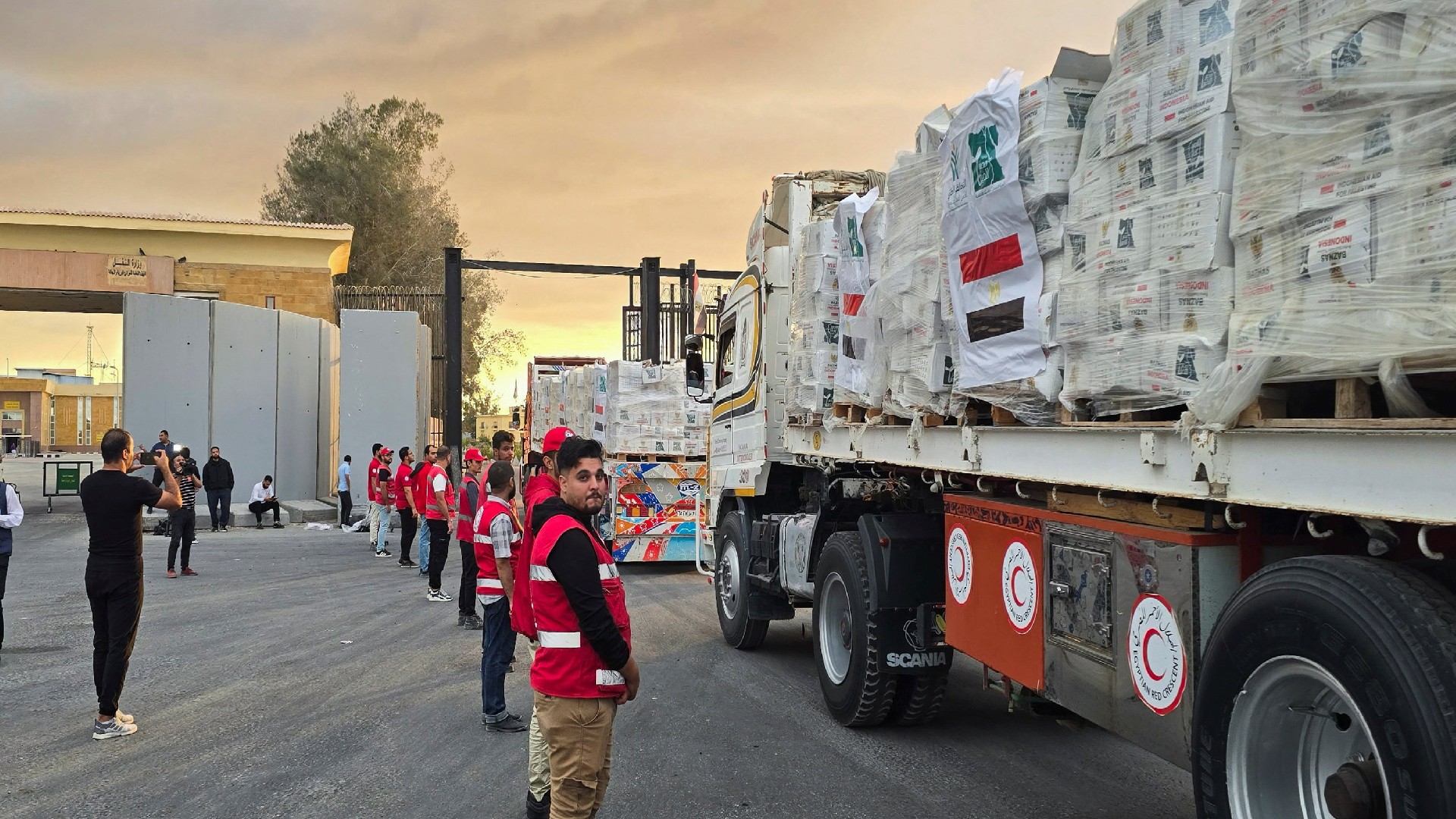
Aid trucks have begun to arrive, as UN agencies prepare to dramatically scale up deliveries as part of the ceasefire deal which stipulates that 400 trucks will enter the strip daily.
This is set to increase to 600 - the minimum number estimated by the UN required to address the humanitarian crisis in the strip.
Trump's 20-point plan states that the entry and distribution of aid into Gaza will "proceed without interference", but Israeli administrative restrictions and bureaucracy have long hampered the flow of badly needed aid into the territory.
Large-scale aid distribution will be led by the UN, although the role of the UN Agency for Palestinian Refugees (Unrwa) in the operation remains unclear.
The agency has said half the supplies stored in warehouses outside Gaza belong to the agency, emphasising that their scope and expertise within the territory is "absolutely critical in controlling the spread of famine".
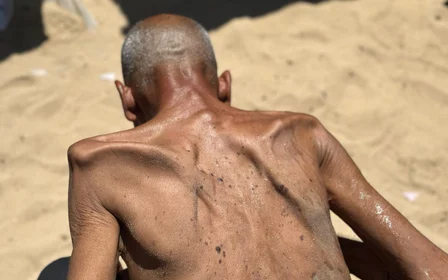
An estimated 460 Palestinians have died from Israeli-imposed starvation since it launched its genocide in Gaza in October 2023.
The UN children's charity Unicef warned that there is a risk of a "massive spike in child death, not only neonatal, but also infants, given their immune systems are more compromised than ever before".
As the UN prepares to take over aid distribution, the scandal-plagued US and Israeli private contractor Gaza Humanitairan Foundation (GHF) is dismantling its hubs across the strip. Israeli soldiers shot large numbers of Palestinian aid seekers at the distribution sites, which one UN official described as "sadistic death traps".
Al Jazeera reported that remnants of Israeli munitions that had been used to attack Palestinians were found at the sites.
Mutual aid groups told MEE that tents, trailers and materials for constructing shelter are the number one priority given the onset of wintry weather, shortly followed by medical supplies and doctors.
Mohammad Zaqout, the director general of hospitals in Gaza, told Al Jazeera that medical supplies and medicines are urgently needed, but none have arrived yet. He added that Israel is obstructing the entry of medical delegations into Gaza.

Israeli authorities have threatened the families of Palestinian prisoners slated for release on Monday, raiding their homes and warning them not to celebrate their return.
Israel is set to release 2,000 Palestinian prisoners, including 250 serving life sentences and hundreds of men, women and children seized from Gaza and held without charge. In exchange, Hamas will release the estimated 20 living Israeli captives as well as several bodies of dead Israelis held in Gaza, believed to be 28 others.
On Friday, Israel's interior ministry published the names of 250 Palestinian captives slated for release.
Several high profile Palestinians have been excluded, including Marwan Barghouti - whose name was unilaterally removed from the prisoner exchange list by Israeli Prime Minister Benjamin Netanyahu's office. On Saturday, a Hamas official told CNN that two detained Palestinian doctors, including paediatrician Hussam Abu Safiya, will not be released.
Israeli troops raided the homes of the families of prisoners set to be released in the occupied West Bank, Wafa news agency is reporting, citing local sources. According to reports, troops raided homes in multiple neighbourhoods in Nablus, Balata and Askar Al-Jadid refugee camps, as well as the towns of Salem to the east, and Aqraba and Zeita Jamma'in to the south.
Israeli forces also raided homes in Hebron and Deir Samet.
Meanwhile, preparations in Israel are under way for the release of the captives held in Gaza. They will be received by members of the International Committee of the Red Cross and then handed over to the army. Medical staff will then give them a checkup and transport them to Israel.
US President Donald Trump is set to arrive in Israel on Monday and will meet with captives' families.
US President Donald Trump and Egyptian President Abdel Fattah al-Sisi are set to co-chair a Gaza peace summit in the Egyptian city of Sharm el-Sheikh on Monday to discuss Trump's proposal to end Israel's genocide in Gaza.
The Egyptian presidency said that the summit aims to "end the war in the Gaza Strip, enhance efforts to achieve peace and stability in the Middle East, and usher in a new era of regional security and stability".
Some 20 heads of state are set to attend, including French President Emmanuel Macron, Turkish President Recep Tayyip Erdogan and UK Prime Minister Keir Starmer, as well as United Nations Secretary-General Antonio Guterres.
Axios is reporting that leaders or foreign ministers from Germany, Qatar, the UAE, Jordan Saudi Arabia, Pakistan and Indonesia are also set to attend. It is currently unclear whether Israeli Prime Minister Benjamin Netanyahu will participate. Hamas is also yet to confirm if any of the group's representatives will attend.
Palestinians are returning home to find flattened neighbourhoods, forcing them to erect makeshift tents on the rubble and search through the debris for scraps of clothing and blankets as wintry conditions begin to set in. In Gaza City, bulldozers have begun clearing the rubble, but it is a drop in the ocean. The equipment they are using is decrepit.
Ali al-Attar, a bulldozer operator told Al Jazeera that the scale of the devastation is "beyond imagination".
"Just opening the roads alone will take at least a month, just so people can access the area," he said. "The bulldozers are in poor condition. The one I'm using is leaking oil and needs major repairs. To be honest, we need 20 times the number of bulldozers we have got."
Latest UN satellite imagery shows that 41,000 housing units have been flattened in Gaza City alone - translating into over eight million cubic metres of rubble.
In Khan Younis, residents spoke to Anadolu Agency, describing devastation akin to a "tsunami or a 10-magnitude earthquake".
Abdel Malek Al-Farra, 63, told Anadolu as he sifted through the wreckage of a four-storey apartment block that he had spent his life in, that "we came back hoping to find a shelter, but everything is rubble - even the empty plots of land are devastated".
"Where do we live? Where do we go? If we head to the sea, we'll drown if the waves rise. We'll drown inside the tents once the rains start, as tents don't protect us," he said.
Withdrawing Israeli forces left fragments of explosives and booby-trapped vehicles in their wake. The few remaining structures bear traces of racist graffiti left by soldiers.
Good morning Middle East Eye readers, here are the latest updates:
-
Tens of thousands of Palestinians have returned to Gaza City to find devastation. They are erecting makeshift tents as wintry conditions begin to set in.
-
Bulldozers have begun to clear the rubble in Gaza City, however the equipment is in poor condition. According to UN satellite imagery, around 4,000 housing units have been flattened in Gaza City alone. This translates into over eight million cubic metres of rubble that needs to be cleared before reconstruction can begin.
-
As people returned to Khan Younis, they reported devastation akin to a "tsunami or a 10-magnitude earthquake".
-
Palestinian civil defence reports that at least 150 bodies have been transferred to hospitals since Friday, most of these recovered from the rubble. The agency estimates that some 9,500 people are still missing.
-
Aid trucks have entered Gaza, preparing for a dramatic scaling up of deliveries into the territory beginning on Sunday. Under the deal, 400 trucks are set to enter Gaza daily, with a view to increasing to 600. The UN agency for Palestinian refugees (Unrwa) continues to be subject to an Israeli ban on their activities, preventing them from conducting large-scale aid distribution in Gaza.
-
US President Donald Trump and Egyptian President Abdel Fattah al-Sisi are set to chair a Gaza peace summit in the Egyptian city of Sharm el-Sheikh on Monday, which over 20 countries are expected to attend.
-
Wafa news agency is reporting that Israeli troops have raided the homes of Palestinian prisoners who are slated for release. According to Al Jazeera, Israeli authorities have threatened prisoners' families, warning them against celebrating their release.
Our live blog is now closed until tomorrow morning.
Here are the day's key developments:
-
More than 500,000 people have returned to Gaza City after a ceasefire was declared in the enclave, Gaza's civil defence agency said.
-
Gaza health ministry said that 17,000 patients need to travel immediately outside the Gaza Strip for medical purposes.
-
US special envoy to the Middle East, Steve Witkoff, said he visited Gaza “to verify Israel’s compliance with Phase I of the [Gaza ceasefire] agreement”.
-
Egyptian President Abdel Fattah al-Sisi and US President Donald Trump will chair an international summit on Gaza in Sharm el-Sheikh, attended by "leaders from more than 20 countries".
-
Hamas official Izzat al-Rishq said the group is working with “various friendly countries and parties” to ensure the entry of aid and relief into Gaza.
-
Head of the Palestinian NGO Network in Gaza said that an estimated 1.5 million residents of the enclave have lost their homes.
-
United Nations Office for the Coordination of Humanitarian Affairs (Ocha) said that it is ready to rehabilitate Gaza's health, water and education systems.
US special envoy to the Middle East, Steve Witkoff, on Saturday said he visited Gaza alongside Trump’s son-in-law, Jared Kushner, “to verify Israel’s compliance with Phase I of the [Gaza ceasefire] agreement”.
Witkoff, in a statement, said that he was also accompanied by CENTCOM chief Brad Cooper.
“We received detailed briefings on security, humanitarian aid, and deconfliction efforts,” he said. “With continued commitment, peace remains within reach.”
World Food Programme (WFP) representative and country director for Palestine, Antoine Renard, on Saturday, said the agency needs to get in 62,000 metric tonnes of aid every month into the Gaza Strip, Al Jazeera reported.
“In the last two months, we’ve been bringing more volume into Gaza, but it was insufficient. We were covering only 40-45 percent of the staple food that was in Gaza … We need now to have the full 62,000 metric tonnes getting every month into the Gaza Strip,” Renard said.
“What is most important now for us to reach the north is crossings to be opened,” he said.
Egyptian President Abdel Fattah al-Sisi and US President Donald Trump will chair a "Peace Summit" in Sharm el-Sheikh on Monday, attended by "leaders from more than 20 countries," the Egyptian presidency announced in a statement on Saturday.
"The summit aims to end the war in the Gaza Strip, strengthen efforts to establish peace and stability in the Middle East, and open a new chapter in regional security and stability," the text said, on the second day of a ceasefire between Israel and Hamas.
Reporting by AFP
Israeli forces on Saturday opened fire during a raid in the city of Yatta, south of Hebron, in the occupied West Bank, Al Jazeera Arabic reported.
At least one person has been wounded, the report said, quoting local Palestinian sources.
Israeli forces also stormed the home of prisoner Arafat Al-Zeir in the village of Raboud in Hebron, the sources added.
Over 500,000 protesters marched in London to mark two years of genocide in Gaza.
They told MEE why they are demonstrating, despite the latest ceasefire agreement.
The ceasefire agreement struck by Hamas and Israel stipulates an increase in aid deliveries into the Strip, as well as the opening of the Rafah crossing with Egypt, although questions remain around how the aid will be distributed and which agencies will be permitted to do it.
London has been a regular site for marches since October 2023, with demonstrators protesting for a ceasefire, an end to Israeli arms exports, and the sanctioning of the Israeli state.
Hamas official Izzat al-Rishq on Saturday said the group is working with “various friendly countries and parties” to ensure the entry of aid and relief into Gaza, Al Jazeera reported.
In a statement, al-Rishq who is a member of Hamas’s political bureau, said the group is committed to providing relief to people in Gaza “despite the massive destruction caused by the war of extermination and despite the lack of all components of normal life in the Strip”.
Egyptian President Abdel Fattah al-Sisi on Saturday called for the deployment of international forces in Gaza, and the ceasefire agreement to receive international legitimacy through the UN Security Council.
Anadolu news agency reported that, speaking during a phone call with Nikos Christodoulides, leader of the Greek Cypriot Administration, Sisi said the importance of the deal is in halting the war, securing the release of captives, ensuring the entry of humanitarian aid, and initiating the reconstruction of the Gaza Strip.
He added that Egypt plans to host an international conference on early recovery and reconstruction in Gaza.