

LIVE BLOG: Israeli Elections

Israeli polls opened on Tuesday as voters determine whether Israelis still want incumbent Prime Minister Benjamin Netanyahu as leader, or will seek change after six years.
With final opinion polls giving centre-left Zionist Union, led by Labor head Isaac Herzog a 3-4 seat lead over Netanyahu, the election could be a nail biter - although whoever wins will depend entirely on the remaining Knesset members and their parties to form the next government.
It is unlikely that the make up of the next government will be clear for at least several days, potentially weeks, but polls have also predicted that the Joint List party, which includes many politicians who are Palestinian citizens of Israel who have been on the political margins for years, is likely to become the third-largest faction in the Knesset and bring the minority into the decision-making mainstream.
Some observers have noted that the focus on the elections has drifted from hard issues - like the economy and security - to focus squarely on whether voters want to keep Netanyahu or not.
Others accentuate the identity politics that underline the Israeli political scene and say that beyond social issues or a Netanyahu referendum, voters will be motivated by their religious and ethnic affiliations.
And then there are a whole segment of Palestinian citizens of Israel who are boycotting the election altogether, many telling Middle East Eye that they believe voting normalises a system of discrimination that does not see them as equal citizens of Israel in comparison to their Jewish Israeli neighbours.
Nearly 6 million voters will be able cast their vote until 8pm GMT. We'll be following developments here with commentary and news. Stay with us for updates throughout the day.
Live Updates
Benjamin Netanyahu's Likud Party has won 30 seats in Israel's Knesset, with 100 percent of votes counted, Israeli media reported Wednesday.
The Zionist Union, which is led by Isaac Herzog, came in second place with 24 seats, Israel Public Radio added.
The Joint List, made up of four Arab parties, won 13 seats, whereas the Yesh Atid Party, which is led by former finance minister Yair Lapid, won 11 seats.
Kulano party, which is led by former communication minister Moshe Kahlon, won 10 seats and the Jewish Home Party, which is led by former economy minister Naftali Bennett, eight seats.
Shas and United Judaism won seven seats each, the radio said, adding that Yisrael Beiteinu Party won six seats and Meretz four seats.
In the Nazareth headquarters of the Joint List after midnight Wednesday, members of the Knesset addressed a crowd of supporters, who sang and danced and raised Palestinian flags.
Dov Khenin, an MK of the left-wing Jewish-Arab Hadash party, said: "One thing you can say about the day we’ve been through is that Prime Minister Netanyahu has crossed every red line in his behaviour.
"A prime minister that runs an election campaign and instead of calling citizens to go and vote, he says beware, citizens are voting - this is a prime minister that cannot go on in his position," Khenin said.
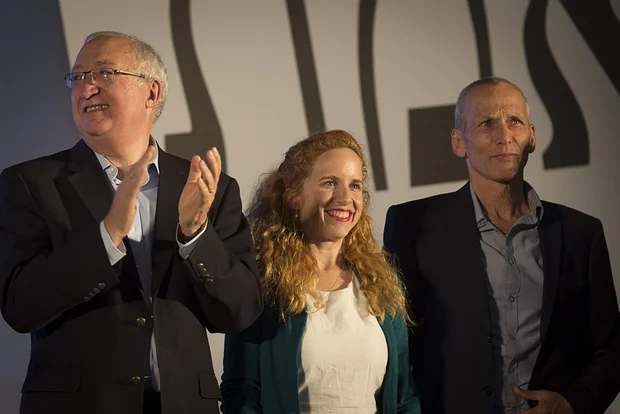
Stav Shaffir, a Labor politician and member of the Israeli Knesset since 2013, told MEE:
"These are pretty amazing results. We started this campaign with 12 or 13 sets and today we got at least 27 seats. Netanyahu does not have a political bloc to build a new government, so we are waiting to see the real results in the last few hours ... to see where we are heading. But what has been proven now is that this Israeli public said clearly that they don't trust Netanyahu anymore. The Left-centre bloc in Israel became much bigger. Much bigger than we've seen in recent years and that means a lot."
In the latest count, Benjamin Netanyahu's Likud Party leads in Israel's Knesset election with 24.4 percent of votes, according to Israel's election commission.
The Zionist Union, led by Isaac Herzog, comes in second position with 19 percent of the votes, the commission was quoted by the Israeli newspaper Yedioth Ahronoth as adding after counting 57 percent of ballot boxes in polling stations across Israel.
Israeli President Reuven Rivlin prefers a national government to be formed by the right-wing Likud Party and the centrist Zionist Union alliance, sources close to the President told Israeli media Wednesday.
The sources told Channel 10 that Rivlin preferred this option, even as he would not impose it on any of the two rival political blocs.
"The President's suggestion is based on the close results each of the two camps achieved in the Knesset election," one of the sources said.
Meanwhile, the Israeli news site Ynet quoted sources close to Rivlin as saying that "the president reads and understands that Netanyahu has the ability to form a coalition very quickly."
"The right choice in his eyes is a unity government that will be a strong government; however, if the sides are not interested in this he will not force it."
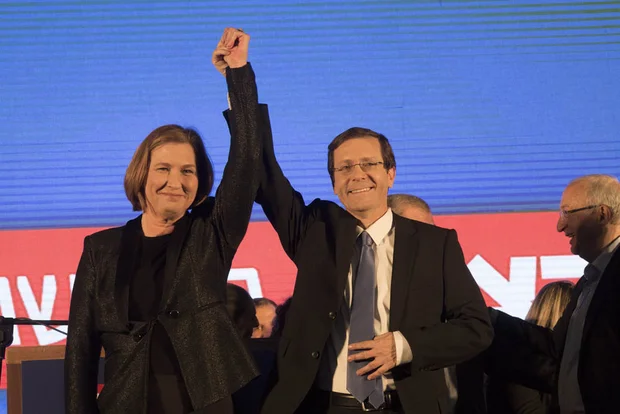
As Israeli Prime Minister Benjamin Netanyahu claimed victory in the Israeli elections after midnight on Wednesday, Zionist Union leader Isaac Herzog said he was still in the race to form Israel's next government.
"Everything is open," Herzog told activists in Tel Aviv after analysts said Prime Minister Benjamin Netanyahu would have a far easier task of putting together a 61-seat majority than Herzog.
"I intend to make every effort to build a real social government in Israel."
Meanwhile, Netanyahu addressed a crowd of supporters, saying he had won the election.
“Against all odds, we achieved a great victory for Likud. We achieved a great victory for our people,” the Times of Israel quoted him as saying.
“And now we must establish a strong, stable government that will take care of the security and welfare of all Israel’s citizens.”
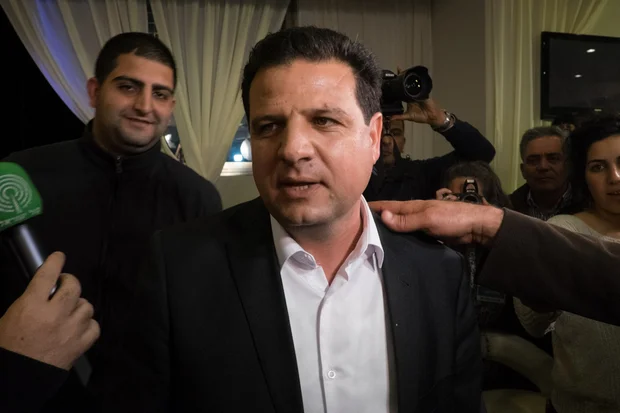
Joint List leader Ayman Odeh told MEE:
“We reached our goals. We are the third biggest party. The voting percentage among the Arab population was the highest since 1999, and we will prevent the right-wing from creating the next government. The joint list is a success story: we are at the heart of a historical event."
Wael Omri, 53, a voter from Nazareth said:
“I think it's a historic event. It's the first time the Arabs come together: you can see the journalists everywhere. We've never seen this before: a point when all the world and Israel sees that Arabs here as a big power, [and see] that we can have our rights. We want to see a government in Israel that says yes to our rights.”
On the day of the Israeli election, Israeli troops arrested seven people, including Palestinians, Israelis and international activists.
The arrests were made in the West Bank on Tuesday, during a protest against the 'E1' plans, which would see Israel annex some West Bank settlements behind the separation wall.
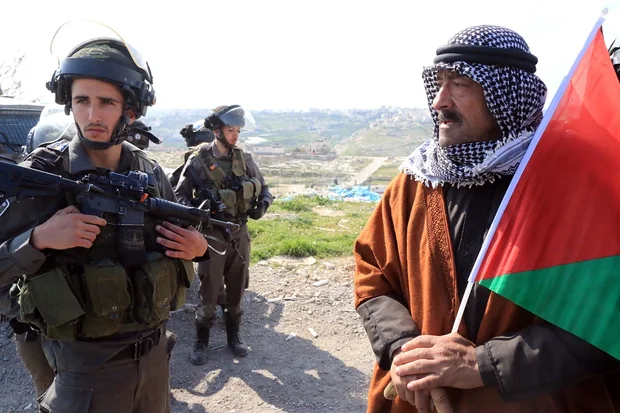
One of the participants, Mustafa Bargouthi, secretary-general of the Palestine National Initiative (PNI) told MEE: "We don't care about the Israeli elections whatever the result will be. We are here to prove that struggle in the field is the only way for freedom".
An anarchist Israeli activist said: "I didn't vote this morning because I don't believe that we can change anything from inside an apartheid system".
"I support my friends who voted for the Arab Joint List but I don't believe they will succeed in the election".
MEE contributor Oren Ziv, asked people at a voting in Jaffa who they will be voting for and what they wanted out of the election:
Orly Ben Yosef:
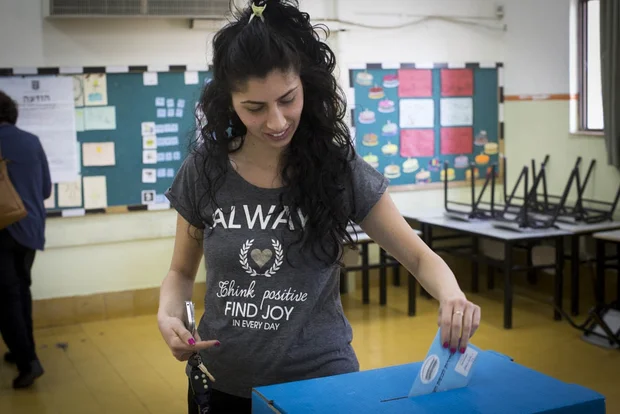
“I think Netanyahu will win, I voted for him, because we don't have any other choice and there is no alternative, and I think many others will vote as well for him.”
Anat Peled:
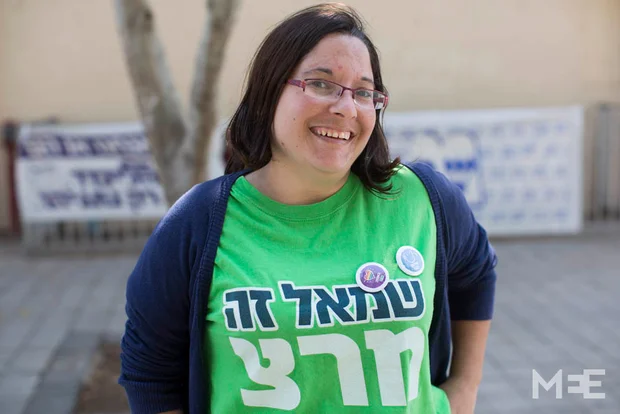
I voted for the Meretz party. It seems many people came out to vote today, I think Meretz will pass the needed threshold (of 3.25 percent).
I spoke today with an old woman that all her life voted for Likud, and this time she didn't want to vote for them. She didn't know for who to vote and I convinced her to give Herzog a chance.
Erga Shiloni and Itai Tzimer:
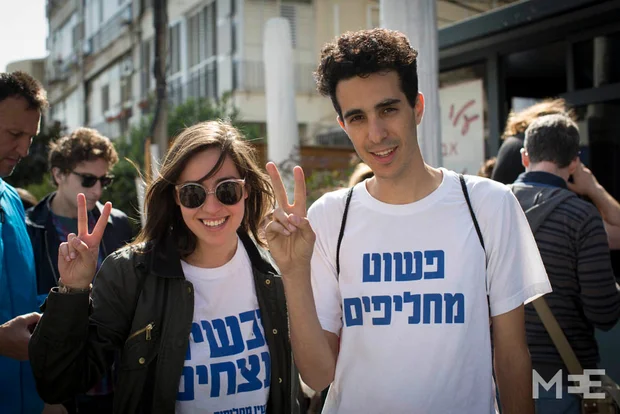
We have a good feeling and can see many people that are going to vote all around us. And we feel it is because many people want to replace the government, because we had enough with Netanyahu. We are from the V15 movement, and for us we will consider today a success if any party from the centre-left block wins.
Raisa Aibrahim voted with her daughter (who places Raisa’s ballot in the box):
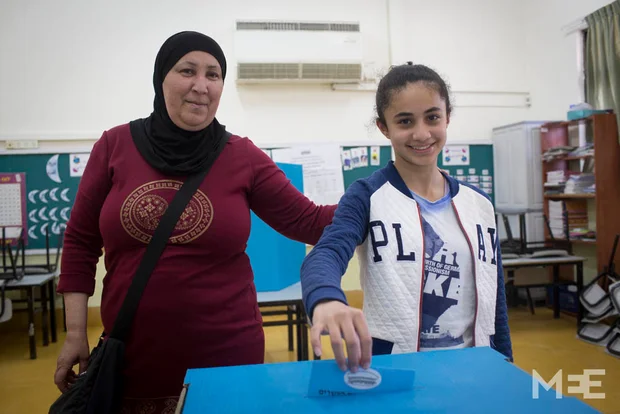
I voted for the Joint Arab list. I was never too sure who to vote for, because the Arab parties were separated. But now when all the Arabs are united we had an easy choice. Before I was voting for (the leftist) Meretz.
I hope the Arab List will be part of the next government. We hope that if the party gets around 15 seats, we will have representation in the parliament and will be able to improve our economic situation. As well as improvements on the political level, we hope that I will be able to openly say here in Israel that I'm a Palestinian and not feel under threat.
As he cast his ballot in Jerusalem on Tuesday, Israeli Prime Minister Benjamin Netanyahu said that he would phone leader of the right-wing Jewish Home party Naftali Bennett for talks on the formation of a coalition government following the parliamentary polls.
"Bennett is a major partner in any government I will form," Netanyahu, leader of the right-wing Likud party, said.
Netanyahu stressed that he has no plans to form a coalition government with the Zionist Union, an alliance between the centrist Labor and Hatnuah parties led by MK Isaac Herzog and former Justice Minister Tzipi Livni respectively.
"There will be no unity government with Labor," he said. "I will form a nationalist government."
Victoria and Gary walk out of a polling station in the city of Holon, south of Tel Aviv, 17 March 2015, after voting for Yair Lapid's Yesh Adit party. They voted shortly before making their way to their wedding.
Gray told MEE: "We chose to do our wedding on the election date because we thought it's a nice date, we are supporters of Yair Lapid and his party Yesh Adit."

"Hugh Lovatt, Israel/Palestine Project Coordinator for the European Council on Foreign Relations, wrote for the Italian-based Institute for International Political Studies:
"When Israelis go to the polls on Tuesday 17 March to elect their 20th Knesset, from which a new governing coalition will be formed, they will do so at a critical time in Israel's relations with the Palestinians. They will also be voting at a time of increasing US and European frustration with Israeli actions in the Occupied Palestinian Territories (OPTs). Yet solving the Palestinian conflict seems to have hardly featured in Israel’s 2015 election campaign.
"Even after the bloodiest round of fighting in Gaza to date and recurrent Palestinian lone-wolf attacks in Jerusalem, Israeli voters are more preoccupied by domestic issues, such as Israel’s widening socio-economic gap – amongst the highest in the OECD area – and the future of Israel’s Jewish democratic character. In fact, according to a survey conducted in February, only 19 percent of Israelis view the Palestinian question as the most important issue.
"Once taboo, opposition to a two-state solution has become a rallying call for right wing politicians, not just within Naftali Bennett’s pro-settler Jewish Homeland but also within Netanyahu’s centre-right Likud. Even centre-left Labor seems to have moved away from the traditional formula of a Palestinian state based on the 1967 borders. Labor’s candidate for Defence Minister, Amos Yadlin, advocates Israeli annexation of the major settlement blocks in exchange for a withdrawal from the roughly 80 percent of Palestinian land that lies east of the security barrier – an initiative that falls spectacularly short of Palestinian expectations."
Netanyahu has been banned from giving a press conference, due to be broadcast later this afternoon.
The Central Elections Committee has issued an injunction against the live broadcasting, after the Zionist Union and Yesh Atid parties objected. They took legal measures against Netanyahu, arguing that the statement amounted to election propaganda which is prohibited on election day.
Netanyahu's office had originally announced that the prime minister intended to make a statement at 5:45pm.
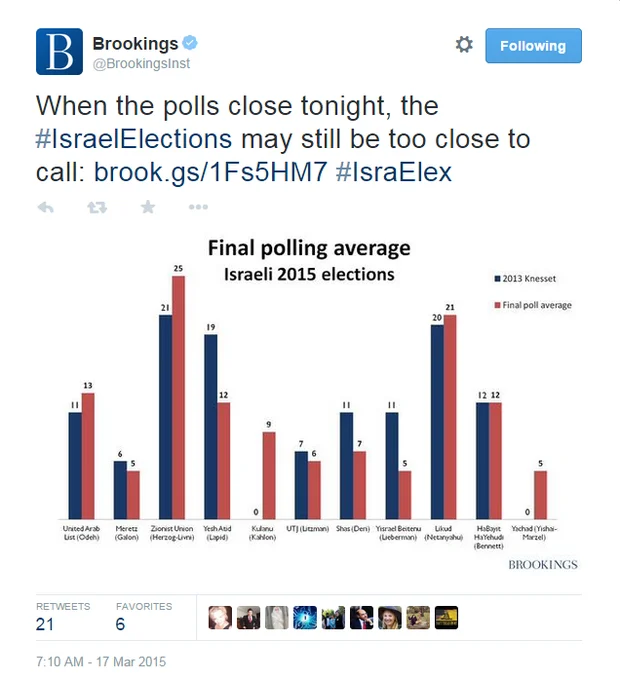
Brookings believes that even when the election results begin to roll in this evening, the vote could be too close to call.
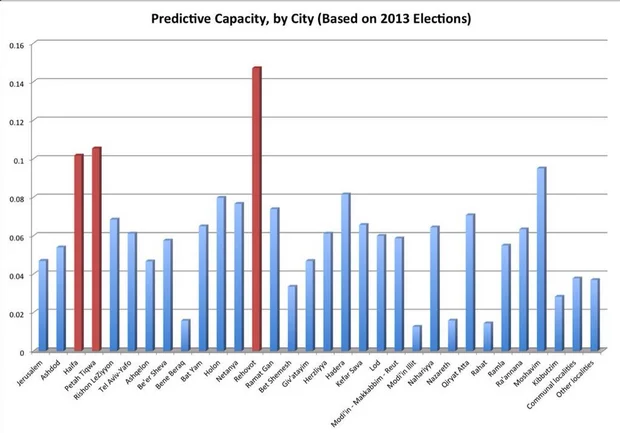
But looking at these districts that were key in 2013 could help to give us an idea of where the vote is heading.
MEE's Meron Rapoport gives his initial reactions to the exit polls and Israel's future: