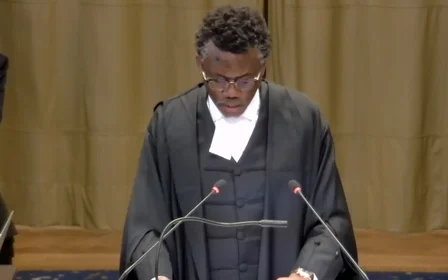
Israel-Palestine live: Israel’s response to South Africa’s genocide case at the ICJ ends

Live Updates
The UN and other aid agencies have said that families in Gaza are now surviving on scraps.
The UN's World Food Programme (WFP) says half of the displaced families in southern Gaza go entire days without eating anything.
Disease is also on the rise in Gaza, as a result of Israeli bombardment causing healthcare and water systems to collapse.
The World Health Organisation says that 180,000 people are suffering from respiratory infections.
It has recorded 136,400 cases of diarrhoea and 55,400 cases of lice and scabies, among other ailments. Only about one-third of Gaza’s hospitals are even partly functional, and they are short of basic supplies; those in the south are operating at three times their intended capacity.
An Israel NGO, Peace Now, has noted that there has been a “surge” in settler activity in the occupied West Bank since the start of the war on 7 October.
The organisation said there was an “unmatched” increase in the construction of outposts, roads, fences and roadblocks by settlers.
“Settlers persist in seizing control of Area C in the West Bank, further marginalising the Palestinian presence,” a press release said.
Far right Israeli heritage minister Amihai Eliyahu said on Friday that the Israeli government must find a way “to encourage as many Palestinians in Gaza as possible to leave the Strip immediately,” according to Israeli media.
He added: “It is not a shame to decide, to create such a mental burden that no one will stand up on their legs again...We need to find what hurts them, what will overwhelm them, break their spirit. I think it is possible to break their spirit, we did it to the Nazis in Germany."
Eliyahu also said that it is “impossible to live alongside them,” during the interview.
Hezbollah's secretary general, Hassan Nasrallah, said in a speech on Friday that all of Lebanon would be exposed if the group did not react to the assassination of deputy Hamas chief Saleh al-Arouri in Beirut.
“The response will inevitably come,” he added.
In his second speech since Israel killed Arouri in the Lebanese capital, Nasrallah also said that the latest escalation now marks a “historic opportunity” for Lebanon to liberate its land from Israeli occupation.
However, he said that no agreements can happen before a ceasefire in Gaza.
Nasrallah also praised the “resistance” from Yemen and Iraq.
Here are some of the key points from his speech.
- The Islamic resistance in Lebanon conducted 670 operations against Israel in the past three months, targeting border positions 494 times.
- At least 2,000 Israeli soldiers were wounded on the Lebanon-Israel border. Nasrallah also blasted Israel for not releasing clear numbers of casualties on its side.
- The Lebanese front is there to alleviate pressure on Hamas and Gaza, and to impose a ceasefire in Gaza.
- Israelis in the north should ask their government for a ceasefire if they wish to be safe.
- The response to the Arouri assassination will come from the battlefield.
Nasrallah ended his speech by telling families of fallen Hezbollah soldiers “we are proud of you” and said he would have visited them and “kissed your hands” if the security situation allowed him to.
The International Federation of Red Cross and Red Crescent Societies (IFRC) has released a statement saying it is “appalled” by the ongoing Israeli shelling of al-Amal Hospital and the Palestine Red Crescent Society (PRCS) headquarters in Khan Younis.
“These strikes have led to the loss of innocent civilian lives, including a five-day-old infant, and displaced thousands who were taking shelter at the hospital,” the statement said.
At least four members of the PRCS emergency medical services have been killed, and 27 others wounded, the IFRC said.
The chief of fast-food giant McDonald's said on Friday that “misinformation” about McDonald’s support for Israel is having a “meaningful impact” on its sales in the Middle East.
Chris Kempczinski said calls from pro-Palestinian groups to boycott McDonald’s over the war on Gaza were harming operations, according to UK daily The Telegraph.
McDonald’s has been targeted by pro-Palestinian campaigners after photos and videos on social media showed franchised stores in Israel giving free meals to soldiers during the bombardment of Gaza.
The Boycott, Divestment, Sanctions (BDS) movement, a pro-Palestinian organisation, called for people to boycott McDonald’s in November after franchisees “openly supported” the Israeli military.
Kempczinski said in a blog post on LinkedIn published on Thursday: “Several markets in the Middle East and some outside the region are experiencing a meaningful business impact due to the war and associated misinformation that is affecting brands like McDonald’s.
“This is disheartening and ill-founded. In every country where we operate, including in Muslim countries, McDonald’s is proudly represented by local owner operators who work tirelessly to serve and support their communities while employing thousands of their fellow citizens.”
There was no further information on the magnitude of the sales hit in the Middle East. McDonald’s does not publicly provide sales figures in the region.
A project coordinator in Gaza for Doctors Without Borders described the situation in Gaza as “horrific” for Palestinians on the ground.
“Gaza is gone, basically, and there is nothing left. It’s difficult for Palestinians to see a life here again, which is very sad,” said Jacob Burns.
The US Department of State's Rewards for Justice Program put out a statement on Friday stating that they are offering up to $10m in rewards for information relating to Hamas financial networks and funding.
According to the statement, "rewards may be provided for information leading to the identification and disruption of any source of revenue for Hamas or its key financial facilitation mechanisms; major Hamas donors or financial facilitators; financial institutions or exchange houses facilitating Hamas transactions.”
It also added they are looking for information on businesses or investments owned or controlled by Hamas or its financiers.
Lebanon is filing a complaint to the UN Security Council over Israel’s killing of the Hamas official Saleh al-Arouri, according to Reuters.
Lebanon said the killing was the “most dangerous phase” in Israel’s attacks on Lebanon.
The complaint also states that Israel used Lebanese air space to bomb Syria.
Israeli forces continued on Friday to attack the vicinity of Gaza’s al-Amal Hospital as well as the Red Crescent HQ where thousands of Palestinians are sheltering, according to Medical Aid for Palestinians.
According to the organisation, many medical staff are not able to reach the hospital due to the ongoing bombardment.
A doctor for Medical Aid for Palestinians in Gaza says that the healthcare system in the besieged enclave has now fallen apart due to Israeli bombardment.
“Last night was horrific. The system has fallen apart - not even the best triage system can withstand this. The operating rooms are full. We have run out of morphine. There's no space for dignity in dying,” doctor James Smith said.
Team members on the ground added that the sound of air strikes is “constant” and that hundreds were wounded overnight on Thursday evening.
“The bombing in Nuseirat and Bureij means that many healthcare workers can't come in because they can no longer safely move, or they're being displaced to the south,” Smith added.
German Foreign Minister Annalena Baerbock on Friday said the existence and protection of Israel cannot be questioned but called for more humanitarian pauses and said there should be no occupation of the area afterwards.
Speaking to reporters alongside her counterpart from Luxembourg Xavier Bettel, Baerbock also warned against the risk of the conflict widening in the region.
On 7 October, Hamas mounted a bold and desperate operation in which it invaded southern Israel and occupied a score of towns and kibbutzim, killing 1,140 people.
This carefully coordinated air, land and sea assault by Hamas, which is proscribed as a terrorist organisation in the UK and other countries, was overwhelming in scope. It stunned Israel and the world.
After well over a year of planning and training, 1,000 fighters broke through the billion-dollar defensive shield Israel had painstakingly erected around Gaza over a decade or more.
The assault showed everyone that all the sophisticated technology in the world can be defeated by a small guerilla force using surveillance, planning and swarming battlefield tactics.
Hamas breached security measures that Israelis had been lulled into thinking were impenetrable. It smashed all assumptions Israeli military intelligence had made about Hamas.
Read more: Why Hamas might have already won
Shipping giant Maersk said that its vessels would be diverted around Africa for the “foreseeable future” and avoid using the Red Sea and Suez Canal.
Maersk's decision cited the volatile situation in the Red Sea where Yemeni group the Houthis have attacked merchant ships heading to Israel.
“We have therefore decided that all Maersk vessels due to transit the Red Sea/Gulf of Aden will be diverted south around the Cape of Good Hope for the foreseeable future,” it said in a statement.
The Houthis have said all other shipping not destined for Israel can pass through the Red Sea.
At least 22,600 people have been killed in Israeli attacks on the Gaza Strip since 7 October, the Palestinian Ministry of Health said on Friday.
Over the past 24 hours, at least 162 Palestinians have been killed by Israeli strikes on the Strip.
A total of 57,910 people have been wounded, the majority of them women and children. About 7,000 are missing, presumed to be dead under the rubble.