Algeria suspends diplomatic relations with UAE after months of tensions

Algeria announced on Thursday that it would sever all diplomatic relations with the United Arab Emirates after “exhausting all means to preserve bilateral relations”.
In a statement, the Algerian Ministry of Foreign Affairs said it had warned the UAE over its “hostile actions” and had expended significant effort in “drawing the attention of the Emirati side and warning it of the grave consequences that may result from its regrettable and unjustified behavior”.
“Despite these numerous warnings, the United Arab Emirates has persisted in these actions, which have reached a point where they can no longer be considered acceptable or tolerable within the framework of relations between two sovereign states, or remain unanswered,” the statement added.
The Algerian foreign ministry said it had informed the UAE ambassador of the decision and had given him 48 hours to comply.
Tensions between the two countries have increased in recent years as the UAE has played an increasingly destabilising role across the Middle East.
New MEE newsletter: Jerusalem Dispatch
Sign up to get the latest insights and analysis on Israel-Palestine, alongside Turkey Unpacked and other MEE newsletters
In a headline in 2023, the Algerian newspaper Le Soir d’Algerie called the UAE a “pyromaniac state” and condemned the state’s “harmful role” around Algeria’s borders.
UAE threat to Algeria
In recent years, the UAE has funded authoritarian leaders and breakaway groups across the Sahel and North Africa.
In Libya, the UAE has backed military leader Khalifa Haftar in the east of the country, destabilising not only Libya but also Chad, Sudan and Niger.
The UAE has also used Libya as a base to provide support for Sudan's Rapid Support Forces militia, which has been accused of committing genocide in the country's civil war.
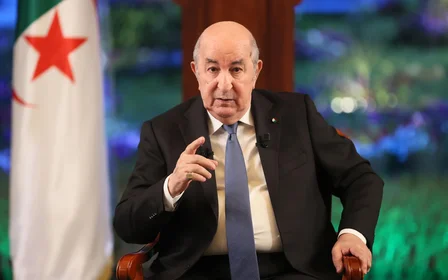
In April 2024, Algerian President Abdelmadjid Tebboune said in comments widely perceived as aimed at the UAE: “Wherever there is conflict, the money of this state [the Emirates] is there - in Mali, Libya, and Sudan."
Tebboune has also disparagingly called the UAE the “midget state” without naming it, saying: “I will not name it. They wanted to interfere in matters in which we prevented great powers from interfering.
'President Tebboune had spent the better part of a year railing against a 'small state' bent on stirring trouble; today he just stopped pretending it was anonymous'
- Andreas Krieg, associate professor, King’s College London
“This has been coming for a long time, and to my mind the significance is less the break itself than what it tells us about how Algeria now reads the UAE,” Andreas Krieg, associate professor of security studies at King’s College London, told Middle East Eye.
“Algiers has effectively concluded that Abu Dhabi's regional playbook - cultivating what I call an 'axis of secessionists,' from Haftar in Libya to the RSF in Sudan to the southern movement in Yemen - was being turned toward Algeria itself,” said Krieg, reacting to the decision.
Algeria has spent the best part of this year signalling its displeasure with the UAE.
On 7 February, Algeria began cancelling its bilateral air-services agreement with the UAE. While Algiers did not provide a formal explanation, most analysts understood that the decision reflected the UAE’s continuing interventions in Algeria’s backyard.
“The sharpest fear is Emirati contact with the Kabylie autonomy movement, the MAK, which Algiers treats as a terrorist organisation and as a red line running straight through national unity,” said Krieg.
When the UAE announced its withdrawal from Opec earlier this year, Tebboune publicly dismissed the decision as a “non-event”.
Tebboune said Saudi Arabia was Opec’s main pillar and declared, regarding the UAE, that “the book is closed”.
“The foreign ministry's wording is the tell,” said Krieg. “It says the decision came 'after exhausting all means' to save the relationship, and it pointedly names no single trigger. That's deliberate: this wasn't one incident but an accumulation - the suspected outreach to separatists, the UAE's military footprint in Libya and the Sahel, and Abu Dhabi's backing of Morocco on Western Sahara, which for Algeria is the most sensitive file of all,” he said.
“President Tebboune had spent the better part of a year railing against a 'small state' bent on stirring trouble; today he just stopped pretending it was anonymous,” Krieg added.
Middle East Eye delivers independent and unrivalled coverage and analysis of the Middle East, North Africa and beyond. To learn more about republishing this content and the associated fees, please fill out this form. More about MEE can be found here.