Bangladesh could join Mecca pact, official suggests

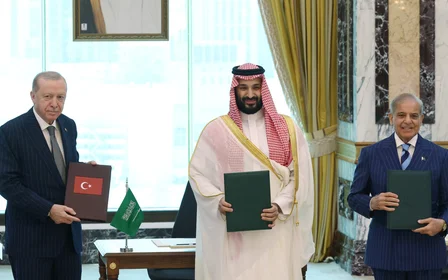
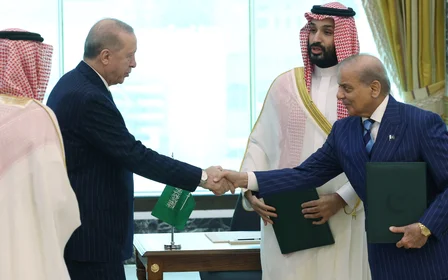
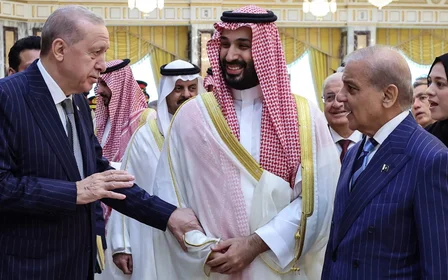
Bangladesh may be joining the defence agreement signed by Turkey, Saudi Arabia and Pakistan earlier this month.
Bangladeshi State Minister for Foreign Affairs Humayun Kabir told reporters on Monday that his country has been invited to participate in what has become known as the Mecca pact, but did not say who extended the invitation.
Reuters news agency, however, cited an unnamed source saying Riyadh had reached out to Dhaka.
"If there is a security arrangement among Islamic nations in the Middle East, it is not unusual for us to consider participating. It is being viewed positively," Kabir said.
The agreement stipulates that an armed attack against any of the three countries shall be regarded as an attack against all three, in a formula approaching the collective defence logic of major military alliances like Nato.
New MEE newsletter: Jerusalem Dispatch
Sign up to get the latest insights and analysis on Israel-Palestine, alongside Turkey Unpacked and other MEE newsletters
Bangladesh's participation would rock its regional standing as a country that tries to stay out of major geopolitical rifts, given it sits next to two nuclear-armed rivals in India and Pakistan.
However, it is still seeking the extradition of its former leader Sheikh Hasina, who fled to India in 2024 after mass protests toppled the government in Dhaka.
A Bangladeshi-Pakistani security alliance would likely be perceived as a threat to India, which maintains strong ties with Israel.
The Iran angle
The three countries in the Mecca pact have emphasised that it is defensive in nature and not directed against any particular state.
Many analysts, however, have suggested that the alliance between Ankara, Riyadh and Islamabad is targeted at Tehran.
The three states have largely Sunni populations, but while Saudi Arabia has had frosty relations with Iran, Turkey and Pakistan have remained relatively cordial with Tehran.
Islamabad has been a key conduit for negotiations between the US and Iran as they engage in a prolonged conflict over the Strait of Hormuz, which Tehran has blockaded in response to the US and Israeli war on the country, which was initially aimed at toppling its government.
Saudi Arabia, on the other hand, has been the subject of Iranian retaliatory action primarily aimed at US military assets within its borders.
As the conflict has dragged on, hostilities have reignited between Saudi Arabia and its neighbours to the south, the Houthi-led administration in Sanaa, which controls most of northern Yemen.
Although Turkish officials initially envisioned a trilateral treaty, Middle East Eye was told that Egypt emerged as a natural candidate for inclusion in the mechanism.
Possessing a powerful military, Egypt increasingly found itself aligned with Turkey, Qatar and Saudi Arabia on issues ranging from the negotiations to end the war on Gaza to developments in Africa.
An Ankara-based source familiar with the discussions told MEE that Turkey had made considerable efforts to include Egypt in the treaty and had formally proposed its participation.
However, once it became clear that Cairo was not prepared to join, the other countries decided to proceed without it.
Middle East Eye delivers independent and unrivalled coverage and analysis of the Middle East, North Africa and beyond. To learn more about republishing this content and the associated fees, please fill out this form. More about MEE can be found here.