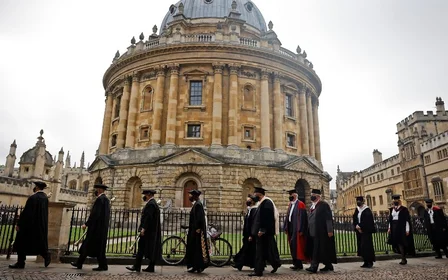
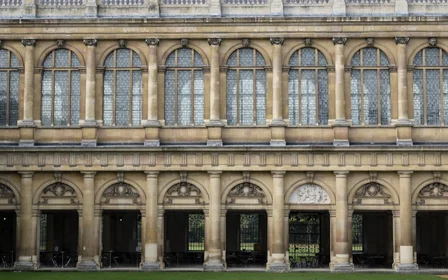
Cambridge University to consider divesting from arms industry amid Gaza protests

The University of Cambridge has announced it will divest from companies involved in producing "controversial weapons", and will vote next month on whether to divest from all arms companies following the publication of a landmark report.
Its announcement comes after years of student pro-Palestine protests and follows one of the university's largest colleges, King's College, deciding it would divest from the arms industry and companies complicit in "the occupation of Ukraine and Palestinian territories".
The report, which followed a year-long review into the university's links to the arms industry, was approved unanimously by the University Council on Monday.
It called for the university's £4.2bn ($5.62bn) endowment fund to divest from "any company which manufactures weapons illegal under UK law, even if those weapons are legal elsewhere", including chemical and biological weapons and cluster munitions.
Cambridge's university council has adopted this as policy. Significantly, it is also set to decide whether to divest from all arms manufacturers in a meeting on 20 November.
New MEE newsletter: Jerusalem Dispatch
Sign up to get the latest insights and analysis on Israel-Palestine, alongside Turkey Unpacked and other MEE newsletters
There is currently considerable secrecy surrounding Cambridge's investments.
The report, published on Monday, said: "We acknowledge the commercial importance of confidentiality, but the fact that the members of the Working Group do not know the extent of the University’s investments in companies which manufacture weapons has made the formulation of our recommendations significantly more difficult.
"The confidentiality relating to the investments and consequent lack of transparency has undoubtedly contributed to a suspicion in parts of the wider University that the University’s investments in [its endowment fund] are much more extensive as regards companies which manufacture weapons than appears to be the case."
'Forced reckoning'
The report put forward three options for the council, one of which is to set a timeline for completely divesting.
Another option is to make no changes and a third is to set a one percent cap on investments in conventional weapons.
Cambridge for Palestine (C4P), a group which has organised encampments and protests over the past year and a half, called the development a "forced reckoning".
The group said the university "has been made to accept, for the first time, that complete divestment from the arms industry is a legitimate option it can pursue".
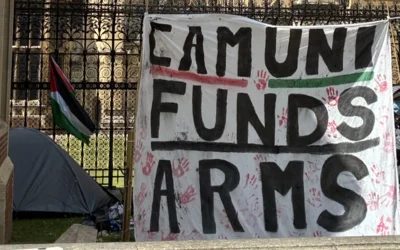
"As students and community members, we see this report as a clear mandate ripped from the hands of the administration.
"By deciding to divest from companies manufacturing weapons legal in their country of manufacture but illegal under UK law, the university has been forced to demonstrate that arms divestment is possible."
C4P continued: "This report proves that Cambridge has the power to act morally if it chooses to. The question now is whether it will choose to stand on the side of justice or continue to profit from war and occupation.
The Cambridge Students' Union has backed full divestment from the arms industry.
Professor Graham Virgo, the master of Downing College and chair of the working group that conducted the review, said: "Over recent months we have carried out a thorough and thoughtful process, heard a very broad range of perspectives from across the university and beyond it, and had an honest exchange of views on what are extremely important issues.
"I would like to thank everyone who has contributed to this report."
Cambridge University is made up of 31 self-governing colleges which operate autonomously, including in their financial investments - which are separate from the university's investments.
King's divestment
King's College Cambridge, founded by Henry VI in 1441, announced in May that by the end of 2025 its investments will exclude companies that "are involved in activities generally recognised as illegal or contravening global norms, such as occupation".
Its investments will also exclude companies that "produce military and nuclear weapons, weapons restricted by international treaty, or companies that produce key or dedicated components of such weapons".
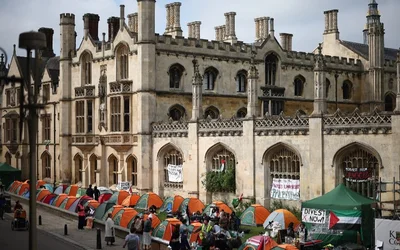
As of March 2023, the institution invested £2.2m ($2.94m) in arms companies, including Lockheed Martin, Korea Aerospace and BAE Systems.
King's was the first Oxford or Cambridge college to take such measures.
Middle East Eye revealed last year that Trinity, the university's wealthiest college, had $78,089 invested in Elbit Systems, Israel's largest arms company, which produces 85 percent of the drones and land-based equipment used by the Israeli army.
Trinity students reported in May 2024, after months of protests targeting the college, that they had been told it would divest from all arms companies.
However, the college refused to comment on its investments, and freedom of information requests, seen by MEE late last year, revealed that it continued to maintain investments in arms companies.
In November, the college's master insisted that Trinity had "no interest in divesting from arms companies".
Middle East Eye delivers independent and unrivalled coverage and analysis of the Middle East, North Africa and beyond. To learn more about republishing this content and the associated fees, please fill out this form. More about MEE can be found here.