Death of Syrian in police custody sparks protest and conversation about prison reform

The recent death in custody of a Syrian detainee sparked backlash and protest in the country, as activists and rights groups urged authorities to build on efforts to overcome the dark history of arbitrary detentions, torture and disappearances under former leader Bashar al-Assad.
Mohammed Ghamira, a father of two and former volunteer at the White Helmets rescue organisation, died on Sunday, days after being detained over a financial dispute.
He left al-Haffah police station in the Latakia province in a critical condition, and was later pronounced dead in hospital from “complications from cerebral and gastrointestinal haemorrhaging” that “resulted from a beating he sustained after being detained”, Syrian authorities said.
Ghamira, 29, suffered from haemophilia, a rare condition which makes it difficult to stop a bleed once it begins.
According to his family, authorities were informed of his condition during his detention, and asked not to subject Ghamira to physical violence due to his circumstances.
New MEE newsletter: Jerusalem Dispatch
Sign up to get the latest insights and analysis on Israel-Palestine, alongside Turkey Unpacked and other MEE newsletters
The government launched a three day investigation into the case, which concluded on Thursday.
It found that Ghamira’s death had resulted from a slap delivered by a police investigator, who has since been detained and referred to judicial authorities.
The probe also found procedural shortcomings and negligence by the police department chief and investigator, including by not recording Ghamira’s medical condition in an official report.
Earlier this week, a crowd gathered in Aleppo to demand accountability over the death. Protesters held up signs, including one that read: “Do not repeat the oppression that we revolted against”.
“This is absolutely heartbreaking,” Syrian activist Nedal al-Amari wrote on X.
“After liberation, every Syrian who is killed under torture in state prisons or institutions is a disgrace that we, as people of the revolution, have to carry.”
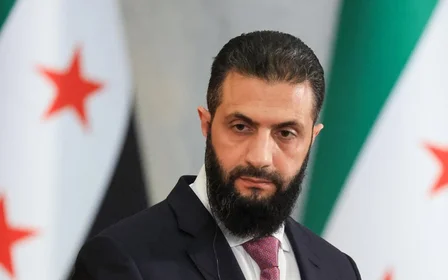
Assad’s government was overthrown in December 2024, after a lightning offensive by forces led by Ahmed al-Sharaa, who has since become the country’s president.
Saana-Maria Jokinen, a writer and expert on human rights in Syria, said the backlash over Ghamira’s death showed that Syrians were not afraid to speak out and seek accountability.
“A very tragic case,” she said on X. “However, in stark contrast to the days of the Assad regime, Ghamira's death is openly discussed in the Syrian media and Syrians aren't afraid to voice their criticism and demand that those responsible for the young man's death are held accountable.”
Years of abuses under Assad
During Assad’s 24 years of authoritarian rule, hundreds of thousands of Syrians were detained, held in grim conditions or forcibly disappeared.
The detentions and enforced disappearances particularly escalated after the government’s violent crackdown on protests which led to the Syrian civil war in March 2011.
Between March 2011 and August 2024, more than 150,000 individuals were arrested by Syrian authorities, including 5,274 children and 10,221 women. Tens of thousands died under torture in the notorious detention system.
Syria had more than 100 detention facilities, including Sednaya prison, described by rights groups as a “human slaughterhouse”.
At Sednaya, thousands of detainees were killed in mass hangings or tortured to death, while others died due to food and water deprivation. Authorities then dumped the bodies into mass graves, which Amnesty International described as a crime against humanity.
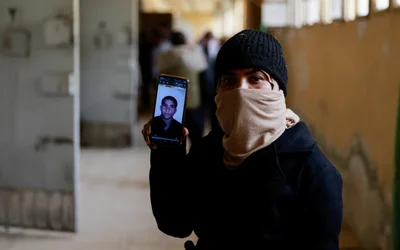
After the fall of Assad, Sharaa said that facilities like Sednaya would be closed and that officials involved in torture, killings and other abuses would face justice.
The Syrian Network for Human Rights (SNHR) told Middle East Eye that changes had occurred under the new government.
“The available evidence indicates that the fall of the Assad regime brought an end to the previous government's vast and centralised system of arbitrary detention, enforced disappearance, and systematic torture,” it said.
But the group added that a new detention system that consistently complied with Syria’s obligations under international law had yet to be properly established.
Syria’s new constitution, issued in March last year, included several formal guarantees.
Article 18 lays out safeguards for human dignity and physical integrity, while prohibiting enforced disappearance and physical and psychological torture.
SNHR noted that detainees were being released: at least 993 were released from detention centres during the first half of 2025.
'It isn't valid to conclude that the current authorities have re-established the detention apparatus that existed under Assad'
- Syrian Network for Human Rights
“At the same time, however, SNHR documented 192 cases of arbitrary detention attributed to the transitional government during the same period,” the rights group said.
“These facts show, at one and the same time, a measure of progress and the limits of this progress.”
SNHR called for a unified and transparent register of all those detained, guaranteed access to lawyers, family members and medical professionals, as well as ending the use of unofficial or temporary facilities outside the scope of the usual judicial and administrative oversight.
“It isn't valid to conclude that the current authorities have re-established the detention apparatus that existed under Assad,” the group said, adding that there was no evidence of centrally directed torture and arbitrary detention.
“The decisive factor is primarily institutional,” SNHR concluded.
“A detainee remains at risk when his arrest isn't registered immediately, his family isn't informed of his whereabouts, lawyers and doctors can't reach him quickly, or when he is held in unofficial facilities, his transfers aren't documented, and independent monitors can't inspect places of detention without prior notification.”
Middle East Eye delivers independent and unrivalled coverage and analysis of the Middle East, North Africa and beyond. To learn more about republishing this content and the associated fees, please fill out this form. More about MEE can be found here.