Analysis: Ed Miliband is becoming the UK's most formidable foreign secretary in decades

Rarely has a British foreign secretary come under such ferocious attack as Ed Miliband over the past weeks.
Miliband provoked a two-pronged assault when he announced his intention to impose punitive measures against Israel in an attempt to halt settler violence - and rescue the prospect of a Palestinian state.
The foreign secretary is set to announce a ban on trade with illegal Israeli settlements on Tuesday. The ban will aim to bring the UK into compliance with the International Court of Justice’s advisory opinion of July 2024, according to Whitehall sources.
Many pro-Palestine advocates complain that Miliband's statement comes far too late, will not go nearly far enough and in any case will consist of largely meaningless gestures.
They are further angered by Labour's refusal to employ the term genocide, halt all arms sales to Israel and sanction Prime Minister Benjamin Netanyahu.
New MEE newsletter: Jerusalem Dispatch
Sign up to get the latest insights and analysis on Israel-Palestine, alongside Turkey Unpacked and other MEE newsletters
The American and Israeli responses to Miliband's plans, however, have been brutal.
In a highly unusual diplomatic intervention, US Ambassador to Israel Mike Huckabee posted on X on Saturday: "The Brits have lost it. The Jew hate of their government knows no boundaries and knows no facts."
Miliband is Jewish and Huckabee is not.
Netanyahu last month branded Britain the "Islamic Republic of Britain".
The Israeli government's outrage is accompanied by threats. "If Britain acts against Israel, Israel will act against Britain," warned the Israeli Foreign Minister Gideon Saar last week.

Yair Netanyahu, son of the prime minister, declared that the Falkland Islands belongs to Argentina, not Britain.
US President Donald Trump then suggested he would not back the UK if Argentina invaded the territory.
The Tory opposition, heavily backed by the British right-wing press, has echoed this vociferous criticism.
The Sunday Telegraph awarded massive prominence to an interview with the new shadow foreign secretary, Tom Tugendhat. Tugendhat took the side of Israel against the British government and cited Israeli threats that British national security could be threatened if Britain sanctions the settlements.
The advocacy group Conservative Friends of Israel has moreover accused Miliband of planning "a morally indefensible move that further singles out and demonises the world's only Jewish state and a close ally."
Miliband is stepping out of line
The British foreign secretary, who has been in office for just two months, is showing unusual determination amid the onslaught of threats and criticism.
No foreign secretary this century has ever successfully challenged either the power of the White House or pressure from Israel – let alone both at once.
Miliband is stepping out of line. Moreover, he is doing so against strident opposition from significant sections of the British media. In short, Miliband has torn up the script on British foreign policy.
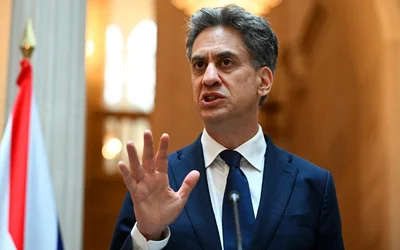
In his first performance as foreign secretary in parliament last Tuesday, he insisted Britain "will not acquiesce in the destruction of the two-state solution."
He assured Labour, Green and SNP MPs who pressed him to act against Israel's settlement expansion in the occupied West Bank that they wouldn’t have to wait much longer.
Well-informed sources tell Middle East Eye that, inside the Burnham government, Miliband has been the internal driving force behind the policies he is expected to announce on Tuesday.
The foreign secretary has also deployed a new language on Gaza: "I just came out of this meeting talking about Gaza to people who've been there and are there on the ground, and frankly it was horrific what is unfolding."
He asserted last week that "we as a UK government, as the prime minister has said, have got to act and act more decisively than we have."
His two predecessors as Labour foreign secretary, David Lammy and Yvette Cooper, will each have been given horrifying briefings on conditions in Gaza.
Neither reacted in the strong and anguished way that Miliband has chosen to do.
These words mark him out as an unusually moral and humane politician.
Almost as significant, the force of his language means that it will be impossible for Miliband to give in to future US and Israeli pressure without opening himself to charges of hypocrisy.
A well-placed Labour source said on Monday that "the prime minister and foreign secretary are going to set out a comprehensive reset in the British government's approach" to the situation in Israel and Palestine.
Settlement goods ban set to be seismic
These developments come at a pivotal moment. Israel's new E1 settlement project east of Jerusalem is poised to effectively cut the occupied West Bank in two. It is designed to make a Palestinian state completely unviable.
Britain’s settlement goods ban therefore looks set to be seismic. As Ben Jamal, until recently the director of the Palestine Solidarity Campaign, put it: "Such a ban has been a core demand of the Palestine solidarity movement for many years, as a key basic step towards ending UK complicity with Israel’s violations of international law."
A report that Netanyahu is already ordering the removal of settler outposts, if confirmed, would suggest that Britain's stand could be having an immediate effect
If properly implemented, the ban will bring the UK into compliance with the 2024 ICJ advisory opinion, which declared the Israeli occupation of Palestinian territory to be illegal and obligated states - including Britain - to take steps to oppose it.
To achieve this, the ban will need to be comprehensive and cover both goods and services. It will have to prohibit any investment in settlement businesses and be backed up by real enforcement powers.
Other European countries, including Ireland, Spain and Belgium, have introduced similar measures. But Whitehall sources insist the UK’s planned sanctions will be even stronger.
While it is true that the ban will enrage the Netanyahu government and offend Donald Trump, it may also be a diplomatic boon for Andy Burnham's government, establishing it on the world stage as a country willing to defy the United States.
And if Sunday's report that Netanyahu is already ordering the removal of settler outposts is confirmed, this would suggest that Britain's stand could be having an immediate effect.
Politically secure and in tune with the public
Pro-Israel critics of Miliband repeatedly accuse him of bowing to Muslim opinion in Britain. Polling does not support this claim.
Miliband's approach is, in fact, bringing foreign policy back into line with British public opinion in general. Only 16 percent of Britons, a small minority, oppose a ban on settlement goods.
This helps to explain why more than 140 Labour backbenchers have urged the government to implement a comprehensive trade ban with the settlements.

Polling of Labour members earlier this year showed that a staggering 87 percent support a ban.
This means Miliband is politically secure and in tune with the public mood. Crucially, he appears to have Downing Street's backing.
But Labour insiders stress the foreign secretary also sincerely believes these measures are necessary.
Consider his record on the issue. As Labour leader when the party was in opposition, Miliband distinguished himself by strongly criticising the coalition government's failure to challenge Israel when it bombed Gaza in 2014, killing 1,600 Palestinian civilians, including 550 children. Six Israeli civilians were killed.
In 2014 Miliband accused then-Prime Minister David Cameron of getting it “wrong” and slammed his "inexplicable silence" on “the killing of innocent Palestinian civilians caused by Israel’s military action”.
That same year, Miliband backed recognising Palestinian statehood unilaterally, a position opposed by the Tories.
In the cabinet last year, sources say, Miliband was a leading voice pressuring then-Prime Minister Keir Starmer to recognise a Palestinian state - which he finally did in September last year.
According to a senior Whitehall source, Miliband and Home Secretary Shabana Mahmood privately lobbied Starmer not to back the US-Israeli strikes on Iran this February.
The makings of an independent foreign policy
It is worth remembering just how significantly British foreign policy appears to have changed. Rishi Sunak's Tory government showed contempt for international law in late 2023 and early 2024.
It publicly mocked the International Court of Justice ruling on the genocide case brought against Israel by South Africa, while Foreign Secretary David Cameron privately tried to influence the International Criminal Court’s chief prosecutor not to seek arrest warrants for Israeli ministers.
Under Starmer, two Labour foreign secretaries - Lammy and Cooper - introduced a series of half-measures against Israel.
There was an arms embargo, but not a full one. Intelligence sharing from surveillance flights over Gaza continued throughout Israel’s genocide.
When Lammy suggested Israel had broken international law, Downing Street swiftly rowed back on the comments. There was advice against businesses investing in Israeli settlements, but no ban.
If Burnham and Miliband want to avoid the ire of the Trump administration they will need to weaken the planned sanctions. This will signal to the US and Israel that it is fundamentally business as usual, and there is no substantive change in approach from that of the Starmer government.
But if Burnham and Miliband press on with introducing and implementing the sanctions, they will be standing up to the US and Israel and announcing to the world that Britain finally has the makings of an independent foreign policy.
Middle East Eye delivers independent and unrivalled coverage and analysis of the Middle East, North Africa and beyond. To learn more about republishing this content and the associated fees, please fill out this form. More about MEE can be found here.