France: Far-right party’s ‘de‑demonisation’ strategy rattled by antisemitism scandal

“Nature always returns,” says the proverb - a phrase that perfectly captures the current predicament of the president of France’s far-right Rassemblement National (RN).
Jordan Bardella is facing serious allegations published by the investigative outlet Mediapart, which attributes to him antisemitic messages exchanged on social networks in 2013, when he was 17 and already a party member.
According to Mediapart, Bardella allegedly wrote on Messenger: “Banks are all owned by Jews,” “The Jew must dominate other peoples, crush them and steal from them; a Zionist is necessarily Jewish, and deeply so,” and “The most important ministries go to people for whom Israel and banking interests take precedence over French interests.”
Bardella, an MEP since 2019, has denied the accusations, denouncing “crude fabrications, obscure and manipulable screenshots reproducing vile statements I obviously never made.” He has filed complaints for defamation, forgery and use of forgery.
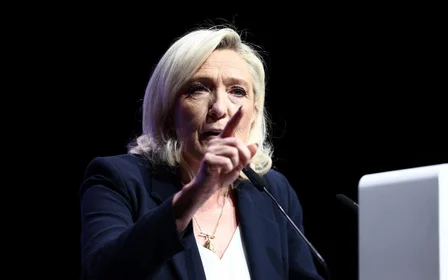
RN officials have rallied around him, with Marine Le Pen leading the charge. The party’s candidate for next year’s presidential election said she trusts Bardella “a thousand percent”, accusing Mediapart of a “vile manoeuvre”.
New MEE newsletter: Jerusalem Dispatch
Sign up to get the latest insights and analysis on Israel-Palestine, alongside Turkey Unpacked and other MEE newsletters
Amid the turmoil, Bardella also received support from an unexpected figure: Amichai Chikli, Israel’s minister in charge of combating antisemitism, who described him as “one of the clearest voices in Europe against Hamas”.
“No one will convince me that Jordan Bardella hates the Jewish people or the Jewish state,” Chikli said.
In 2025, during an International Conference on Combating Antisemitism, the Israeli minister hosted Bardella, who has consistently presented himself as a friend of Jews and Israel.
The event, held in Jerusalem and attended by other European far‑right figures as well as numerous supporters of US President Donald Trump, was boycotted by several European and international Jewish organisations.
From antisemitism to Israeli alignment
In recent years, Israel has drawn closer to several European far‑right parties, united by a shared agenda on security and opposition to Islamist movements.
For French Green MP Sabrina Sebaihi, Israel’s continued support for Bardella despite Mediapart’s revelations stems from the fact that he “supports its genocidal project” in Gaza.
‘The most important thing for the Israeli government is not the fight against antisemitism, but the eradication of the Palestinian people and the occupation of their land’
- Sabrina Sebaihi, Green MP
“The most important thing for the Israeli government is not the fight against antisemitism, but the eradication of the Palestinian people and the occupation of their land,” she told Middle East Eye.
She pointed to “an alliance of convenience” between Israel and the RN, recalling that the party was founded by members of the Waffen‑SS, the armed military units of the Nazi.
Before changing its name in 2018, the RN was called the Front National (FN). The FN was founded by Jean-Marie Le Pen, Marine Le Pen’s father, along with members of various far-right movements, including Pierre Bousquet and Leon Gaultier, both former Waffen-SS, and supporters of French Algeria.
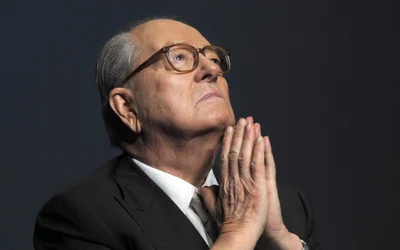
Jean‑Marie Le Pen himself had been a lieutenant in a paratrooper regiment during the French colonisation of Algeria, where he allegedly tortured independence activists. A notorious antisemite, he once declared that gas chambers in Nazi concentration camps were “a detail of history”.
Despite Le Pen’s record and six criminal convictions, Bardella defended him in 2023, even denying that he was antisemitic. He later paid tribute to the former FN leader after his death in 2025. A widely shared photograph also shows an 18‑year‑old Bardella waiting in line to meet Le Pen, whom he regarded as a key figure of the movement.
At the time, Bardella also associated with members of the Group Union Defense (GUD), a violent far-right student group, and with one of its former members, Frederic Chatillon, a close associate of Marine Le Pen.
Mediapart also attributes to Bardella a fascination with Alain Soral, a Holocaust‑denying polemicist repeatedly convicted by French courts. “His analyses are accurate because everything is confirmed by the facts,” Bardella allegedly wrote.
Close to Jean-Marie Le Pen, Soral joined the party’s central committee in 2007. But Marine Le Pen pushed him out two years later as part of her so-called “de-demonisation” strategy.
The goal of this policy, which became the goal of Marine Le Pen’s leadership, was to shed the party’s image as a radical far-right movement and break its association with antisemitism, seen as a major obstacle to electoral success.
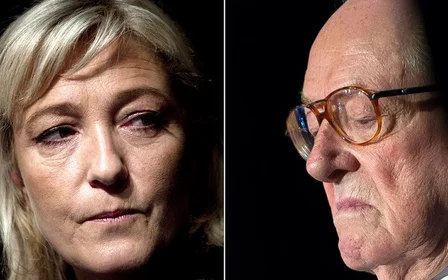
This involved removing candidates who displayed racist, antisemitic, homophobic or neo-Nazi messages, and even excluding the party’s founder - her own father - in 2015 over his antisemitic and Holocaust-denying remarks.
Marine Le Pen chose to form a duo with Bardella, encouraging his rise to the RN presidency to present a youthful, suit-and-tie image far removed from the party’s historical far-right figures.
Elected RN president in 2022 at age 27, Bardella became a pillar of the party’s de-demonisation strategy. Gone were the provocations and scandals: the RN sought to appear as a moderate, respectable party ready to govern, presenting itself as a bulwark against antisemitism while embracing an overtly pro‑Israel stance.
Cosmetic change
However, experts on the party argue that the strategy is primarily a media smoothing operation. Historian and political scientist Sylvain Boulouque explains that this “facade of normalisation” does not alter the party’s deep ideological foundations.
“Despite the change in rhetoric, the RN’s core programme - national preference, sovereignty, opposition to immigration, identity politics, hardline security - remains rooted in the historical identity of the far right,” he told MEE.
‘Antisemitism is a founding dimension of the far right and has never disappeared’
- Sylvain Boulouque, historian and political scientist
“Antisemitism is a founding dimension of the far right and has never disappeared,” Boulouque added. “A portion of the RN electorate fully identifies with the statements attributed to Bardella,” he said.
Outraged by the Mediapart revelations, Sebaihi took the matter to court. Backed by a dozen left‑wing MPs, she announced plans to refer the case to the Paris public prosecutor. In a letter seen by AFP, she cited facts “likely to receive criminal qualification due to their antisemitic nature”.
“It is our duty as political leaders to never let antisemitic, Islamophobic, racist or xenophobic statements go unchallenged. The lack of systematic condemnation of such remarks contributes to the liberation of racist speech and deepens fractures in our country,” she said.
Sebaihi argues that the messages attributed to Bardella show that the RN’s de-demonisation is a sham.
“They changed the shop window, but the core of this party remains the same - fundamentally racist and antisemitic,” the MP told MEE.
The president of the Representative Council of Jewish Institutions of France (CRIF), Yonathan Arfi, also notes that “antisemitism remains widespread among RN supporters and even among its officials”. “It seems illusory to believe that the RN could protect Jews,” he added.
In a column published in Le Monde, Judith Cohen Solal, a psychoanalyst, and Jonathan Hayoun, a documentarist, recall that the far right’s deep DNA is structured around hatred of Jews.
“The man who walked through Jerusalem in March 2025 claiming that ‘the fight against antisemitism must tolerate no ambiguity’, the man meant to embody the very face of de-demonisation, is today caught up by his own antisemitic writings,” they wrote.
In 2019, they published a book showing how far‑right leaders like Marine Le Pen and Bardella seized on the rise of violent militant groups such as the Islamic State to court a previously hostile Jewish electorate, framing Muslims - or “Islamism” - as “the real antisemites”.
The narrative helped the RN appear more respectable while deepening hostility toward Muslims.
But this philosemitic posture, which the RN embraced more strongly after 7 October, has not fooled observers. Cohen Solal told MEE that the party sought to shed its antisemitic image solely to expand its electoral base.
“There has been no work of repair or reflection on antisemitism within the RN,” she said, adding that Mediapart’s revelations “support the arguments of those who were already convinced” of the party’s antisemitic nature.
Will these revelations harm the RN ahead of the 2027 presidential election? Cohen Solal does not think so: “We can see that Bardella denies the facts and his supporters back him, crying conspiracy.”
For his part, Boulouque notes that studies show the RN’s electoral base is antisemitic.
According to a recent poll, only 45 percent of RN voters consider the antisemitic statements attributed to Bardella “serious”, compared to 74 percent for the general population and approximately 95 percent on the left and centre of the political spectrum.
Meanwhile, despite a slight drop in popularity this month (-4 points), Bardella remains, alongside Le Pen, one of the frontrunners in polls for the presidential race.
Middle East Eye delivers independent and unrivalled coverage and analysis of the Middle East, North Africa and beyond. To learn more about republishing this content and the associated fees, please fill out this form. More about MEE can be found here.