'No one listens to us': France's mass student protests expose social and racial inequality

As France's student protests stretch into a third week, testimonies from young people show how unequal and often degrading school conditions fall hardest on ethnic minorities and working‑class suburbs.
Police violence has intensified and schools have been disrupted nationwide, pushing students from the banlieues – France’s working‑class, often ethnically diverse suburbs – to demand better conditions and an end to the structural inequalities they say marginalise their communities.
The protests began in mid-September following a staff and students strike over teacher shortages and deteriorating conditions at the Lycee Saint-Exupery in Creteil, in the southeastern suburb of Paris.
When videos of the strike circulated online, other high schools joined in, blocking entrances and staging demonstrations. Within 10 days, the movement had spread nationwide.
According to figures from the interior ministry, by 6 October around 250,000 people - including school and university students, parents, teachers and unionists - had taken to the streets to demand higher public investment in education and improved conditions, particularly in low‑income neighbourhoods.
New MEE newsletter: Jerusalem Dispatch
Sign up to get the latest insights and analysis on Israel-Palestine, alongside Turkey Unpacked and other MEE newsletters
Their demands range from renovated facilities and increased staffing to smaller class sizes, a fairer college application system and an alternative to the current “8h-18h” school day.
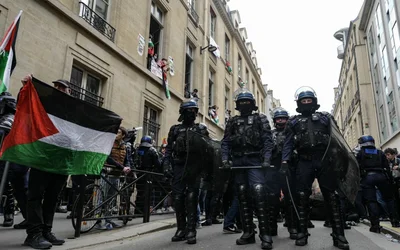
The French state has reacted with what rights groups, including Amnesty International, have condemned as an "unnecessary and disproportionate" use of force, urging authorities to de-escalate.
Footage circulating online shows police and national guard units deploying tear gas, firing rubber bullets and beating protesters with batons. Hundreds have been injured, some very seriously.
In Val‑d’Oise, a 14‑year‑old lost several teeth after a tear‑gas canister was fired at his face at point‑blank range. In Lens, a 15-year old student lost his hand in a confrontation with police. Following the incident, the interior minister announced a temporary halt on stun grenades at school demonstrations, while rejecting accusations of police brutality.
Meanwhile, more than 5,000 protestors have been arrested - 85 percent of them minors, according to the ministry.
Dilapidated schools
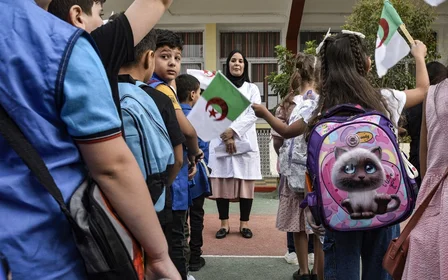
The wave of high‑school blockades across the country has exposed a deep crisis in the education system. Material conditions are a central grievance.
In many high schools, particularly in low‑income areas, buildings are in severe disrepair. Students speak of leaks, damaged ceilings, rats, broken toilets, insufficient furniture, and classrooms which overheat during recent heatwaves.
'It's either freezing in the winter or unbearably hot in the summer. The power cuts out, so the classrooms go dark, the computers stop working, the lights stop working'
- Madeleine, high school student
Class sizes are often overcrowded, reaching more than 36 students in urban areas, and school days are notoriously long. On top of this, around 10 percent of teaching hours go undelivered, with teacher absences hitting poorer areas hardest.
"We have asbestos in the walls, classrooms where there aren’t enough chairs or desks. There are 35 of us in a classroom. We go to school from 8am to 6pm and then we have to do homework, it's impossible," a student from the Lycee Alfred Kastler in Pontoise, 30km northwest of Paris, told Middle East Eye.
Other students criticised the lack of ventilation or air conditioning systems at school to battle surging heatwaves as well as repeated power failures.
"We have major problems with insulation. It's either freezing in the winter or unbearably hot in the summer," Madeleine, a student at the Lycee Francois Villon in Les Mureaux, 40km northweast of Paris, told MEE.
"The power cuts out, so the classrooms go dark, the computers stop working, the lights stop working. Nothing works anymore."
Ousmane, 17, from the Lycee Emily Bronte in Lognes, an eastern suburb of Paris, said some classrooms don’t even have chairs.
"Sometimes we have to stand during lessons," he told MEE.
Other students mentioned the state of sanitary facilities in schools, saying that bathrooms are not cleaned, and reporting a lack of toilet paper and soap.
In response to the protests, the government has acknowledged the "legitimate" nature of the grievances and pledged to address class sizes, daily schedules, teacher replacement mechanisms and building conditions. According to a Senate report, billions of euros will be needed in the coming years to renovate thousands of ageing schools.
Banlieues suffer disproportionately
While underfunding affects schools across France, those in deprived neighbourhoods with large immigrant populations are hit hardest.
Unlike cities such as London, where different social and income groups as well has housing tenures are integrated within a single neighbourhood, Paris exposes a stark geographical divide, where wealth is heavily concentrated in the west and adjacent suburbs, while lower-income populations mainly live in peripheral northern and eastern banlieues.
This contrast shapes students' experiences. According to the OECD, social background remains one of the strongest predictors of academic success, with disadvantaged pupils concentrated in under‑resourced schools where teacher absenteeism is higher and learning conditions poorer.
Jelan Kone, a student from the Lycee Paul Eluard, one of the first high schools to have joined the protest movement, in the northern suburb of Saint-Denis, told MEE that racialised prejudices towards disadvantaged cities and their populations perpetuate institutional neglect.
"They assume that because we’re from the banlieues, we’re supposed to be uneducated, that we don’t learn anything, that the suburbs are worthless," she told MEE.
"But we don’t just let people walk all over us. We try to improve our communities and show that the banlieues aren’t something that should be neglected," she added.
Mohamed, 17, who attends the selective Lycee International de L’Est Parisien in Noisy‑le‑Grand - one of the most disadvantaged cities in the Paris region, where 18.7 percent of residents live below the poverty threshold - stressed the importance of students from better‑resourced schools joining the movement.
"It’s sad that others don’t have the opportunity to improve their social situation. It’s very important for us, in this area, to support neighbouring high‑school students out of solidarity," he told MEE at a mass protest in Paris’s Place de la Republique on Tuesday.
'They assume that because we’re from the banlieues, we’re supposed to be uneducated, that the banlieues are worthless'
- Jelan, High school student
Discrimination is also visible in the way police treat protesters, according to witness testimonies and extensive documentation of racial bias within French police forces.
A 2025 study by the independent administrative authority Défenseur des droits (Rights Defender) found that young men perceived as Black, Arab or North African face a risk of identity checks four times higher than other population groups.
Nellie, a high school student from the Lycee Alfred Kastler in the northwestern suburb of Cergy, told MEE police disproportionately target Black and Arab youth.
"During one of the school blockades, I heard one student say to a policeman: 'I don't speak to cops'. The police man replied: 'We don't speak to Black people'," she said.
Nellie's classmate Maelie told MEE that the police would "show up at their school, hit and tear-gas innocent people".
'No one listens to us'
Another source of frustration among students is Parcoursup, France’s national higher‑education application platform.
Students have raised concern over algorithmic biases in the system, saying that applicants from schools in more affluent neighbourhoods get prioritised, perpetuating already existing social and racial inequality.
"We’re at a high school in the Paris banlieue. Because of that, we’re not viewed as favourably and it means that we don’t necessarily have the same opportunities as students from rich schools, even though we have the same level, and sometimes an even higher level than them," Imene, a high-school student in Saint-Denis, told MEE.
"Parcoursup is a source of stress for all students in France. It’s unbearable. There are people who have an average grade of 18 out of 20 but were rejected by top universities, or from programmes like medicine, simply because other students were given priority," she added.
Earlier this year, a Defenseur des droits report on discrimination based on origin among young people highlighted persistent inequalities in access to higher education and raised concerns about selection procedures, including Parcoursup.
It called for stronger measures to ensure equal treatment and issued recommendations for Parcoursup to publish clear, verifiable and understandable selection criteria, strengthen ministerial oversight of admissions algorithms, and prohibit the use of applicants’ previous high schools as a selection criterion.
Yet despite these calls for reform, many students say they still feel overlooked. Melissa, another high school student in Saint-Denis, told MEE that she feels that students, especially from the banlieues, are ignored by the government.
"Everyone is equal in this country, we want to have the same rights as everyone else. That’s what they don’t want to understand. They just want us to stay quiet and put up with it," she said.
'We're not viewed as favorably and it means that we don't necessarily have the same opportunities as students from rich schools'
- Imene, high school student
Although many teachers support the protests, Imene, Melissa and Zara expressed concern over the socioeconomic gap between staff and pupils in Saint-Denis, which prevents them from relating to the students' grievances.
"Most of our teachers studied at really prestigious universities. So for them, it’s not really the same experience. They don't come from the Paris banlieues, and they’re not racialised people," Imene told MEE.
The protest movement, they said, will continue until the "students will be heard", arguing that students and staff have raised these issues for years without meaningful change.
"Every single year, there’s another issue. But nothing changes," Zara said, deploring that despite the recurrent protests over the years, "no one listens to us".
While speaking to MEE, Zara, Imene and Melissa were preparing for another blockade of their school on the following day, painting slogans on cardboards. More and more students joined them. Despite the violence and uncertainty, they expressed determination - and hope.
"If we don’t act now, it’s never, ever, ever going to change. But this time, if we keep going, things will change, I have hope," Imene said.
Middle East Eye delivers independent and unrivalled coverage and analysis of the Middle East, North Africa and beyond. To learn more about republishing this content and the associated fees, please fill out this form. More about MEE can be found here.