Gaza family mourns boys killed by Israel along Yellow Line

A drone strike landed close by as Hala Abu Assi brewed tea outside her tent, using the last of the family’s firewood.
Moments earlier, her two sons, Jumaa, 10, and Fadi, nine, had set off to gather more. Firewood was all the displaced Palestinian family had to fend off the cold.
The boys walked towards the so-called “Yellow Line”, a demarcation line established under the ceasefire in October that splits Gaza into east and west.
Anyone approaching the area is routinely met with lethal fire from Israeli forces, regardless of the reason.
So when a drone strike hit on 29 November, Abu Assi felt something was wrong.
New MEE newsletter: Jerusalem Dispatch
Sign up to get the latest insights and analysis on Israel-Palestine, alongside Turkey Unpacked and other MEE newsletters
“The moment I heard the explosion, a sharp pain struck my chest,” she told Middle East Eye.
“I said to myself: that blast must have hit my babies.”
She sprinted from the tent - pitched within the rubble of their home - towards the place her sons usually collected wood.
“As I got closer to the Yellow Line, I suddenly couldn’t move. I froze. My breath stopped for a few seconds; it felt as though my heart might stop as well,” she said.
“Then I saw it - the little cart my boys use to carry firewood. And beside it, the two of them lying on the ground, eyes closed, their small bodies streaked with blood.”
Since the Gaza ceasefire came into effect in October, Israeli forces have routinely violated it with air strikes, home demolitions and gunfire.
'Did the soldier not see they were just little children gathering firewood?'
- Tamer Abu Assi, Palestinian father
At least 379 Palestinians have been killed and nearly 1,000 wounded since the truce was established, according to the health ministry.
Many of those deaths have occurred along the shifting, unmarked Yellow Line boundary that Israeli forces continue to move at will.
Others were killed while inspecting the remains of their homes or, as in the case of Abu Assi’s sons, simply gathering firewood and basic supplies.
“I never imagined that the moment I was making tea over a fire to warm my children - waiting for them to return from gathering firewood on that cold morning - would be cut short by the drone strike,” the bereaved mother said.
‘Devastating and cruel’
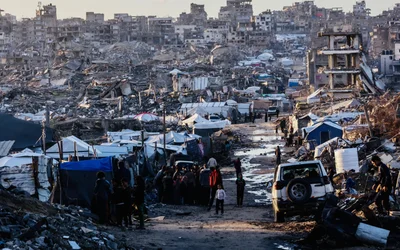
The Abu Assi family lives in the town of Bani Suheila, east of Khan Younis in southern Gaza.
During Israel’s two-year genocidal war on Gaza, they fled their home due to the presence of invading troops in the area.
After the ceasefire was announced, they returned to what remained of their house, which Israeli attacks had damaged.
The army had withdrawn from densely populated areas within the Gaza Strip at the start of the ceasefire agreement, but remained stationed across nearly half of the northern, southern and eastern parts of the territory.
In some areas, the army erected concrete blocks and poles painted bright yellow to mark the line, but much of it remains unmarked.
'I am crushed, not only because they were killed unjustly, but because the army labelled them as terrorists who posed a threat'
- Hala Abu Assi, Palestinian mother
Furthermore, Israeli forces have shifted the line several times, pushing it deeper into residential areas.
On the day Jumaa and Fadi were killed, the Israeli army posted on X that “two suspects who crossed the yellow line, carried out suspicious activities, and approached the troops in southern Gaza”.
It added that they posed “an immediate threat” and were “eliminated” by the air force to “remove the threat”.
The announcement was “devastating and cruel” to Abu Assi.
“I am crushed, not only because they were killed unjustly, but because the army labelled them as terrorists who posed a threat,” she told MEE.
“All they were doing was trying to bring home some firewood so we could cook enough to survive.”
Tiny bodies
The two boys were full of life before the war began, according to Abu Assi.
“They lived comfortably, ate whatever they loved, went to school, played football with their cousins, adored video games, and dreamed of excelling in their studies,” she said.
Their teacher from the online school they were enrolled in had messaged just a day before they were killed, saying classes were about to resume.
“Before they could return to their desks - the Yellow Line killed them,” their devastated father, Tamer Abu Assi, told MEE.
The 38-year-old still cannot understand how a soldier decided to kill his sons simply for collecting firewood near an army position.
“I keep asking myself - did the soldier who killed them not see they were just little children gathering firewood?” he said.
“Didn’t their smart surveillance cameras show him their tiny bodies, their exhaustion, their innocence? How could they kill them when we were supposed to be living in peace after two years of war?”
For Tamer, his boys Jumaa and Fadi were his companions and the anchor that kept him grounded.
Because of a disability in his legs, he relied heavily on them to collect firewood and bring drinking water for the family during their displacement.
“The sadness is unbearable. In one moment, I lost two of my four children,” Tamer said.
“They were with me every step - eating breakfast with me, having tea with me. I even took them along when visiting friends.”
The Abu Assi family is not alone.
Last month, Unicef estimated that Israeli attacks were killing an average of two children every day since the ceasefire began in October.
“When the ceasefire was announced, I imagined life would finally smile at us again. I imagined they would return to learning, to playing football - maybe we could start rebuilding what remains of our home after months of displacement,” Tamer said.
“But an Israeli drone killed them - and killed every dream we had left.”
Middle East Eye delivers independent and unrivalled coverage and analysis of the Middle East, North Africa and beyond. To learn more about republishing this content and the associated fees, please fill out this form. More about MEE can be found here.