Inside the struggle to 'stop the game' between Ireland and Israel

For months, a campaign to stop Ireland’s football team playing Israel in September and October has raged.
In early July, the Football Association of Ireland (FAI) appeared to put the matter to bed by passing a motion paving the way for the Nations League games to be played on neutral territory.
But this, activists tell Middle East Eye, is not enough. They remain unbowed. Their campaign is going nowhere.
“I think it's only going to gain strength,” says Rebecca O'Keeffe, from the Irish Sport For Palestine (ISFP) group. “We really, really remain resolute in stopping these games.”
“The facts haven't changed,” says O'Keeffe, a former Irish international basketball player who has been involved with ISFP since early 2024. “There will be a fresh wave of campaigning, because we're still witnessing genocide, we're still witnessing the total impunity of a genocidal regime.”
New MEE newsletter: Jerusalem Dispatch
Sign up to get the latest insights and analysis on Israel-Palestine, alongside Turkey Unpacked and other MEE newsletters
Through months of wrangling and protest, the FAI has insisted it will fulfill its obligations in the Uefa competition. But discord continues in the grassroots of Irish football, with campaigners adamant that the movement to “stop the game” is far from over.
“Let's just say anything and everything, up to and including surrounding the airport to prevent the team travelling … , is on the table,” the League of Ireland Fans for Palestine group declared on social media.
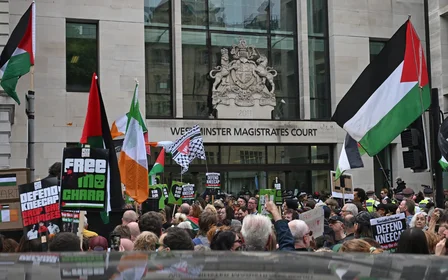
After the FAI’s vote on the game, a number of people from that group challenged the association’s president, Paul Cooke. The following day, activists staged a protest on the roof of FAI headquarters in Dublin, vowing further unrest.
Ireland has another Nations League game, against Austria, in Dublin in between the Israel fixtures, which is now expected to become a staging ground for further protest.
“There was never any issue with the location,” says Ken Powell of the LOI fans group. “It's who is playing the game. Israel has killed 566 footballers in Gaza alone, since 7 October [2023]. So our message remains the same: no game, not here, not anywhere.”
But others who have campaigned to cancel the game are now gloomy about their prospects.
'There will be a fresh wave of campaigning, because we're still witnessing genocide, we're still witnessing the total impunity of a genocidal regime'
- Rebecca O'Keeffe, Irish Sport for Palestine
“Realistically, I think the games will proceed. I don’t see where we can go from here unless the players take a stand and I don’t see that happening,” says Stuart Gilhooly, from the Professional Footballers' Association of Ireland.
The union - chaired by World Cup hero Pico Lopes of Shamrock Rovers and Cape Verde - has been calling for a boycott. But it only represents players in the domestic Irish leagues, and very few of them ever represent the country at international level.
The games in Uefa Nations League Group B3 between Ireland and Israel are now due to take place in Hungary and Serbia, on 27 September and 4 October respectively.
Before then, there will be much more debate, argument and protest, as Ireland - a country known worldwide for its Palestinian solidarity, but which is dependent on deep economic ties to the US - grapples with the symbolic weight of the matches.
Irish football in trouble
When Troy Parrot poked home a last-gasp winner against Hungary in November to propel Ireland into a World Cup qualifier playoff, fans dared to dream.
But defeat at the hands of the Czech Republic in March meant it was not to be.
Though facilities and training academies are desperately lacking resources, the League of Ireland is on an upward trajectory and the women’s team has reached its own World Cup playoff.
But just as some rare optimism was washing over Irish football, the February draw for the Nations League arrived, placing Ireland in a group alongside Austria, Kosovo and Israel.
The FAI immediately said it would play both games and host Israel in Dublin. This despite its own motion submitted to Uefa last year to suspend Israel.
Calls for Ireland to boycott the games in the face of Israel's genocide in Gaza were swift.
The Stop the Game campaign was launched with input from Irish Sport For Palestine, several League of Ireland clubs, fan groups, as well as trade unions and civil society organisations. They have also triggered a legal challenge. A clear schism has emerged between Irish football at an institutional level and its grassroots.
It would be an understatement to say that the FAI comes to this at a point of weakness, long beset by financial troubles and rancour off the pitch. The organisation is in the process of shedding 25 percent of its staff, while strategy documents highlight how far behind international peers it has fallen. The association is €38m ($43m) in debt and relies on Uefa to remain financially afloat.
While being disappointed by the FAI's approach, Aodhan O Riordain, a Labour Party MEP from Dublin, says: “The FAI shouldn't be in this position. Uefa should have made the decision a long time ago. Israel are in breach of Uefa and Fifa statutes, and Israel should not be competing at all.”
O Riordain has been campaigning for a sporting boycott. “It's just the intensity of what's happening in the Middle East - the presentations we as politicians are getting week in week out in the European parliament,” he says. “Nobody is standing up, nobody is exercising any kind of sanction or veto.”
'An Irish solution to an Irish problem'
The fallout in Irish football has been felt in a number of directions.
Joanna Byrne, the Sinn Fein TD (member of parliament) for Louth, had been co-chairperson of LoI Premier Division side Drogheda United. She claims she was forced out of the voluntary position by the club's US-based owners the Trivela Group, because of her statement calling for the games not to go ahead and for Israel to be removed from the competition. Trivela denies this.
A protest outside the Irish parliament in May was followed by the biggest indication of potential trouble during a drab friendly international at the Aviva stadium against Qatar. The coalition of League of Ireland fans threw tennis balls wrapped in Palestinian colours bearing the slogan “#stopthegame” on to the pitch.
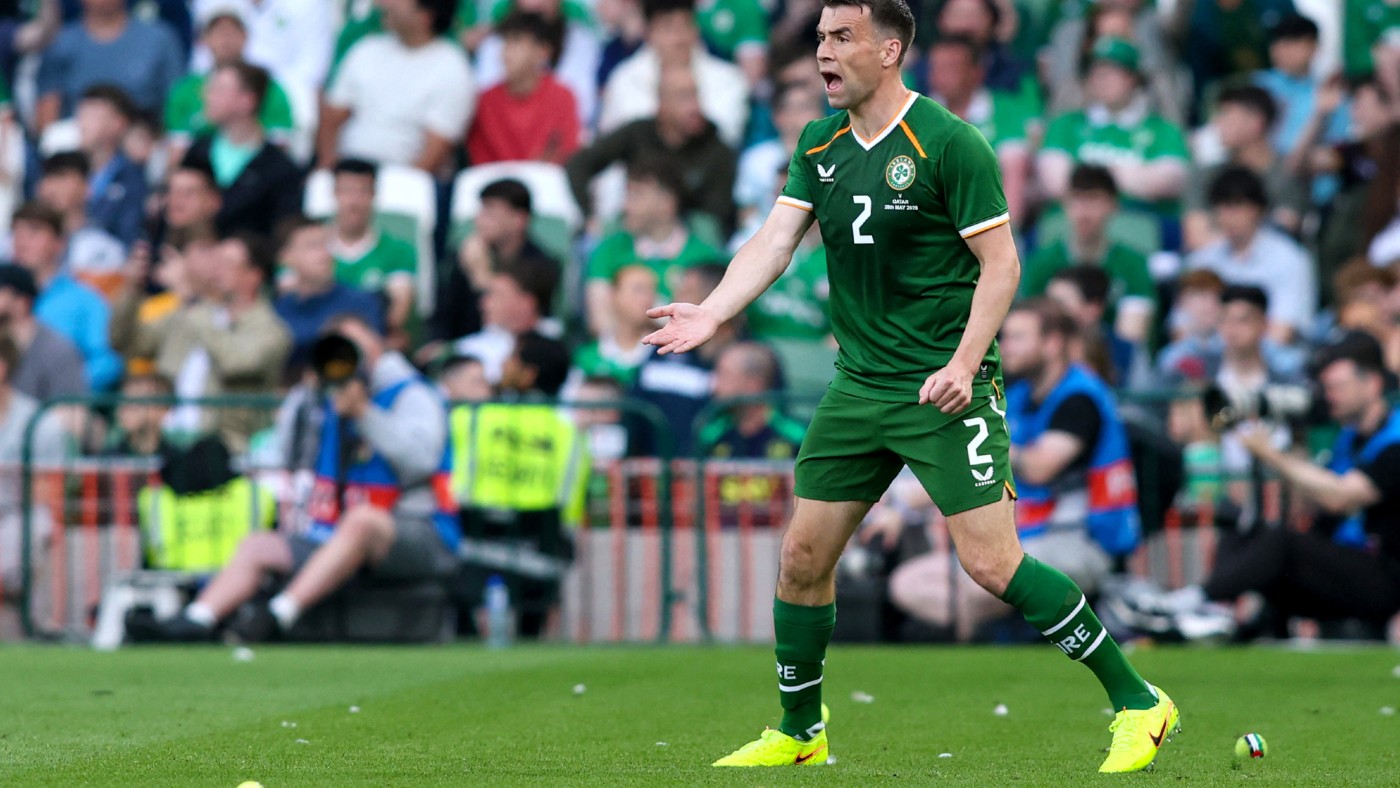
Ahead of the Qatar match, a number of Irish players were asked about the Israel games. Veteran Seamus Coleman said it should have been dealt with at a higher level. “It is very difficult for us players, difficult for the manager, and all the staff that we are dealing with this… But of course, you know our feelings as human beings.”

Into all of this came the spectre of the old canard, an Irish solution to an Irish problem.
First the minister for sport Patrick O'Donovan said he wouldn't attend the Israel game in Dublin, all while the government insisted any decision was solely the preserve of football authorities, having previously supported the games being played. And then eventually came the move to play the home game behind closed doors in Serbia - with Israel's home tie to be played in Hungary.
The FAI may have hoped this provided some breathing space, but calls for a boycott persisted, while some campaigners said moving the game away from Dublin robbed them of their right to protest.
A letter from the FAI board to its members said that “refusing to play these fixtures would cause significant and lasting harm to Irish football, with no indication that such an action would result in any change to Israel's participation in Uefa competitions”. The letter laid out an initial €5.5m loss in revenue with a “likely” further loss of €10.3m, relegation from the division, and potential exclusion from international competitions at all levels.
This also comes against the backdrop of Ireland being a co-host of Euro 2028, as well as bidding to stage the 2029 Women's Champions League Final in Dublin.
“I do think the financial aspect was exaggerated,” says O'Keeffe, who is sceptical of the FAI's projections. “They're really relying on this narrative that it comes at a great risk, but it has to be pushed back on, because all these potential sanctions, they're hypothetical.
“If there are any sanctions imposed, you can take a case to the Court of Arbitration of Sport.”
She cites Russia's removal from football competitions, when other federations refused to play them before governing bodies acted.
Can Ireland put pressure on Israel?
While the Irish police, government and football authorities may breathe a sigh of relief that the problem has been moved away from their shores, activists expect protests to ramp up.
“We're looking at all channels of action,” says O'Keeffe. “We have been connecting with pro-Palestine Austrian groups on the ground, civil society groups, and we're going to be working alongside them.”
Advocating for Palestine and against the actions of Israel isn't confined to football. There is a campaign to get the GAA, the association for Gaelic games, to end its three-decade long National League sponsorship deal with Allianz, after the insurer was named in UN Special Rapporteur Francesca Albanese's June 2025 report for financially benefiting from Israeli forces being in Gaza.
'It's just the intensity of what's happening in the Middle East - the presentations we as politicians are getting week in week out in the European parliament'
- Aodhan O Riordain, Irish MEP
Presaging football's predicament were calls for the Irish women's basketball team to boycott a Eurobasket qualifier with Israel in November 2023, one of the first sporting flashpoints following the 7 October Hamas-led attack. Basketball Ireland said it faced potentially ruinous repercussions if it forfeited the game, which was eventually played under charged circumstances in Riga.
“I think what happens now, is a lot of the pressure goes on players, and that is absolutely not what anyone wanted,” says O'Keeffe. “Certainly not from the campaign - we said the organisation and governing bodies need to act because that will take pressure off players.”
Though O Riordain is now pessimistic that the games can be stopped, “unless the players themselves en masse decide not to play”, he says he would be “wary of a campaign that targets players”.
He also expressed disappointment at abuse being directed at the FAI president. “I don't think that's the way to go forward.”
Irish football's official stance on Israel, meanwhile, somewhat resembles the Irish government's wider approach: it talks a good game in standing up for Palestine backed by strong public support, but struggles with more concrete actions, especially with the spectre of external pressure.
But O Riordain adds that the game can't be the sole focus of attention in attempting to address Israel's actions in the region, especially with Ireland's six-month presidency of the European Council, which began this month.
“The bigger responsibility is that we use our presidency to push the agenda of ending the EU-Israel Association Agreement, which would be disastrous for Israel, because the EU is Israel's biggest trading partner,” he says.
But there remains a belief that a sporting boycott of Israel can be a catalyst for further action, though the FAI's financial weakness and fear of being isolated was clearly a factor in avoiding taking a stance.
“Of course that is a risk and that was the main reason the vote was lost in my opinion,” says Gilhooly. “I think others would have followed but nobody will ever know. I do know that someone has to start.”
Ireland is not one of the more powerful countries within Uefa. It remains to be seen if other nations that have been otherwise vocal in support of Palestine, such as Spain, Norway or the Netherlands, will use their greater footballing clout to act.
Norway’s football association has donated money to a Gaza charity and is reportedly working behind the scenes to isolate Israel.
“We don't know, but in 50 years, 100 years' time,” says O Riordain, “if we decided not to play these games, we don't know what kind of a domino effect that would have had. And I think if they had decided not to go ahead with the games, they certainly would have gotten a lot of credit for it.”
Middle East Eye delivers independent and unrivalled coverage and analysis of the Middle East, North Africa and beyond. To learn more about republishing this content and the associated fees, please fill out this form. More about MEE can be found here.