Inside the Turkey-Azerbaijan rift: How a headscarf ban strained an alliance

Senior Turkish military and defence industry officials were all smiles in Baku two weeks ago as they announced contracts worth $500m to supply the Azerbaijani army.
The deals appeared to show that the alliance between the two countries, which share ethnic, religious, cultural and historical ties, was continuing to bear fruit, particularly after the 2021 Shusha Declaration, in which Turkey and Azerbaijan committed themselves to each other’s defence.
Yet despite multibillion-dollar investments in each other’s economies, spanning energy, transportation, construction and agriculture, multiple Azerbaijani news outlets with close ties to Baku this week accused Turkish Foreign Minister Hakan Fidan of trying to instigate an insurrection against President Ilham Aliyev’s administration.
The unprecedented attacks on Fidan and the Turkish government followed Azerbaijan’s decision last month to impose a headscarf ban in primary and secondary schools, triggering protests and critical media coverage in Turkey.
Fidan visited Baku last week for a regional summit and reportedly also visited a Turkish educational foundation while in the city.
New MEE newsletter: Jerusalem Dispatch
Sign up to get the latest insights and analysis on Israel-Palestine, alongside Turkey Unpacked and other MEE newsletters
Qafqazinfo, a website with close ties to the Azerbaijani presidency, linked Fidan’s visit to broader allegations about Turkey-affiliated entities operating in Azerbaijan.
“Azerbaijan, too, has faced attempts by Turkey-affiliated entities to stage a coup and incite chaos in the country,” said a report that was later deleted and republished without the passages targeting Fidan after the Turkish embassy's strong denial. “There is serious information suggesting that Fidan gave specific instructions during the meeting.”
Multiple officials and people familiar with the issue told Middle East Eye that the attacks on Turkey and Fidan had been ordered from the top.
'Fidan’s visit made things worse'
The spat began when Aliyev issued a veiled rebuke to Ankara for allegedly trying to interfere in Azerbaijan’s domestic affairs.
Azerbaijani sources previously told MEE that Aliyev was responding to Turkish President Recep Tayyip Erdogan’s UN address, in which he criticised countries that placed barriers to education in the way of Muslim girls. Ankara maintains that those remarks were directed at European countries, not Azerbaijan.
The crisis deepened last week when Turkish presidential adviser Oktay Saral posted a message on social media calling on Baku to reverse the headscarf ban.
'Our strategic alliance with our brothers is resilient enough to weather this crisis'
- Turkish official
Leyla Sahin Usta, a deputy chair of the ruling Justice and Development Party (AKP), who became a prominent symbol of opposition to Turkey’s headscarf ban in the late 1990s, also criticised the Azerbaijani decision.
Their comments prompted a sharply worded statement from Aliyev’s New Azerbaijan Party, warning Ankara against seeking hegemony over the Islamic world.
As Turkish officials, including former Prime Minister Binali Yildirim, rushed to defuse the dispute, they argued that Saral was expressing his personal opinion rather than speaking on Erdogan’s behalf.
Three officials and a source familiar with the issue told MEE that, in response, Baku had asked Ankara to dismiss Saral from his official position.
Baku also asked Ankara to prosecute social media commentators who had insulted Aliyev and handed over a list of accounts it wanted banned.
The Turkish government later blocked some accounts belonging to the commentators but no further action has so far been taken.
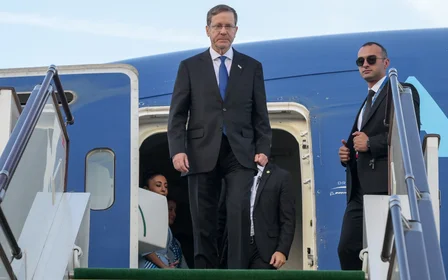
Erdogan’s decision not to attend the seventh summit of the Conference on Interaction and Confidence Building Measures in Asia (CICA) on Thursday, to avoid being in the same room as Israeli President Isaac Herzog, also angered Baku, which viewed his absence as a snub to Aliyev.
Multiple sources told MEE that Aliyev’s participation in the Turkic States summit in Turkey later this month was still not confirmed, some thinking he might reciprocally skip it.
Fidan attended the summit, but his decision to lead a boycott of Herzog’s speech with other participating countries also went down poorly with the Azerbaijani hosts.
“Fidan’s visit made things worse,” said an Azerbaijani source familiar with the issue. “His visit, actions and messages had a negative impact on the situation; we need to see real change in the Turkish attitude.”
The dispute became more complicated after Erdogan said in a speech at an educational foundation event last week that Turkey was no longer a country whose children had to study abroad because of their clothing or political views. His remarks were interpreted in Azerbaijan as another jab at Baku.
Anti-AKP reports
An avalanche of reports targeting the AKP government followed.
The Qafqazinfo report accused the AKP of trying to spread its Islamist ideology through affiliated NGOs, including the foundation Fidan reportedly visited. It also alleged that Turkish intelligence used such entities to interfere in other countries’ domestic politics and suggested that Fidan might have issued instructions to that effect during his visit.
The same report claimed that the Ottoman Empire had pushed Armenians into Azerbaijani territory in 1915 to divide the country, a conspiracy theory previously promoted by some Azerbaijani nationalists.
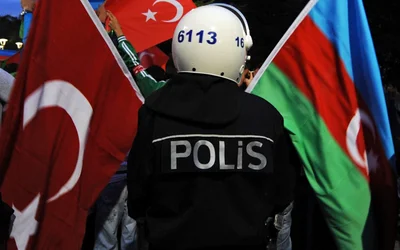
Publika accused the AKP of exporting Islamist and Muslim Brotherhood ideology. It also warned other Turkic states that Turkey’s state development agency, TIKA, could pose a risk to their internal stability.
Musavat alleged that the AKP was using the headscarf dispute to divert attention from domestic criticism over Turkey’s $17bn fund scandal.
Global Info, another Azerbaijani news site, accused Turkey of pursuing a neo-Ottoman policy in the region, saying Ankara was treating Baku as a subordinate rather than an equal partner.
Roman Gurevich, an honorary ambassador of the World Jewish Agency (Sokhnut) and an Israeli political scientist and journalist, wrote in News.Az International that “Baku will not surrender its sovereignty to Islamist demands”, urging Ankara to stop trying to export its model to the region.
Gurevich is seen as close to Aliyev, who has had a strategic alliance with Israel for decades.
The Azerbaijani source said the media had been instructed to amplify Baku’s rejection of the AKP’s political Islam, its alleged attempts to export that model to Azerbaijan, its interference in the country’s domestic affairs and its treatment of Azerbaijan as part of Turkey’s sphere of influence.
“It was a crisis we needed, otherwise some people in Turkey were thinking Azerbaijan was part of Turkish sphere of influence,” the source said. “Now they have to understand that we are one nation, but two states.”
A Turkish official told MEE that Ankara would continue to maintain its calm and wouldn't escalate the tensions by responding to the Azerbaijani remarks and media reports.
“Our strategic alliance with our brothers is resilient enough to weather this crisis,” the official said. “We won’t give bad-faith actors the satisfaction of seeing us damage it.”
Levent Kemal has contributed to this report from Ankara.
Middle East Eye delivers independent and unrivalled coverage and analysis of the Middle East, North Africa and beyond. To learn more about republishing this content and the associated fees, please fill out this form. More about MEE can be found here.