
Israel orders diplomatic staff in UAE to evacuate, citing 'heightened security risk'

Israel is evacuating most of its diplomatic staff from the United Arab Emirates after the National Security Council (NSC) updated its travel warning for Israelis in the Gulf state, according to local media.
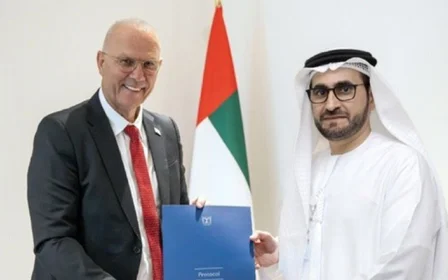
The move comes after Israel reportedly recalled its ambassador to the UAE, Yossef Avraham Shelley, when the Emirates said it was no longer willing to accept him due to "undignified" behaviour at a bar.
On Thursday, Israel's NSC warned of possible attempts to target Israeli and Jewish people in the UAE, "especially around Jewish holidays and Shabbat".
The council, which oversees issues related to foreign affairs and national security, has linked the move to "concerns about retaliatory attacks" following Israel's 12-day assault on Iran in June and growing international isolation over its onslaught on Gaza, which many countries and human rights groups have now described as genocide.
The UAE established formal diplomatic relations with Israel in 2020, becoming the third Arab state to do so, following Egypt in 1979 and Jordan in 1994. In 2022, the two countries also signed a free trade agreement.
New MEE newsletter: Jerusalem Dispatch
Sign up to get the latest insights and analysis on Israel-Palestine, alongside Turkey Unpacked and other MEE newsletters
Since June 2022, the UAE has operated direct flights between Dubai and Tel Aviv, and tourism and business ties have grown.
Israeli officials maintain that the UAE is one of the safest places for Israelis.
However, in March, three people in the UAE were sentenced to death over the killing of an Israeli-Moldovan rabbi, Zvi Kogan.
The current NSC warning points towards growing tensions.
Earlier this week, the Emirati authorities lodged diplomatic complaints against Shelley, the Israeli ambassador, over three separate incidents.
Israeli media reported that Shelley behaved inappropriately on multiple occasions and clashed with Emirati security personnel. The Times of Israel reported that UAE officials felt that Shelley crossed “a huge red line" at a bar in Abu Dhabi and acted in an “undignified” manner.
Recognition of Palestinian state
Meanwhile, international pressure on Israel over its war on Gaza grows.
British Prime Minister Keir Starmer on Tuesday announced that the United Kingdom will recognise a Palestinian state by September unless Israel agrees to a ceasefire in Gaza.
On the same day, 15 western countries, led by France, stated their willingness to move towards recognition of a Palestinian state.
On Wednesday, Canada's prime minister, Mark Carney, similarly announced his intention to recognise the state of Palestine at the next UN General Assembly, which was followed by Portugal.
Several Middle Eastern countries also joined in a call for "a sovereign and independent Palestinian state".
International human rights organisations, including two major Israeli groups, have stated that Israel is committing genocide against Palestinians in Gaza.
The United Nations' Integrated Food Security Phase Classification (IPC) has cited evidence that "worst-case scenario of famine" is unfolding in Gaza due to the Israeli-imposed blockade on aid.
Middle East Eye delivers independent and unrivalled coverage and analysis of the Middle East, North Africa and beyond. To learn more about republishing this content and the associated fees, please fill out this form. More about MEE can be found here.