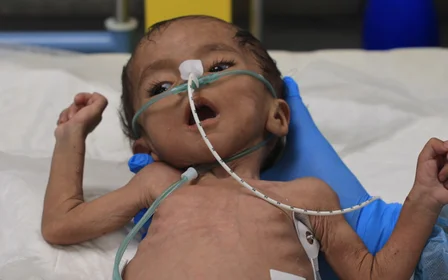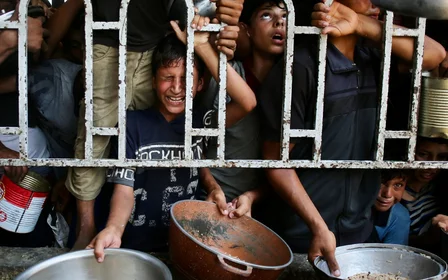

‘We’re drowning’: Gaza baby dies as storm floods tent encampments

A Palestinian infant died from the cold on Thursday as heavy rain across the Gaza Strip continued for a second day, flooding tented encampments and roads.
Eight-month-old Rahaf Abu Jazar died in Khan Younis after rainwater leaked into her family’s tent during overnight storms.
Her family was among hundreds of thousands of displaced Palestinians awoken in the night as torrential downpours inundated the makeshift shelters they rely on for protection.
Gaza’s war-damaged sewage system also overflowed under the heavy rain.
“We are drowning in rainwater mixed with sewage,” said Amal Eleiwa from Gaza City.
New MEE newsletter: Jerusalem Dispatch
Sign up to get the latest insights and analysis on Israel-Palestine, alongside Turkey Unpacked and other MEE newsletters
Originally from the Shujaiya neighbourhood, Amal's home was destroyed in the war, forcing her to flee from shelter to shelter at least 10 times.
“Water comes in from both above and below. Our blankets are soaked – so are our children,” she said.
With their home destroyed, the family of 10, including seven children, was living in a single tent.
“We have nowhere else to go.”
People mourn the baby Rahaf Abu Jazar, who lost her life due to cold weather conditions in Khan Younis, Gaza.
— NABA (@naba_pix) December 11, 2025
📸Abed Rahim Khatib/Anadolu pic.twitter.com/K5PXRyqKRU
The heavy rain also caused at least three buildings to collapse, according to local media.
Moamen Riyadji rented a damaged house just before the storm, after warnings that it could be catastrophic for displaced people in tents.
He tried to cover the partly open roof, damaged in Israeli strikes, but flooding still reached more than 15 centimetres.
“Last night was some of the worst we have experienced. We couldn’t even sleep,” he told Middle East Eye.
“God knows what will happen to us. But if things stay like this, I may have to find another place – maybe a tent would be safer.”
Storm Byron has hit Palestine and Israel earlier this week and is expected to last until Friday, with the heaviest downpours still to come.
The UN Office for the Coordination of Humanitarian Affairs (Ocha) warned on Wednesday that low temperatures and heavy rains place vulnerable populations at extreme risk, particularly newborns.
In a post on X on Thursday, the UN Relief and Works Agency (Unrwa) said winter rains are "bringing new hardships" across the besieged enclave.
“Flooded streets and soaked tents are making already dire living conditions even more dangerous,” it said. "Cold, overcrowded and unsanitary environments heighten the risk of illness and infection."
Worn-out tents
An estimated 1.5 million people live in worn-out tents across the Gaza Strip, displaced after nearly 80 percent of structures were destroyed by Israel in two years of genocidal war.
Last month, heavy rains destroyed around 13,000 tents.
According to Gaza’s Government Media Office, 300,000 tents and mobile homes are needed to meet minimum shelter requirements.
However, Israel has refused to allow the supplies in, in violation of the ceasefire agreement.
“This is the third winter we are spending in tents. We have been displaced since the beginning of the war and are constantly drenched by rainwater,” said Said al-Ghoula, originally from Shujaiya.
“I have children and no proper shelter for them. Every winter, we wake in the night to lift blankets and mattresses off the ground and place them on chairs so they don’t get soaked.”
“The water levels reached a metre and a half inside the tent. We are devastated."
— Middle East Eye (@MiddleEastEye) December 10, 2025
Palestinians in Gaza woke up drenched in rainwater once again as their tents flooded after a heavy downpour hit the besieged territory. pic.twitter.com/KjhJ6Vi2t1
Om Osama Abujarad, from Beit Hanoun in northern Gaza, described a similar ordeal.
When the rain began at 2am, she fled her tent and took shelter in a school building until morning.
On returning, she found her tent submerged in water.
“We tried to prop up the tent so the water could drain from underneath,” she told MEE. “But the tent is flimsy – water seeps through from above and below. I honestly don’t know where to go.”
Middle East Eye delivers independent and unrivalled coverage and analysis of the Middle East, North Africa and beyond. To learn more about republishing this content and the associated fees, please fill out this form. More about MEE can be found here.