
Four killed after armed groups attack Syrian security forces in Sweida

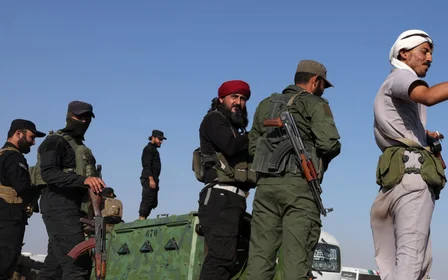
At least four people have been killed after armed groups attacked Syrian security forces in the southern province of Sweida.
The Syrian Observatory for Human Rights said three Syrian security forces personnel were killed "as clashes erupted with local factions around Tal Hadid in the western Sweida countryside".
The Observatory also reported the death of a "local fighter".
Fighting also erupted around the city of Thaala, the Observatory said, "following bombardment of the area with shells and heavy weapons launched from areas under the control of government forces, while the sound of explosions and gunfire was heard in various parts of Sweida city".
A security source told the outlet the armed groups had violated a ceasefire agreed in the predominantly Druze region, which has seen more than 1,000 killed in fighting over the past month.
New MEE newsletter: Jerusalem Dispatch
Sign up to get the latest insights and analysis on Israel-Palestine, alongside Turkey Unpacked and other MEE newsletters
Violence in Sweida erupted on 13 July between Bedouin fighters, Druze factions and government forces.
Israel also carried out strikes on Syrian cities, claiming they were coming to the assistance of the Druze.
A US-brokered truce ended the fighting, while the government said it would investigate the clashes, setting up a committee to investigate the attacks.
Since the overthrow of Bashar al-Assad in December, Syria has been rocked by waves of sectarian violence which new President Ahmed al-Sharaa has struggled to manage.
Attacks by Assad loyalists in the coastal province of Latakia provoked a violent sectarian backlash against the minority Alawi population, which the former president and his family were members of.
At least 1,500 Alawis were killed in the subsequent violence, with a Reuters investigation tracing much of it back to officials in Damascus.
Middle East Eye delivers independent and unrivalled coverage and analysis of the Middle East, North Africa and beyond. To learn more about republishing this content and the associated fees, please fill out this form. More about MEE can be found here.